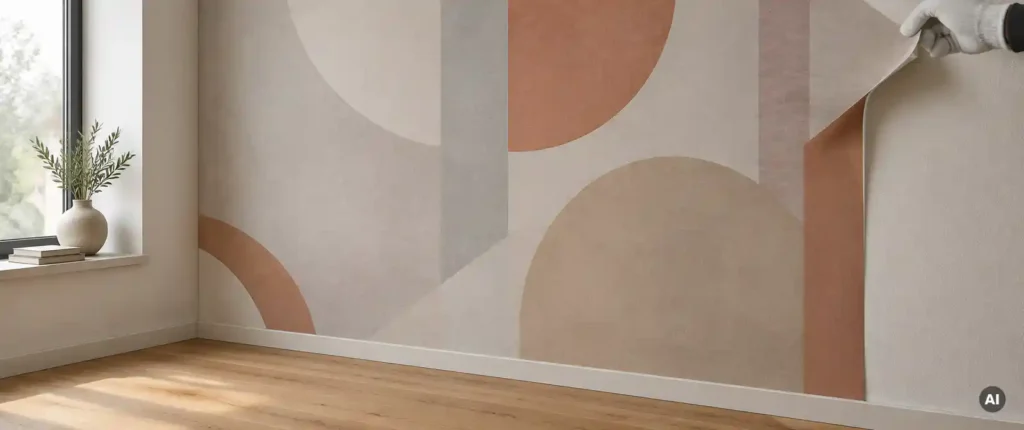
A substrate is suitable for bonding if it is dry, clean, firm, smooth enough, and free of solvents. Before applying self-adhesive films or self-adhesive wallpaper, check the load-bearing capacity, suction behavior, surface tension, and residues. With systematic visual inspection, wiping samples, and a bond test, you can identify problems before they cost you material and time. The following sections show which properties are important and which tests are proven in practice.
Which underlying properties determine the liability?
The responsibility is mainly determined by the cleanliness, load-bearing capacity, flatness, dryness and the surface energy of the substrate. If only one of these characteristics is missing, the adhesive layer cannot bond completely and permanently. Therefore, you should check every substrate for all five points.
- Cleanliness: Dust, grease, silicone or wax act as a barrier film between the adhesive and the surface.
- Durability: Cracking paint, crumbling plaster or loose layers tear when being removed; the film then only holds as well as the weakest layer underneath.
- Evenness and structure: The rougher the surface, the less contact area the adhesive has. We will describe in detail how to deal with this topic. structured substrates.
- Drought: Moisture in the material prevents wetting and can cause bubbles later on.
- Surface energy: Low-energy surfaces such as some plastics or powder-coated surfaces absorb the adhesive less well than glass or metal.
The temperature is also included. The substrate, the space and the material should be within the processing range specified in the data sheet for the film.
How can contamination and residues be detected on the substrate?
You can detect impurities in three simple steps: visual inspection using a streak light, wiping with a bright cloth, and water drop testing. Dust, grease films, and silicone residues are often barely visible to the naked eye, but are reliably detected during these tests.
Visual inspection and wiping test
Hold a lamp flat against the surface. The strip light will create streaks, differences in brightness, scratches, and adhesive residue. Then, wipe a small area with a clean, light cloth. If the cloth turns gray or the surface feels greasy, there is dust or grease present. You can feel old labels and adhesive residue with your fingertips. How to safely remove them depends on the material; an overview can be found in our article on how to remove film Remove without residue let it be.
Water drop test for grease and silicone
Apply a drop of water to the surface. If it beads into balls, there is fat, silicone, or a moisturizer on the surface. If it runs flat, the wetting is good. Clean up any noticeable results with a suitable cleaner, such as isopropyl alcohol on painted surfaces or glass, and retest after complete drying. Test the cleaner on an inconspicuous area beforehand, as it can attack sensitive paints.
Which tests show whether a film is truly adhesive?
The most reliable way to determine whether a film adheres is to apply a sample to an inconspicuous area, let it sit for at least 24 hours, and then remove it. If the backing material tears or the corner immediately separates, the area is not suitable.
Proceed in this order:
- Cut a piece of the film or wallpaper, for example in a hand-sized size.
- Stick it on a representative, inconspicuous place and rub it firmly in place.
- Wait for the end-holding time specified in the data sheet, which is usually at least one day.
- Slowly pull the piece at a shallow angle and assess the adhesive: Does it stick to the substrate, the film, or does it tear the surface?
- Additionally, check the edges and corners for lifting after several days.
For applications with later loading, such as heat, moisture, or cleaning, simulate these conditions on the test piece. Only then will you see if the bonding holds up in everyday use and not just at the moment of application.
How do the tests differ depending on the material?
The test is based on the substrate material: you check the strength and absorption properties of mineral surfaces such as plaster and concrete, the curing and adhesion properties of paints, and the surface energy of glass and metal. Each material has its own typical sources of error.
- Paving, concrete, masonry: Rub the surface with your hand. Sanding or sanding is necessary to achieve a smooth finish. Also, check the residual moisture and the suction performance by applying a water droplet that absorbs immediately when the surface is heavily sudsy.
- Painted walls and furniture: New paints and varnishes need time to harden, often several weeks. Perform a test by cutting a strip of tape and applying it to a surface. If the tape adheres, the paint will not peel off. Surfaces For self-adhesive wallpaper in detail, we have described them separately.
- Glass, metal, tiles: Here, fat, lime and cleaning film are the main culprits. Clean thoroughly and test with the water drop test.
- Plastics: Polyethylene, polypropylene and some coated plastics have low surface energy. Only a sample bonding can help here; if necessary, use special adhesive or pre-treatment.
- Wood and wood-based materials: Be careful of resins, oils, waxes and moisture. Seal open-pore surfaces before applying adhesive.
Why does the film peel off despite a tested substrate?
A film usually breaks down despite a tested substrate due to later-occurring influences: residual moisture, gassing out of plasticizers or paints, temperature changes, mechanical stress, or too short curing time of the adhesive. The test only shows the condition at the time of the test, not the strain afterwards.
Typical causes in summary:
- Processing errors: Insufficient pressure on the film, air or dust under the film, too stretched out tracks that curl back in corners and edges.
- Temperature: Processing on too cold or too warm surfaces, later strong temperature fluctuations, or direct heat sources.
- Moisture from the back: Moisture that presses through the wall or supporting material infiltrates the adhesive layer.
- Evacuation: Fresh colors, paints, or plastics release substances that weaken the adhesive.
- Incorrect material choice: The type of adhesive does not match the surface, for example, permanent adhesive on a highly textured surface.
- Cleaning: Aggressive cleaners or high-pressure cleaners at the edges can damage the adhesive.
When filing a claim, document where the film is tearing: at the edges, in large areas, or only in certain places. The damage pattern often reveals the cause.
When should one contact the film manufacturer for advice?
Contact the film manufacturer if the substrate is unusual, the film is intended to withstand continuous high loads, or a trial coating yields unclear results. A brief inquiry before processing costs less than the re-coating of a finished printed surface.
Consulting is particularly worthwhile in these cases:
- The substrate is unknown, highly structured, freshly painted or made of a plastic that is difficult to stain.
- The application is demanding, for example in outdoor areas, in conditions of humidity, heat, or frequent cleaning.
- The test adhesive shows edge imperfections, bubbles, or adhesive residue.
- They are planning larger volumes or projects where a mistake causes high follow-up costs.
- The film should later be completely removable.
Prepare background material, surface condition, location of use, load, and photos of the test adhesive for the discussion. The more precise your information, the more targeted the recommendation will be.
Secure bonding with com2C: advice and suitable materials
We know the challenges of bonding from daily practice and develop our materials for different substrates and requirements. As a manufacturer with its own laboratory, we tailor coatings specifically to meet your needs and support you from the material selection to the processing.
Among other things, we offer products for wall applications: self-adhesive wallpaper PVC-free as well as non-adhesive, PVC-free wallpaper media for adhesive-based tiling. The PVC-free composition is a material property that can be of interest for applications where PVC is to be avoided.
That is what we specifically offer you:
- Advice on material selection appropriate to the substrate, location, and load
- Technical support for liability issues and trial bonding
- Self-adhesive films and wallpaper for various applications, compatible with common large-format printers and ink systems
- Rapid development of customized solutions when standard materials reach their limits
- Short distances and personal contact com2C
If you have a difficult substrate or want to ensure the best possible material choice, arrange a consultation with us. Consultation with us. We will work with you to find the right solution for your project.