Anyone who wants to design sales areas seasonally faces a practical question: How do you change the designs regularly without having to plan the entire expansion every time? Between the spring collection, the summer promotion, the autumn theme and the Christmas season, there is often only a few weeks between each period. By carefully coordinating materials, backgrounds and processes, you save time, nerves and budget.
In this article, you will go through the steps step by step: First, you learn which materials can facilitate a change of motif. Then we explain how backgrounds influence the choice of material. Next, you plan the change yourself, ensure quality, and consider PVC-free solutions as a material requirement for large-format printing in retail.
Which materials can facilitate a change in motif
A changeable motif requires a material that can be applied and removed as little as possible leaving no residue. The effort required is not solely determined by the print itself, but by the way the medium adheres to the substrate or is secured. How well a self-adhesive material can be removed later depends on the specific product, the substrate, the shelf life, and the application.
In retail, three material groups are used primarily:
- Self-adhesive films: They are often used for shop windows, glass surfaces and smooth walls. Some products are equipped with a removable adhesive and are intended for temporary applications. Whether and how a film can be removed after the season depends on the product, the substrate, the duration of use and the conditions of use. They are often used for clear graphics, promotional areas and signage.
- Non-woven wallpapers: They bring wall surfaces to life as large-scale motifs and are often used as photo motifs and backdrops. Whether a vinyl wallpaper can later be removed dry depends on the specific product, the wall construction, and the processing. The characteristics and processing instructions of the specific product are decisive.
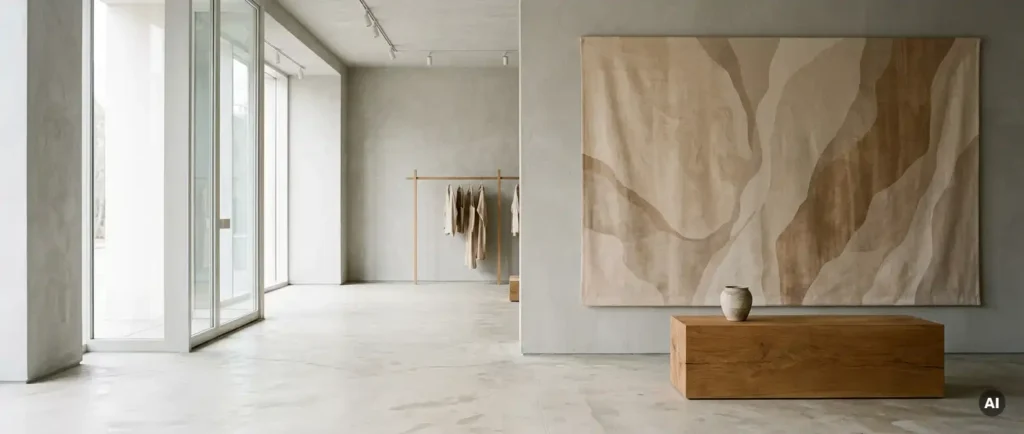
- Textile printing: Printed fabrics are often used in tension frames. Such systems can be a solution for frequent changes of motifs because when changing the fabric, only the frame can remain unchanged. The actual time required depends on the frame system, the format and the accessibility of the area.
An example: A fashion store uses a tension frame in the entrance area and changes the fabric every season. Because the frame remains, there are no modifications to the wall surface required. To determine how quickly the change in everyday life will be achieved, you should test it with the chosen system beforehand.
How substrates and surfaces influence the choice of material
The substrate has a major influence on whether a design can be removed cleanly later on. The same material behaves differently on glass than on rough plaster or freshly painted walls.
Glass and smooth surfaces
Self-adhesive films are often used on shop window glass. To determine whether a product is suitable for the specific glass surface and the intended shelf life, refer to the product’s specifications and instructions for use. As a general rule: The substrate should be thoroughly cleaned and free of grease. Products with removable adhesive are ideal for window displays featuring alternating motifs. However, a guarantee that no adhesive residues remain cannot be inferred from this. A test at the point of use provides clarity in this regard.
Walls, plaster and paint
With walls, success depends on durability and surface quality. Fresh paint should be fully cured before applying anything. Harsh or absorbent surfaces often require preparation or another medium, such as a vinyl wallpaper instead of a film. Which medium is suitable and how it can be removed later depends on the product and wall construction.
Grounds and heavily used areas
For motifs on the ground, requirements may vary depending on the intended use. Anti-slip properties, abrasion resistance and mechanical durability Therefore, use only media that are suitable or approved for this application and check in advance which requirements apply to your sales area.
With knowledge of the material and the subsurface, you can now plan the change yourself.
Plan seasonal changes in steps
A cleanly planned change of motif follows a fixed sequence. This way you avoid the pressure of time just before the start of the season.
- Set the season calendar: Note all the changeover dates for 2026 and calculate lead times for design, printing and delivery. Also determine how often the respective area should be changed.
- Inventorying areas: Capture every area with dimensions, ground conditions, and accessibility. A uniform grid prevents errors in ordering.
- Assign material to a surface: Determine which medium to use on which surface. Take the substrate, the frequency of changes, and the planned lifespan into account.
- Design and proofing motifs: Check the colors and details on a test print before the entire run is produced. If necessary, test the adhesion and removability at the point of application as well.
- Performing and documenting changes: Keep track of how long the exchange took and what worked well. This improves the planning for the next season.
A practical tip: Plan motifs modularly. If several elements have the same dimensions, they can be flexibly combined over the seasons.
How can color brilliance and quality be ensured?
Color brilliance arises from the interplay between the printing medium, the ink, and the printing profile. Anyone who changes any of these elements changes the result.
Please note these points:
- Aligning medium and printer: Not every medium is suitable for every printing or ink system. Whether a product is intended for solvent, latex, UV or water-based inks depends on the respective medium and its coating and can be found in the technical product data.
- Using color profiles: A suitable ICC profile for the combination of medium and printer, as well as documented settings, can support consistent and reproducible color reproduction, even when reprinted in the next season. An automatic guarantee of identical colors does not result from this.
- Take lighting into account: Motifs in shop windows appear differently in daylight than in the interior of the store. Backlit media or opaque backgrounds can significantly alter the color impression.
- Check patterns: An illustration on the original material shows how the motif looks at the place of use.
Anyone planning follow-up prints for the same brand should document profiles and settings. This makes it easier to maintain consistent color reproduction over multiple seasons.
Switching to PVC-free solutions
PVC-free is a material property and a specific requirement for some projects: PVC-free printing media are made from base materials other than conventional PVC films. For the retail sector, this means above all that you can choose between different material families based on the appropriate project requirements. However, one cannot derive any statements about environmental, health or quality benefits from PVC-free alone.
Technically, it matters whether the material meets your requirements: adhesion, peelability, dimensional stability and printability. Suitability cannot be generalized to a single material family; it can only be assessed based on the product's technical data sheets. Therefore, for each application, check the product specifications and test the medium on the actual substrate.
As an example: If a project requires a PVC-free medium for a wall area in the showroom, you could consider using PVC-free vinyl wallpaper instead of PVC film. Then, before starting the project, check the product specifications to see how this wallpaper will interact with your wall structure and how it can be removed later.
Season change with com2C: We support you from the material selection to the printing
As a manufacturer of digital printing media, we are here to help you decide which material works best for your surface and motif. We develop and produce in Porta Westfalica and have our own laboratory for inkjet coatings. This allows us to also develop special solutions when standard materials reach their limits. In the field of Interior Design You will find media for walls, windows and floors that are intended for use in retail. The suitability for changing motifs depends on the specific product and your application.
That is what we specifically offer you:
- Advice on material, subfloor and removability, tailored to your sales area
- Self-adhesive films, vinyl wallpaper and printable textiles for various applications
- PVC-free media that we explain to you with technical data regarding processing and use
- Different digital printing media for different printing and ink systems, with the specific compatibility depending on the particular product
- Quick coordination and solutions for individual requirements
You can also find out which medium is suitable for your project using our productfinder If you would like to discuss your season planning in more detail, we are happy to offer you a Consultation an.