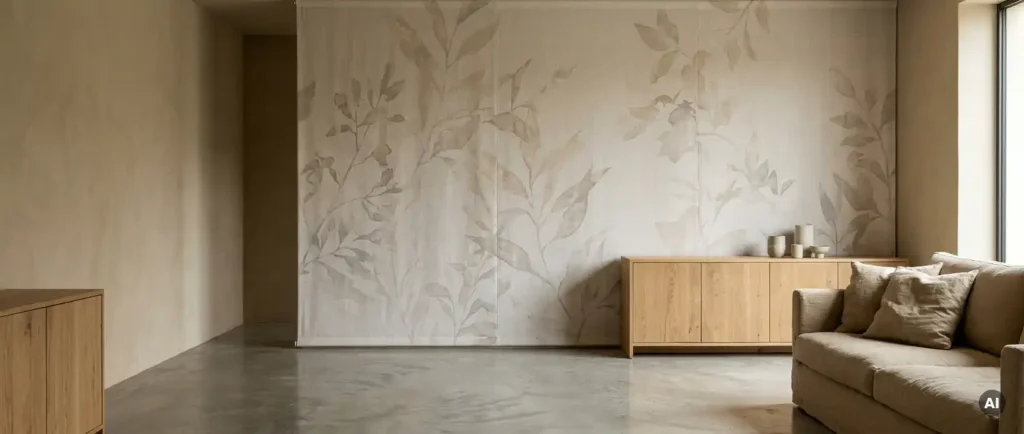
Fabric creates atmosphere: A printed textile frame in the showroom, a room divider in the large office, or a seamless wall covering in the flagship store transform spaces without requiring structural modifications. Printed textiles in interiors combine freedom of design with practical functionality. In this article, we will take a step-by-step approach: First, you will get acquainted with the typical application areas, then the textile types, the factors affecting print quality, and the topics of material selection, fire protection, and installation. At the end, you will know the criteria for selecting the appropriate digital printing medium and plan a textile project cleanly from idea to implementation.
Application areas for textile printing in interior design
Textile printing in spatial design means that fabrics are printed in digital large format with motifs, colors, or patterns and then used as a design element in the interior. Compared to rigid materials, textiles offer advantages in terms of weight and flexibility in many cases. The extent of these benefits depends on the chosen textile medium and the structure of the system.
Three areas of application are particularly common. In retail, brands use printed textiles for shop window decorations, background walls and promotional areas that can be changed seasonally. In showrooms and at trade shows, textile systems for large, seamless displays are used. In interior design, they serve as room dividers, wall coverings or ceiling panels. Acoustic solutions are also possible, but they require materials and systems specifically designed for acoustic applications. Ordinary printable textiles do not automatically improve room acoustics.
A typical example is the Suspension frame with textileAn aluminum profile holds the printed fabric over a silicone edge, so that when matching material is used, a smooth, wrinkle-free surface is created. When changing the motif, you only replace the fabric, not the frame. To determine whether a specific textile is suitable for this system, refer to the manufacturer's specifications for the product.
Which textile types are suitable for which application?
Not every fabric is suitable for every task. The choice depends on the application area, lighting conditions, assembly method and the desired appearance. Textiles that can be printed in large format can roughly be divided into three groups. The properties mentioned here are tendencies and not guarantees: they differ from product to product.
- Textiles for the overhead application: They are often used in wall coverings and frame systems that are viewed from the front. The opacity of a material and the matt or glossy effect of the design depend on the specific textile.
- Backlit textiles: These fabrics are intended for backlit frames and light walls and allow light to pass through. How uniformly the light is distributed and whether individual LED points remain visible depends on the respective textile material as well as on the structure, distance, and lighting system. A sample or mock-up creates clarity in this regard.
- Decorative fabrics for printing: Curtains, room dividers and hanging rails place particular demands on the design, grip and ability to be pulled up. These characteristics vary significantly depending on the fabric and should be assessed by looking at the pattern.
Also check the suitability for your printing system. Whether latex, UV, solvent or sublimation printing or water-based inks: The compatibility depends on the respective textile medium and should be checked based on the product release. If fabrics and inks do not match, color absorption and durability suffer. Those who have fabric printed with decorative fabrics should clarify this question beforehand with the printing service provider.
Color brilliance and print quality in textiles
The quality of textile printing results from the interplay between the fabric, material structure, surface treatment, ink, and printing profile. If these elements are not properly coordinated, the result can appear flat or unclear.
The surface structure is the most important factor initially. A fine, smooth fabric can usually reproduce details better than a coarse one. This is noticeable in photo motives in interior design, such as large-format landscapes or product images. Whether a textile requires additional surface treatment or inkjet coating depends on the material and the printing process. It is crucial that material construction and coating are matched to the respective printing method so that the ink is absorbed in a controlled manner and does not run.
Also plan the color management. Strong full-tone colors and fine gradients behave differently on textiles than on paper or film. A proof print on the original material shows you before production how colors actually look in the room, even under the later light conditions on site.
PVC-free textile solutions in the interior
Textiles that are labeled as PVC-free are available for the interior. PVC-free refers to a material property: the fabric or coating does not contain polyvinyl chloride. Depending on the project, PVC-free may be a requirement in the tender or in the client’s specifications.
From this characteristic alone, no further statements about processing, handling or performance can be derived. Even for fabrics made of polyester, properties such as shape stability, weight, tailoring, storage or interchangeability depend on the specific product. Therefore, please check the specific product's characteristics in the data sheet for each material and do not rely on general statements.
When selecting a product, be sure to specifically ask about its construction, coating, and suitable printing systems. This will prevent any surprises during processing and regarding the color result.
Plan fire protection, installation and maintenance correctly
Fire safety regulations may apply in public spaces, retail areas, and office buildings. The specific requirements to be met depend on the location of the project and the applicable regulations at that time. Please clarify this early with the construction management or fire safety officer. Additionally, check to see if the respective material actually has any certifications, and request to be shown the corresponding documentation. Any subsequent material changes will cost time and budget.
In the assembly process, two system types are essentially available:
- Frame systems with silicone ties: The textile is inserted into the profile and tensioned. Depending on the system, the change of motif is accomplished without much effort. Not all textiles are suitable for this mounting method.
- Direct attachment or suspension: Hooks, tunnel loops or Velcro hold the fabric to the wall or ceiling. The attachment must be suitable for the material, weight and tension.
The type of assembly that is possible depends on the textile, the assembly process and the location of use. Please discuss this before production begins.
The care instructions are as follows: The correct method depends on the material. Light dust can often be removed with a soft cloth or vacuum cleaner. Treat any soiling according to the manufacturer’s instructions, as not all printed textiles tolerate moisture or cleaning agents. It is best to note these instructions in the project documentation.
Developing individual textile media together with com2C
Standard materials cover many projects. As soon as you have specific requirements, such as light transmission, haptics or a combination of printing methods and fire protection, it is worth contacting the manufacturer. com2C has expertise in digital printing media and develops inkjet coatings in its own chemical laboratory. This allows materials to be tailored specifically to your application.
We specifically support you in the following ways:
- Material selection: Together with you, we will determine which textile or digital printing medium is best suited for the printing system, the application area, and the mounting method.
- Compatibility: com2C offers various textile and digital printing media for different printing methods. The specific compatibility depends on the specific product and is verified based on the product specifications and approvals.
- PVC-free options: If your project is to be implemented without PVC, we will transparently provide you with suitable materials and the associated technical data.
- Individual requirements: If you have specific requirements, we will discuss together which adjustments are sensible and feasible.
You can find an overview of solutions for space design in our section. Interior Design. If you are looking for a suitable material for your project, the productfinder in the preliminary selection process. We are happy to offer you a solution tailored to your individual requirements. Consultation at which we will go through your project together.