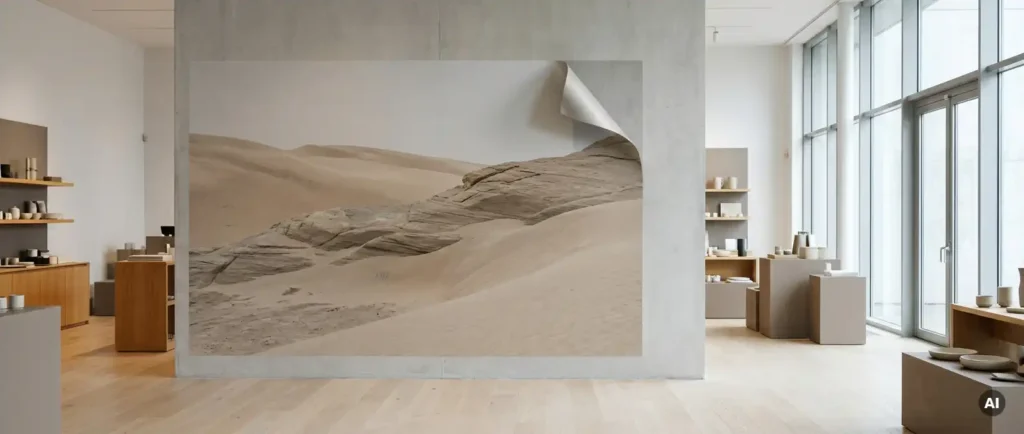
For changing action motifs, smooth, closed, and durable surfaces such as glass, metal, painted surfaces, or coated plates are particularly suitable, combined with removable foils designed for changing motifs. Textile systems and frames can be an alternative when motifs are changed very frequently. How easily a motif can be removed later depends on the interplay between medium, adhesive system, substrate, application conditions, and shelf life.
Which solution is suitable depends on the rhythm of the action, the area and the location. The following questions show what can lead to a change in the design and what you should consider when choosing the material. The specific suitability of a product and a substrate must always be checked.
What can cause a clean change of subject to fail?
A clean change of motif usually fails due to the interplay of several factors: the substrate, the adhesive system, the durability and the application conditions. Heat, sunlight or an untreated, absorbent substrate can also affect how strongly a glue adheres and how it subsequently loosens again.
Possible influencing factors in summary:
- Porous or rough surfaces: The adhesive can penetrate the structure, which can make it difficult to remove later.
- Freshly painted walls: Color that has not yet fully cured may peel off when removed.
- Adhesive system: Permanent-adhesive systems are generally not intended for short periods of action. For temporary applications, there are media designed for changing motifs.
- Service life: Depending on the product and the substrate, the adhesive properties may change over the lifetime of the product.
- Temperature and sunlight exposure: In shop windows or south facades, heat and light can influence the behavior of the adhesive and medium.
Therefore, before taking any action, check the substrate and adjust the adhesive system to the intended lifespan and operating conditions. The information provided for the respective product is decisive.
Which backgrounds are suitable for frequent changes in motifs?
Smooth, closed, and solid surfaces are considered as possible substrates for frequent changes in motif. These include glass, metal, plastic panels, coated wood materials, and well-adhering, fully cured wall paints. The closer and smoother the surface, the more likely it is to be suitable. However, whether a specific substrate actually fits must still be checked on a case-by-case basis.
More critical are rough-textured wallpaper, plaster, concrete, untreated wood, and old or grainy paint. There is a higher risk that parts of the surface will peel off during removal. On walls, a adhesion test on an inconspicuous spot helps: Place a sample of the intended medium, leave it exposed under realistic conditions, and then remove it again. This allows you to see in advance how the substrate and material will interact.
The environment also plays a role. In areas with moisture, temperature fluctuations, or heavy use, you should carefully select the material accordingly.
Which film is suitable for frequently changing motifs?
For frequently changing motifs, removable self-adhesive films suitable for temporary applications are considered, sometimes also repositionable variants that can be reoriented before final application. Whether and how a film can be removed later depends on the product, the adhesive system, the substrate, the application conditions, and the shelf life. Product specifications and the testing of the substrate are binding. A guarantee for a specific peel behavior cannot be derived in a general way.
Film for shop windows
Window displays are made using films that are designed for use on glass. Depending on the design, transparent, perforated, or covering variants are suitable. Perforated media can allow the view from the inside to the outside, while the design remains visible from the outside. The technical properties, such as adhesion, durability, and visibility, that actually apply should be checked based on the information provided for the respective product.
Wall and floor film in retail
Wall films can be considered for smooth, durable interior walls, columns, or furniture fronts, provided that the specific medium is suitable for this purpose. Whether a film can still be corrected after installation depends on the product.
For floor applications, depending on the application, there may be requirements for anti-slip properties, abrasion resistance, or other characteristics. It is best to clarify beforehand with the operator of the surface which are the specific requirements in your individual case and to check whether the selected medium meets these requirements according to the product specifications.
Be sure to check the compatibility of the print with all variants. Whether a medium is suitable for solvent, latex, UV or water-based inks depends on the product and should be checked based on the respective release.
When can textile or frame systems be an alternative to film?
Textile or frame systems can be an alternative when motifs change frequently, the backing for the film is not available, or areas are to be covered without direct adhesive contact. The printed textile is then clamped into a frame and can be replaced if necessary. Whether this is faster or easier in individual cases depends on the system, the area size, and the process.
The following aspects can speak for textiles or frames:
- More frequent changes: With short alternating rhythms, a clamping system can be an option.
- Sensitive or rough walls: Depending on the system, no direct adhesive contact with the wall is necessary.
- Large areas: Depending on the design, large areas can be covered with textile webs. The number of webs required and where the bumps occur depend on the system.
- Reuse of the frame: In many systems, the design remains the same, and only the printed textile is changed.
Film can, however, be useful if you want to work in a continuous strip, close to the wall or on glass. Vinyl wallpaper is also an option, but only if the specific product or system is intended for alternating motifs and later removal. A suitable, durable interior wall and the manufacturer’s processing instructions are a prerequisite for this.
What PVC-free materials are available for action surfaces?
For action areas, there are PVC-free materials, such as PVC-free films, textiles, and vinyl wallpaper. PVC-free describes a material property and can be a requirement in the project. This does not imply any statements regarding environmental, health, or quality benefits. Properties and uses also vary from product to product and cannot be automatically equated with those of other materials.
For PVC-free materials, check the same points as for all other media: adhesive system, substrate compatibility, print compatibility, and application environment. Whether a PVC-free setup is suitable for your application, such as for shop window film or as a substrate medium, is shown in the technical data sheets. Test the material before launching a larger campaign on a sample.
How can a change in motif be well prepared and implemented?
A change of approach works best with good preparation: suitable substrate, appropriate material, planned duration of use, and a clearly defined sequence for assembly and disassembly. Those who plan both as a fixed process can save time and reduce the risk of residues or damage.
- Check and clean the underground: Remove dust, grease and loose particles.
- Testing the sample area: Bring a sample and test how the medium behaves on the substrate and whether it can be removed again.
- Set the lifespan: Plan the dismantling in advance and take the product specifications into account.
- Disassembly according to manufacturer's specifications: The processing instructions of the respective medium apply for the removal and cleaning of the surface.
- Control area: After dismantling, check the condition of the substrate before applying the next motif.
- Prepare the next motif: Keep cutting attachments and tools ready for replacement.
If you are working on large areas as a duo, plan to switch to a different job outside of opening hours whenever possible so that the operation does not suffer.
How does com2C support you with changing promotional motives?
We know the challenges in retail and in space design from daily practice. As a manufacturer, we develop digital printing media ourselves and advise you on material selection, adhesive systems, and inkjet coatings. Especially when changing promotional themes, it is crucial how material, surface, adhesive system, shelf life, and usage conditions work together.
That is what we specifically offer you:
- Materials for different applications: We offer digital printing media for interior design and retail, including foils, vinyl wallpaper, textiles, and floor coverings. The properties of a product, such as its peelability, depend on the specific medium.
- Media for various printing and tinting systems: We offer different media for different printing and ink systems. Compatibility depends on the product and is verified based on the respective approval.
- PVC-free options: With the GoGreener line, we offer PVC-free materials for projects where PVC is to be avoided.
- Application-specific advice: We discuss the underground infrastructure, service life, and requirements with you, and work together to find a suitable solution.
- Individual development: If no standard material is suitable for your project, we will work with you to determine what our own laboratory’s inkjet coatings can be used for.
If you are looking for a suitable material right away, our productfinder in the first selection. An overview of media for room design can be found under Interior Design. We are happy to discuss your promotional areas in person. Consultation based on your requirements.