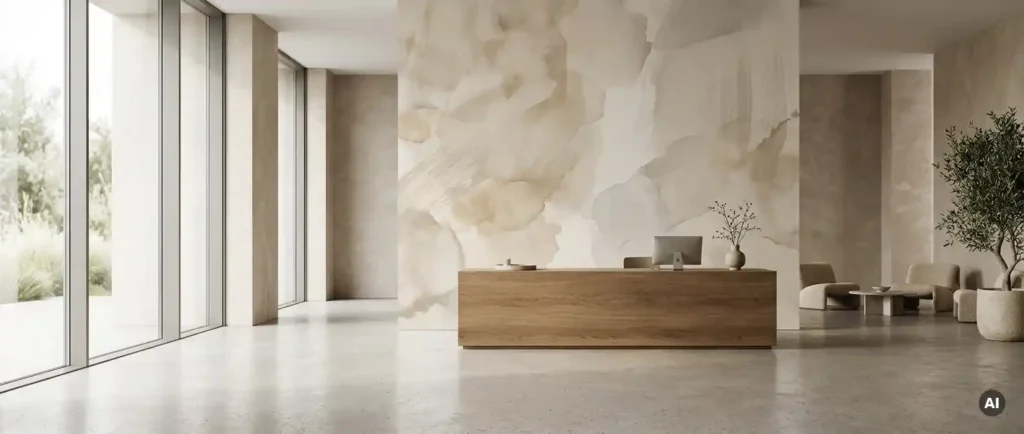
Vellor wallpaper, self-adhesive films, backlit media, printable textiles and floor foils are particularly suitable for reception areas. Which material is suitable depends on the area, the level of usage and the fire safety requirements. The following answers show what you should pay attention to when choosing wall, ceiling and floor materials.
Which print media are suitable for walls, ceilings and floors?
For the wall, vinyl wallpaper and self-adhesive films are suitable; for the ceiling, printable textiles and backlit media; for the floor, special anti-slip floor foils. Each surface has its own requirements regarding adhesion, weight, abrasion resistance and processing.
At Walls The substrate decides. Smooth, stable surfaces easily adhere to films; rough or textured walls are often easier to cover with vinyl wallpaper. For Blankets printable textiles are suitable for use in tension systems or frames. They are lightweight and easy to install without folding, and can be removed again if necessary. Backlit media are suitable for illuminated surfaces, such as light walls or ceiling elements, because they spread the light evenly.
At Ground It comes down to slip resistance and abrasion resistance. A printed floor film in the reception area must withstand daily traffic, rolling suitcases and cleaning. It should therefore be provided with a suitable protective layer and approved for use in the intended location.
Vinyl wallpaper or self-adhesive film: Which is better?
A vinyl wallpaper is better suited if you want to create large, quiet wall surfaces with a textured, matte appearance. A self-adhesive film is better suited if the surface is smooth, you plan short runs, or you want to remove the motif without leaving any residue later on.
The differences in overview:
- Printing vinyl wallpaper: The wallpaper is applied to the wall; the motif looks homogeneous and high-quality. It bridges small imperfections and remains dimensionally stable. It is suitable for permanent wall decoration in reception areas.
- Self-adhesive film for wall decoration: The film adheres directly to the substrate. It also works on glass, metal, or painted surfaces and can be easily cut to size, for example for logos, contours, or furniture fronts.
Another point is the installation. Wallpapers are applied wet or with wall adhesive, and films are applied with a roller. Both variants require a clean, dry and stable surface. Therefore, always check the surface, room climate and planned usage duration before choosing the material.
How is high color brilliance achieved with brand colors?
High color brilliance results from the interplay of the printing medium, the ink system, and color management. The medium must absorb the ink uniformly, the printer must be appropriately profiled, and the brand colors should be available as defined special colors or reference values.
Three points are relevant for reliable results:
- Coating of the medium: The inkjet coating determines how sharp contours and how saturated color areas appear. Media designed for your ink system (solvent, latex, UV or water-based) provide more stable results.
- ICC profiles: A suitable profile for the combination of printer, ink and medium ensures that brand colors such as Pantone or HKS are as close as possible to the desired value.
- On-site lighting: Warm or cold light changes the color impression. Test prints at the later location of use show whether the color matches the actual lighting conditions.
In backlit areas with backlit media, the light transmission is added. The material should distribute light evenly so that no hot spots form and the brand colors remain consistent even when turned on.
What requirements apply regarding fire protection and safety?
Different fire safety requirements apply in the reception area depending on the building type, use, and escape route. Often, authorities or operators require highly flammable materials, for example according to B1 or the European classification B-s1,d0. Ask the building operator or fire safety officer in advance about the requirements.
The requirements are particularly strict in public buildings, hotels, clinics, office buildings with a large number of people and in escape routes. For print media, this means that the material and, in some cases, the entire structure made of medium, adhesive and substrate must meet the required class. Be sure to check for appropriate test certificates from the manufacturers and clarify whether these also apply to printed materials.
When it comes to floors, slip resistance is added. Floor sheets should be suitable for the intended use and regularly checked for detachment or edges to prevent tripping hazards. Textile floor elements need secure mounting and must not cover sprinklers or smoke detectors.
Are there PVC-free alternatives for interiors?
Yes, there are PVC-free printing media for indoor use, including vinyl wallpaper, printable textiles, polyester films, and special PVC-free films. They cover many applications in the reception area, from wall decoration to backlit displays. Please check the data sheet for each product to see whether the selected product is actually PVC-free.
PVC-free media differ in their feel, stretchability, and handling from conventional films. Textiles are softer and can be used without glare. Nonwoven materials are stable in shape and are well suited for large-scale wall designs. For films, it’s worth taking a closer look at the adhesive, edge adhesion, and processing temperature, as these properties can differ from PVC variants.
The materials are available for solvent-based, latex-based, UV-based and water-based printing systems. The required properties are crucial for the choice: fire protection class, surface finish, adhesion and durability. Printable textiles for interior use are particularly suitable for curtain rails, light walls and room dividers.
How long do printed media last in the reception area?
Printed media can last for several months to several years in the reception area, depending on the material, ink, and usage. Wall murals and textiles often have the longest lifespan, while floor foils are most heavily affected by wear and tear. For specific durability information, please refer to the data sheet of the respective manufacturer.
The following factors influence the lifespan:
- Light incidence: Direct sunlight through windows can cause colors to fade. UV-resistant inks and, if necessary, a protective laminate extend the color stability.
- Mechanical stress: Wall surfaces in the running area, counters and floors are touched, bumped or cleaned. A laminate or a coated surface increases scratch resistance.
- Cleaning: Not every medium is compatible with all cleaning agents. Test the product on an inconspicuous area and follow the manufacturer's instructions.
- Processing: A clean substrate, suitable temperature and careful assembly are prerequisites for long-term adhesion.
For frequently changing campaigns, plan to use a medium that is easy to remove, while for permanent brand identities, use a more durable material with a protective coating.
How does com2C support you with print media for your reception area?
We develop and produce digital printing media ourselves and are familiar with the requirements that architects, interior designers and retail companies place on walls, ceilings and floors. With our own laboratory for inkjet coatings, we can also adapt materials to individual requirements. More about our solutions for Interior Design You can find them on our website.
We specifically support you on these points:
- Material selection: We advise you on vinyl wallpaper, self-adhesive films, textiles, backlit media, and floor films suitable for the substrate and location of use.
- Compatibility: Our media are designed for printers from HP, Epson, Roland, Mimaki, Durst and other manufacturers using solvent, latex, UV and water-based inks.
- PVC-free materials: With the GoGreener line, we offer PVC-free printing media for indoor use. Our team will help you choose the product that best suits your needs. productfinder.
- Individual solutions: If standard material is not suitable, we work with you to develop a suitable solution, quickly and with short decision-making processes.
- After-Sales: We also provide support after delivery, for example with questions about processing and care.
Are you planning a reception area and looking for the right materials? We look forward to hearing from you. Consultation with you.