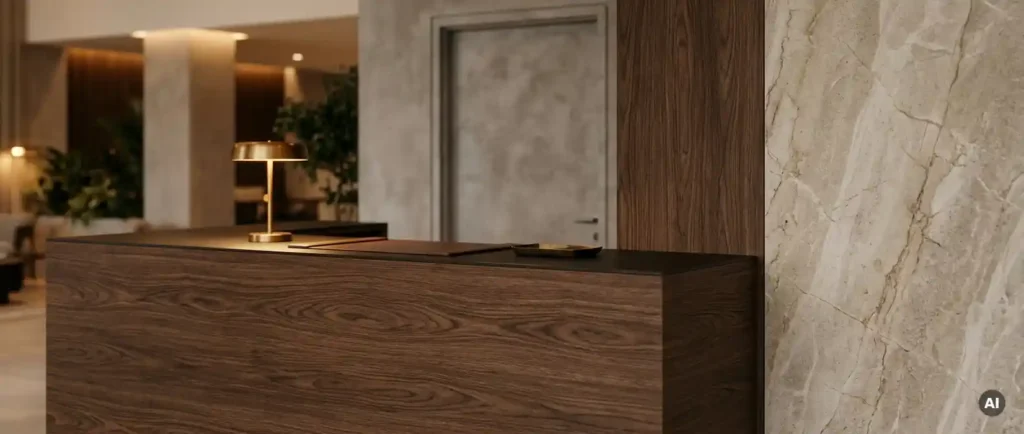
Wall materials suitable for highly frequented interior spaces are those that are mechanically durable, wipe-clean and form-stable. These include durable vinyl wallpaper, self-adhesive wall foils and robust coated textiles. Which material is suitable depends on the level of use, the underlying surface and the design goal. The following sections answer the most important questions about flexible wall design in everyday life.
What technical properties must a wall material have?
Wall material for heavily frequented areas must be abrasion-resistant, easy to clean, scratch-resistant and dimensionally stable. Furthermore, it should be easy to work with and reliably adhere to the existing substrate. These properties determine how long a wall remains visually appealing in everyday use.
In detail, it is worth taking a closer look at these criteria:
- Abrasion resistance: Corridors, reception areas and sales areas are exposed to daily contact and handling of trolleys and bags. The surface must not become rough or form shiny areas.
- Cleaning ability: The surface should be easy to wipe clean without affecting the color or texture.
- Dimensional stability: The material must not stretch, shrink or sag under changes in room climate.
- Light resistance: In shop windows, glass facades and showrooms with strong lighting, it prevents fading.
- Processing: Good positioning capability, clean impacts and a suitable adhesive base save time on the construction site.
Also check the substrate. Rough plaster, drywall or concrete require different preparations. Those who address this early avoid having to rework later.
Vinyl wallpaper, wall film or textile: Which is more durable?
Wall films are usually the most robust solution because their closed surface is well-resistant to bumps, scratches, and moisture. Vinyl wallpaper offers a balanced combination of durability and comfort. Textiles excel in acoustics and feel, but are more susceptible to wear and stains.
Wall foil
Self-adhesive wall films are suitable for areas with high demands, such as hallways, stairwells, or sales areas. In many cases, they can be cleaned with mild cleaning agents and reliably cover smooth, well-prepared surfaces. Proper bonding is important to prevent the formation of air inclusions.
Vinyl wallpaper and textiles
Vinyl wallpaper can be removed from the wall dry, making it practical for subsequent modifications. Textile wall coverings reduce noise and have a classy appearance, but require more maintenance and are more suitable for areas with less body contact, such as wall surfaces above the height of the seat or in meeting rooms.
For areas that are subject to heavy use, planners often combine: a sturdy material on the bottom, a textile or wallpaper on the top. This keeps the design flexible, and the wall withstands everyday wear and tear.
How can walls be kept hygienically clean in everyday life?
Walls remain hygienically clean when the surface is closed, wipeable, and resistant to common cleaning agents. Regular wiping with a soft, damp cloth usually suffices. For wall foils and coated wallpaper, you should avoid abrasive agents and aggressive solvents.
The following routine has proven itself in practice:
- Remove dust regularly to prevent the formation of a film of dirt.
- Treat stains promptly with lukewarm water and a mild detergent.
- Test cleaning products first in an inconspicuous place.
- Do not allow the edges and bumps to get wet, so that nothing will come off.
In areas with frequent hand contact, such as doors, cash registers, or elevators, a material that can withstand frequent wiping is advisable. Before choosing a material, ask about the manufacturer’s care instructions, as they vary depending on the coating.
Which wall materials meet fire safety and sustainability requirements?
Fire safety regulations apply to public and commercial indoor spaces, which vary depending on the building type, escape routes, and use. Wall materials should meet the required fire protection class, usually according to DIN EN 13501-1. Therefore, before ordering, check the certificates and have them confirmed if necessary that the material is suitable for the building.
In material specifications, specific, verifiable properties are included. These include:
- The classification of the fire behavior according to the data sheet
- The indication whether the material is PVC-free, provided this is confirmed for the product
- Test certificates for emissions and ingredients
- Suitability for the intended area of use, such as escape and rescue routes
Developers and planners should coordinate requirements early with fire protection experts. This prevents a material already selected from failing in the approval process.
How can wall materials be individually printed and designed?
Wall materials can be printed in digital large-format printing with your own motifs, patterns, logos or photographs. The motif is printed onto the selected carrier material, then cut to size and processed on the wall. This creates individual wall images without complex handwork and with high color fidelity.
Several factors come together to create flexible wall design:
- Resolution: The file should fit the viewing distance. Areas viewed from close range require higher resolutions.
- Train layout: Plan the bumps so that they do not interfere with the motif, for example along natural lines or corners.
- Tinting technology: Solvents, latex, UV and water-based inks all have different requirements for the medium. The material and the printer must match each other.
- Surface: Smooth, textured or velvety surfaces significantly change the effect and light reflection.
In projects with special requirements, such as curved walls or unusual substrates, a sample helps. It shows the color, feel, and finish of the material in advance at the object.
When is an exchange of wall design worthwhile?
Replacing a surface is worthwhile when the wall is visibly worn out, the design no longer fits the brand or use, or cleaning and repairs are no longer cost-effective. A change in the retail concept or a room redesign in the office are also clear reasons for a new surface.
Typical signs of a change are:
- Discarded edges, cracks or loose parts
- Permanent discolorations that cannot be removed anymore
- A design that no longer fits the target group or season
- New regulations regarding fire safety or hygiene
By choosing materials that are easy to remove without leaving any residue, you can redesign spaces faster and with less effort. This makes changeovers in retail operations or time-limited space concepts more predictable.
How does com2C help you choose the right wall materials?
We develop and manufacture digital printing media in-house and advise you on the selection for your project. As a manufacturer with its own inkjet coating lab, we adapt properties to your requirements when standard materials are not sufficient. Among other things, we offer PVC-free materials from the GoGreener line as a practical product option.
The following is what you can expect from us:
- Personal advice on vinyl wallpaper, self-adhesive films and printable textiles for walls and floors
- Material recommendations suitable for your printer and your ink system (solvent, latex, UV, water-based)
- Quick response and short decision-making processes, even for individual requirements
- Products of own production with constant quality and availability
- Support in selecting PVC-free alternatives if your project requires it
An overview of our solutions for architects and retailers can be found at Interior Design. The material that is suitable for your application will be shown to you by the productfinder. As com2C We stand by you as an equal partner. For a Consultation Feel free to contact us. We will discuss your project in detail with you.