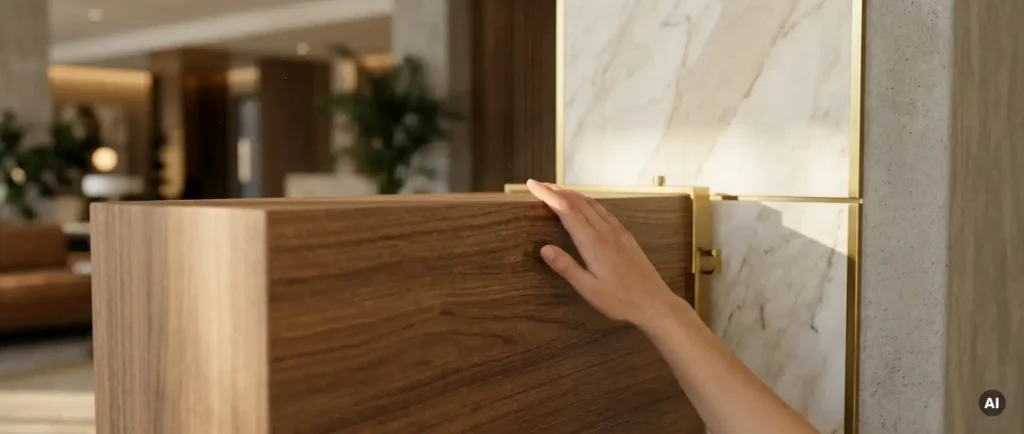
Individually printed surfaces transform spaces without the need for construction. With digital printing, you can transfer motifs, patterns, and brand identities onto walls, glass, textiles, floors, and luminous surfaces. We show you five methods that have proven themselves in practice and what you should consider when planning them.
Where the print media changes spaces architecturally
Printed surfaces are most effective where design and function come together: in retail design, showrooms, offices and the restaurant industry. The advantage of digital printing lies in its flexibility. You can produce one-of-a-kind pieces and small series, change designs quickly and achieve high levels of detail, even with large formats.
Choosing the right substrate material is crucial for the result. It determines how brilliant the colors appear, how robust the surface is in everyday use, and what requirements apply to the substrate and processing. The following five applications differ precisely in these points.
Vinyl wallpaper: striking wall surfaces without effort
Vinyl wallpaper is the most direct way to make a wall into a motif. The backing material is stable in shape, hardly stretches during processing, and can be printed precisely in patterns in digital printing. This results in continuous motifs without visible transitions, from the photo background to graphic patterns and even the brand world.
The practical aspect of the process is this: with the wall adhesive technique principle, you apply the adhesive to the wall, not the backing. This saves time and reduces errors. Many vinyl wallpaper can later be easily removed without leaving any residue, which is helpful in changing retail concepts.
Velvet wallpaper is particularly suitable for accent walls in showrooms, reception areas and offices. Check the substrate beforehand: it should be durable, clean and as smooth as possible, as unevenness can be noticeable with large motifs.
Self-adhesive films: shaping glass, furniture and fronts
Self-adhesive films bring motifs to surfaces that wallpaper won’t fit on: glass walls, furniture fronts, doors, counters or elevator cabins. This achieves visual protection, decoration and branding in one step, without having to replace the components.
Depending on the application, you can choose between covering films for furniture and walls and transparent or perforated variants for glass. Perforated films allow visibility from the inside out and are suitable for shop windows and partitions. The adhesive choice is important: it determines whether a film can be removed without leaving any residue later on or whether it should permanently adhere.
This solution is ideal for renovations in ongoing operation and for areas that change regularly. Pay attention to a clean, grease-free surface and to compatibility with paints or plastic surfaces, as this is where adhesion comes into play.
Printed textiles: combining acoustics and atmosphere
Printed textiles soften and warm rooms while also performing functional tasks. Tightly woven into frame systems, as wall coverings or as hanging sails, they create large-scale motifs with pleasant tactile qualities. Depending on the fabric and structure, they also reduce reverberation and improve room acoustics.
The pressure applied to the textile delivers rich colors and a matte, glare-free surface that remains clear even when light is directed at it at an angle. Textile frame systems can be quickly changed without having to mess with tools or wash or clean them, so you can adapt the motifs to the seasons.
This works particularly well in large office spaces, hotel lobbies, exhibition stands, and exhibition rooms. When choosing materials, consider their fire safety performance, as there are strict requirements for this in public buildings.
Floor films: Running surfaces as a design element
The ground is often forgotten in the spatial concept; it offers a large, coherent surface for messages and orientation. Printed floor foils highlight walkways, brand motifs or action areas and can be applied to existing floors without any modifications.
Here, technical characteristics are particularly important: a floor film must be slip-resistant, withstand abrasion and have appropriate lamination. For commercial areas with public traffic, you should additionally consider the required slip resistance for the specific location of use.
Commercial floor films are useful for promotional areas, at trade shows, in foyers, or as a guidance system. Plan for clean adhesion without air inclusions and edge-safe finishes so that no tripping hazards form in everyday use.
Backlit media: bright room accents set the tone
Backlit media are light-permeable materials that are illuminated from behind. They transform motifs into luminous surfaces that remain present even in bright environments. Typical applications include light walls, light boxes, room dividers, and backlit stretch ceilings.
The interplay of medium, pressure and lighting is crucial for a uniform result. The material must distribute the light homogeneously so that no light spots from the LED modules shine through. Equally important is a pressure that convinces in direct light and when the light is turned off, because both conditions shape the room.
Backlit applications are well suited for reception areas, shop concepts, and presentation surfaces that aim to draw attention. Plan the distance between the light source and the medium and the accessibility for maintenance from the outset.
Individual print media with com2C: advice and materials from a single source
Which surface is best suited for your project depends on the substrate, the load, and the design goal. This is where we can help you. As a manufacturer, we develop and produce the printing media ourselves and adjust the coating and properties to your requirements. Our own laboratory for inkjet coatings helps us find a practical solution for even unusual applications.
For architects, interior designers and retail projects, we are presenting on our interior design page appropriate materials beforehand. About the productfinder Define the limits for vinyl wallpaper, films, textiles, floor films and backlit media according to your printing process and intended use. This applies to solvent-based, latex-based, UV-based and water-based ink systems.
- Wide range of products: Vinyl wallpaper, self-adhesive films, textiles, floor foils and backlit media for the interior.
- PVC-free materials: With the GoGreener line, we offer media without PVC if your project requires it.
- Compatibility: Our media are designed to work with standard large-format printers from HP, Epson, Roland, Mimaki, Durst and other manufacturers.
- Individual development: We adapt materials to meet specific requirements, even for smaller quantities.
- Personal advice: We respond quickly and provide you with specific instructions for processing your substrate.
Do you have a project where standard materials reach their limits? Then we look forward to hearing from you. Consultation with you.