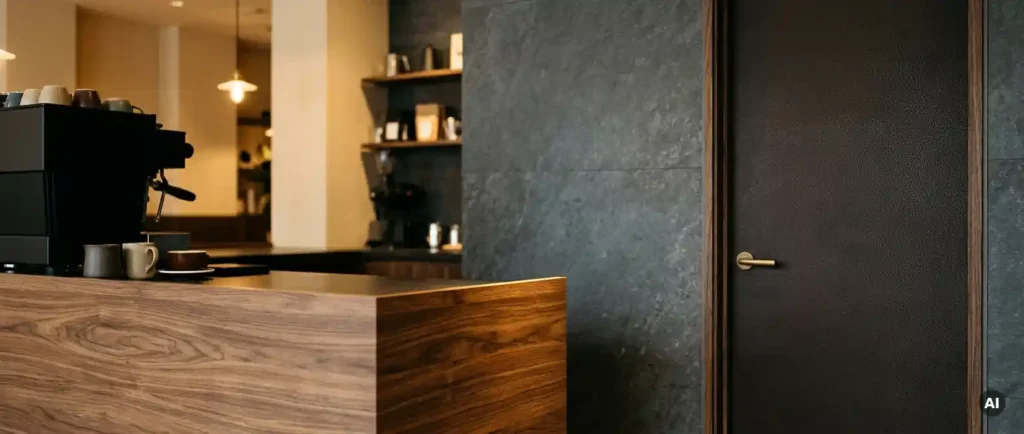
Whether pop-up stores, trade show stands, or seasonal displays in the showroom: Temporary space concepts thrive on being quickly set up, effective in their impact, and then easily removed without leaving any trace. Digital printing makes this possible precisely because you can produce motifs in small quantities and in a short time. However, the choice of the appropriate material is crucial to the result; the motif itself is not the decisive factor, but rather the choice of the right material.
In this article, we will go step by step: First, we will clarify which print media are suitable for short runs. Next, we will discuss residue-free processing, controlling color and effect in the room, and PVC-free material options. Finally, we will show you how to go from concept to the appropriate specialty material.
Which print media are suitable for pop-up concepts
For temporary design, print media that can be processed quickly, are gentle on the substrate, and can also be removed cleanly after weeks or months are suitable. Digital printing offers a wide range of options that can be used to achieve different thicknesses depending on the area and location of use.
The most important material groups at a glance:
- Self-adhesive films For walls, glass surfaces, furniture and counters. It comes with repositionable adhesive, so you can correct the positioning of the motifs when applying them.
- Vinyl wallpaper for large-scale wall motifs. They can be removed from the wall dry if the substrate is suitable.
- Textiles that can be printed for tension frames and room dividers. They are lightweight, tear-resistant and reusable.
- Floor films for wayfinding and brand presentation. They must be slip-resistant and wear-resistant.
- Pop-up films for applications where you want to flexibly use motifs without a classic frame.
As an example: For a four-week pop-up store with smooth walls and a storefront, it is sensible to combine a vinyl wallpaper for the interior walls with self-adhesive film for the glass. In this way, each material meets the requirements of its area.
Apply and remove residue without leaving marks
Removable means that a material can be removed from the substrate after use without leaving adhesive residue, paint chips or damage. This is often a contractual issue for temporary concepts, such as rental spaces in shopping centers.
Three factors determine whether this succeeds:
- The background: Smooth, durable, and well-primed walls are uncritical. Fresh paint, rough plaster, or porous plaster increase the risk of material being carried away when it is removed.
- The adhesive technology: Repositionable adhesives adhere moderately and can be removed cleanly. Permanently adhesive adhesives are usually not the right choice for short-term use.
- The duration and the room climate: Heat, sunlight, and moisture increase adhesion over time. Plan for a shorter shelf life on shopfronts exposed to direct sunlight.
Our practical tip: Before the overall project, conduct a stress test at an inconspicuous location and leave it there for a period of time that is close to the planned duration. This takes little time and prevents surprises during the dismantling process.
Controlling color brilliance and effect in the room
The effect of a motif in a room is created by the interplay of print quality, material surface and lighting conditions. The same image can look calm and high-quality on a matte vinyl wallpaper, but on a glossy film it will create reflections that will make the motif stand out.
Aligning surface and light
Smooth surfaces scatter light and are suitable for walls with spotlights or natural light from multiple directions. Glossy surfaces increase color contrast, but require controlled lighting. Backlit applications use backlit media that distribute the light evenly without individual light points shining through.
Observe color space and background
Bright, opaque designs need a background that does not show through. On dark walls, a film with opaque adhesive or a backing that covers the entire surface may be necessary to make white tones appear truly white. For color-critical projects, such as brand colors in retail, request a print on the original material. A monitor image or a paper proof provides little information about how the ink will appear on the selected coating.
PVC-free solutions for short runs
Many retailers and interior designers are now requiring or preferring PVC-free materials. PVC-free is a factual product characteristic: the material is based on other polymers, such as polyester or fleece, and does not contain polyvinyl chloride.
For temporary applications, this also has practical benefits. Textiles and non-woven materials are often easier to transport, fold, and reuse. You can swap textile tension frame motifs during the next project, while the frame remains in place. However, when choosing PVC-free alternatives, always check the technical specifications: fire safety class, tear resistance, ink compatibility, and adhesive properties vary depending on the material and must fit the intended use.
From the concept to the appropriate special material
The journey from concept to material begins with a few questions that you should answer in advance:
- What area is being designed (wall, glass, floor, furniture) and what is its nature?
- How long should the design be in place?
- What is the lighting situation like?
- Are there any specifications regarding fire protection, slip resistance or material composition?
- With which printing system and ink is it produced?
The answers usually lead to a clear choice of material. For special requirements, such as a film for a difficult surface or a coating for a specific ink, it is worth looking at manufacturers that can customize the materials individually.
Com2C as a partner for temporary space design
We develop and manufacture digital printing media in-house at our Porta Westfalica site, and we help architects, interior designers, and retail teams find the right material for each concept. Thanks to our in-house inkjet coating lab, we can respond to special requirements when standard materials reach their limits.
That is what we specifically offer you:
- Self-adhesive films, vinyl wallpaper, textiles and floor films, tailored for short lead times and residue-free dismantling
- PVC-free materials from our GoGreener line, where we openly disclose the technical data
- Compatibility with printers from HP, Epson, Roland, Mimaki, Durst and other manufacturers, for solvent, latex, UV and water-based inks
- Personal advice on background, lighting, and processing to ensure that your subject appears exactly as you planned
An overview of our solutions for interiors can be found on the page. Interior Design. If you are looking for a specific material, our productfinder When choosing. Learn more about us at Com2C. And if you have a project in mind, we look forward to hearing from you. Consultation.