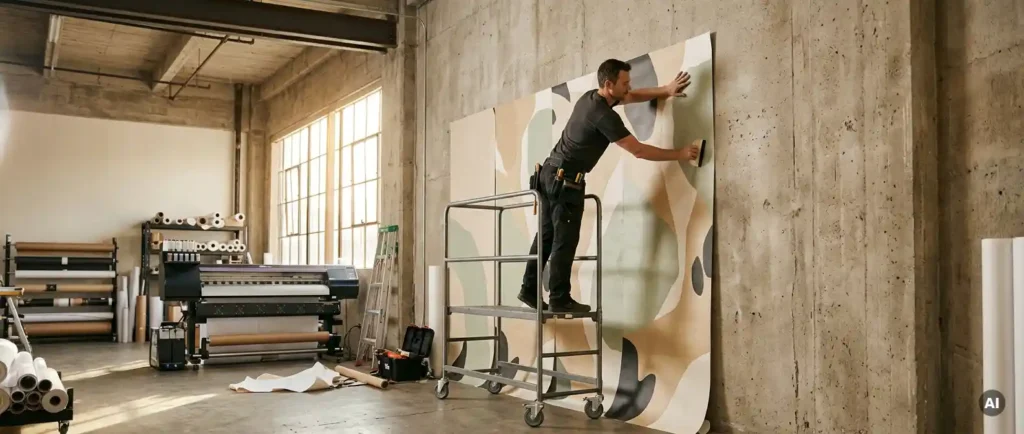
Velvet wallpaper is especially suitable for large wall surfaces, as are self-adhesive wall foils and printable textiles. Which material is suitable depends on the substrate, room usage and installation method. Velvet wallpaper provides a smooth, wallpaper-like finish, while foils offer high durability and textiles add a tactile and acoustic feel. The following questions clarify what you should consider when choosing: Digital printing should be careful.
How are vinyl wallpaper, wall film and textile different?
Vinyl wallpaper, wall film and textiles differ primarily in their surface, processing and durability. Vinyl wallpaper is applied to the wall dry and looks like classic wallpaper; wall films are self-adhesive and wipeable; textiles are usually stretched or framed.
Non-woven wallpaper
Vinyl wallpaper is mold-resistant and easy to install. It is applied to the wall using adhesive, and the strips can be easily removed when necessary. The material is breathable, which is an advantage for interior walls in normal use. The surface has a matte to slightly textured appearance and is well suited for large-scale motifs in residential, office and retail spaces.
Wall foil
Self-adhesive wall films adhere directly to the prepared substrate. They are wipeable and can withstand heavier use, for example in entrance areas or sales rooms. A smooth, clean and stable surface is essential, as unevenness can be visible through the film. Furthermore, the film is less easy to correct during installation due to the adhesive, compared to wallpaper.
Printed textiles bring haptics, depth, and, depending on the design, acoustic effects into the room. They are often stretched in frame systems so that the wall itself remains untouched. This makes them interesting for showrooms, exhibition stands, and areas that are expected to change regularly.
Which substrate influences the choice of material on the wall?
The substrate determines whether a printing medium adheres permanently and the motif appears clean. Smooth, durable, and clean walls are suitable for almost all materials. Rough, absorbent, or uneven surfaces require preparation or another material to prevent structural and color differences from being noticeable.
Before choosing the material, please check the following points:
- Durability: Scratched paint, loose patches of plaster or dust prevent any permanent adhesion.
- Suction behavior: Strongly absorbent walls require a primer to ensure that the adhesive adheres evenly.
- Surface structure: Rough surfaces or coarse plaster are visible through thin films. Spackling or a see-through non-woven fabric can help here.
- Coloration of the background: Dark or spotted walls appear blurred on thin media. Covering materials or a neutral primer solve the problem.
- Humidity: In rooms with elevated humidity, the material and adhesive must be adjusted accordingly.
A short load test in an inconspicuous location saves time and material for large areas.
How can seamless motifs be implemented without visible bumps?
Seamless motifs are created through precisely planned patterns, precise image processing, and clean application to the surface. The motif is divided into patterns that complement each other exactly. With vinyl wallpaper, a careful touch is sufficient; with film, a minimal overlap may be necessary, depending on the material.
These steps help to achieve a clean result:
- Accurately measure: Record wall measurements, including electrical outlets, windows, and slopes, before the layout of the train is determined.
- Setting the standard: The pressure medium indicates how wide a track can be. Plan the bumps where they will be least noticeable.
- Plan for a cut-off addition: A small addition at the edges eliminates wall irregularities.
- Process the tracks in order: Number the lanes and work in the printing order so that the color tone and the pattern of the motifs match.
- Pay attention to the room climate: Process the media at a uniform temperature, as some materials can easily expand when exposed to heat or moisture.
A dimensionally stable carrier material significantly reduces stresses at the points of contact.
What requirements apply to fire protection and room climate?
In publicly accessible buildings, fire protection regulations usually apply to wall coverings. Often, fire-resistant materials are required, such as B1 or Euroclass B-s1,d0. Which class applies in a specific case depends on the building type, use, and escape routes and is determined project-specifically by the fire protection concept.
Therefore, clarify the requirement early with fire protection experts or the construction management. Also, check whether the medium chosen has a valid test certificate for the planned installation. Often, the overall structure, including the foundation, adhesive, and pressure medium, is decisive, not just the material itself.
In terms of room climate, breathability and evaporation play a role. Vinyl wallpaper allows moisture to pass through more easily than closed film. In rooms with continuous use, such as offices or retail spaces, it is therefore worth taking a look at the emission behavior and material composition. Ask for data sheets that demonstrate these properties.
Are there PVC-free printing media for wall surfaces?
Yes, there are PVC-free printing media for wall surfaces. These include vinyl wallpaper, textile materials, and films based on other plastics. They are available for the common printing technologies and cover many applications, from office walls to store walls.
PVC-free media can be printed with solvent-, latex-, UV-, and water-based ink systems, provided the coating is designed for this purpose. When choosing, pay attention to compatibility with your printer and ink, the abrasion resistance of the printed surface, and fire safety properties if required. Check the data sheet to see if the desired property is confirmed for the specific product.
When is an individually developed printing medium worthwhile?
An individually developed printing medium is worthwhile when standard materials do not meet a requirement. This is true when a special surface, special adhesion, a defined fire protection property, or an unusual combination of substrate and printing method are required.
Typical occasions are:
- The substrate is unusual or difficult, and commercial media do not hold up reliably.
- A specific look, such as a unique texture or surface structure, is not available in the standard range.
- The project requires combinations of properties that are excluded from finished media.
- Larger quantities justify the development effort.
Such a step is particularly useful for recurring applications or projects with high requirements. For one-time, simple walls, a suitable standard medium is usually sufficient.
How does com2C help you choose the right printing medium?
We have been developing and manufacturing print media for large-format printing since 2006 and understand the requirements that architects, interior designers and retail companies place on wall surfaces. Whether vinyl wallpaper, self-adhesive film or textile: We help you find the material that suits the substrate, printing process and space utilization.
What we specifically do for your wall project:
- Advice on material selection based on the substrate, installation method and fire protection requirements
- PVC-free printing media, provided that this property is confirmed for the respective product
- Compatibility with common large-format printers and ink systems from solvent to water-based
- Our own production and a dedicated lab for inkjet coatings, so that we can tailor media for special requirements
- Personal contact persons who remain available for questions regarding processing even after delivery
You will find suitable solutions for your project in our section for Interior Design, and with the productfinder Target the appropriate material. If your project requires more than a standard medium, we will work with you to develop a suitable solution. Our team is available to answer your questions via contact us available, and on com2C You can find more information about our range here.