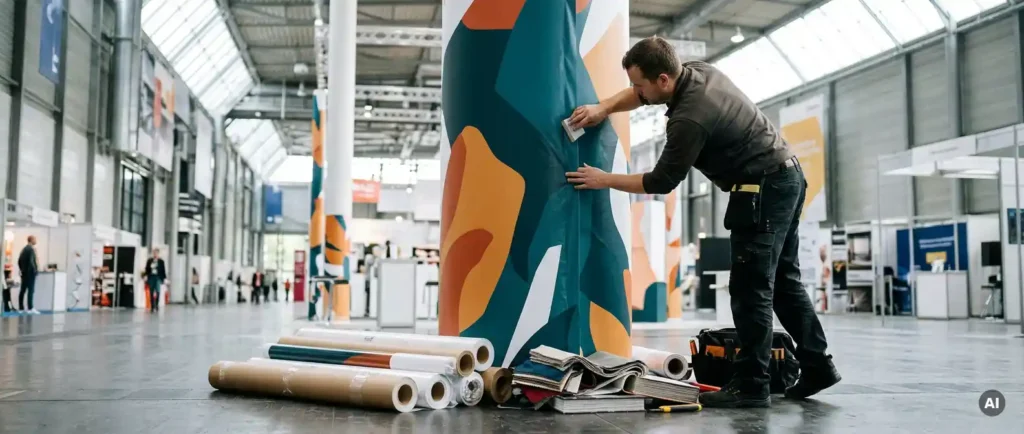
Self-adhesive digital printing films, vinyl wallpaper and printable textiles are best suited for the individual design of columns. Which material is suitable depends on the shape, substrate and location of the column. Round columns require flexible, adaptable films; square columns can also handle stiffer materials. The following questions clarify requirements, material selection, processing and fire protection.
What requirements do round and square columns place on the material?
Round columns require a flexible material that conforms to the curvature without forming creases. Angular columns place high demands on the edge hold because the material is permanently under tension at the corners and can therefore first detach there.
With round columns, the diameter is important. The smaller the radius, the more flexible the film must be. Cast films (cast films) adapt better to curves than calendared films, because they develop less restoring forces. At larger diameters, simpler qualities often suffice.
With angular columns, you should pay attention to high adhesive strength and good dimensional accuracy. Rigid materials such as vinyl wallpaper can be aligned cleanly along the edges, but require precise planning of the motif. Also, check whether the image should run across the edges or be placed individually on each side.
Which materials are best suited for covering columns?
Self-adhesive digital printing films, vinyl wallpaper and printable textiles are best suited. Self-adhesive films offer the greatest flexibility in terms of shape and substrate. Vinyl wallpaper looks more like a wall and is of high quality, while textiles provide a soft, matte texture and can often be removed again.
Self-adhesive films
Self-adhesive films are the most common choice for columns in retail and exhibition buildings. They are available in glossy, matte or textured finishes, with permanent or removable adhesive layers. For curved areas, stretchable cast films are recommended; for flat surfaces, standard qualities often suffice. Laminating protects the print from scratches and abrasion, which is important for columns in busy areas.
Vinyl wallpaper and textiles
Vinyl wallpaper is suitable for columns in interior spaces where a wall character is desired. They are stable in shape and can be aligned cleanly along edges. Printable textiles work particularly well if you want to change motifs frequently, for example in showrooms or offices. Both materials achieve brilliant colors and sharp details in digital printing.
How do you properly prepare the substrate for a column?
The substrate must be clean, dry, grease-free, smooth and durable. Dust, grease or loose paint residues prevent adhesion and can later lead to bubbles or peeling. Always check before applying the coating whether the coating or plaster is firmly attached and the surface is level.
Proceed in this order:
- Clean the surface with a lint-free cloth and a suitable cleaner, with oily dirt using isopropanol.
- Remove loose paint, wallpaper residue, and old adhesives completely.
- Smooth out holes, cracks, and unevenness with putty and sand the areas smooth.
- Allow new paint coats or patches to dry completely. In the case of fresh coats, the gassing out of the solvent can affect adhesion.
- Test the film on an inconspicuous area for adhesion and tearability.
Rough, highly absorbent or porous surfaces should be primed. The room temperature also plays a role: most adhesives work reliably within a range of about 15 to 25 degrees Celsius.
How can column films be processed without bubbles and without residue?
To process column foils without bubbles, apply tape from the center outwards one sheet at a time using a scraper and carefully remove any trapped air. For residue-free removal, choose a removable adhesive layer and then slowly and flatly peel the foil off the substrate.
These practical tips help with the processing:
- Plan the layout of the train: Place the bumps in inconspicuous places, ideally in the edge of the cornered pillars.
- Place the foil in front of the oven: Fix the upper edge with masking tape and align the track with a marker.
- Work with the spatula: Rub with even pressure from the center; with air duct films, this is especially easy to achieve.
- Treat round shapes with warmth: A hot air gun makes the film more flexible, but too much heat can weaken the material.
- Set edges to: After the gluing process, press the edges and corners firmly again.
Light heat helps to soften the adhesive when removing. Pull the film off at a slight angle to ensure no adhesive residue remains on the surface.
Are there PVC-free alternatives for column design?
Yes, there are PVC-free alternatives such as films based on polyolefin or polyester, vinyl wallpaper and printable textiles. They cover many applications on columns and can be printed using conventional ink systems in digital printing. Suitability depends on the specific product and application.
When selecting materials, the technical characteristics are important: stretchability for round columns, adhesive strength, surface structure, and compatibility with your printing system, such as latex, UV, or solvent. Vinyl wallpaper and textiles are inherently PVC-free and are suitable for indoor use. Check the data sheet to see which substrates and applications the material is approved for.
What fire protection requirements apply to materials on columns?
For materials on columns, depending on the type of building and use, requirements apply regarding fire behavior, usually according to the European standard DIN EN 13501-1. In publicly accessible buildings such as shops, trade shows, or offices, at least one highly flammable material (Class B1 according to the previous DIN 4102 or B-s1,d0) is often required.
Which class of premises applies is governed by the respective state building regulations and the building’s fire protection plan. Please clarify this in advance with the operator, the fire protection officer or the building inspector. Escape routes, stairwells and assembly areas often have stricter requirements than ordinary sales areas.
Make sure that the fire safety certificate for the entire combination of foil, adhesive and substrate is available. Laminating can also change the fire behavior. Obtain certificates and test reports from the manufacturer and document them for approval.
How does com2C support you in designing pillars?
We support you in selecting the appropriate material for your pillar design, from consultation to processing. As a manufacturer, we develop and produce our own digital printing media and can tailor properties such as stretchability, adhesion, or surface finish to your specific application. Our media are compatible with common large-format printers and ink systems.
What we specifically do for your pillar project:
- We advise you on films, vinyl wallpaper and textiles, suitable for the shape, substrate and location of use.
- We offer PVC-free materials whose suitability we confirm product-specifically. This applies in particular to our GoGreener line.
- We develop individual solutions upon request when standard materials do not meet your requirements.
- We are here to help you with any questions regarding the processing of your data and are also available to you after the purchase.
- We work with short decision-making processes and respond quickly to your request.
An overview of materials for room design can be found at Interior Design, You can find suitable media for your printing system in productfinder. If you are planning a specific project, we would be happy to discuss the requirements in more detail. Consultation with you.