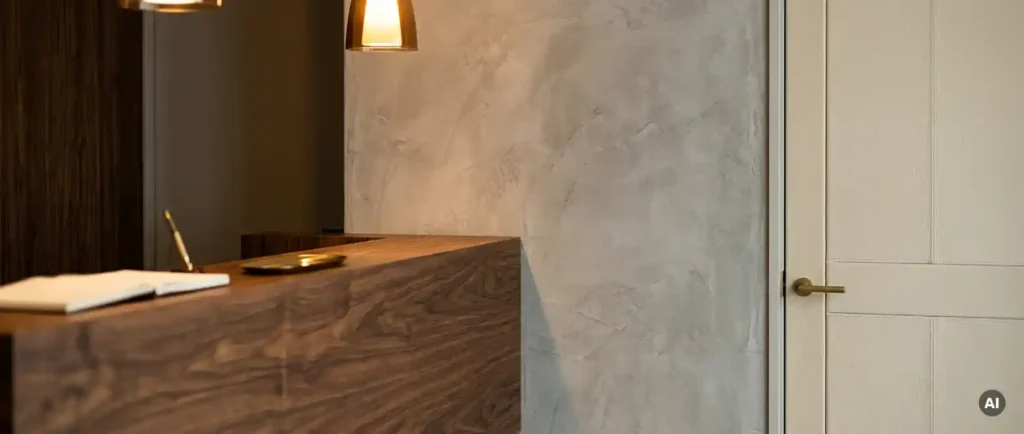
For professional large-format printing on the wall, vinyl wallpaper, self-adhesive wall foils, and printable textiles are particularly suitable. Which material is suitable depends on the wall substrate, the load, and the desired appearance. The following questions will guide you from the choice of material through resolution and lightfastness to the individual material development.
Which print media are best suited for wall surfaces?
Velvet wallpaper, self-adhesive wall foils and printable textiles are best suited for wall surfaces. Velvet wallpaper covers classic wallpapering surfaces, wall foils work on smooth surfaces and with alternating motifs, and textiles create soft, acoustically effective wall surfaces with high-quality haptics.
Each medium has its strengths:
- Printing vinyl wallpaper: The carrier material remains dimensionally stable, can be removed from the wall dryly and is suitable for large-area motifs with clean edges.
- Self-adhesive wall film: It adheres to smooth, stable surfaces and allows for applications on glass, metal, or painted surfaces. The choice of adhesive is important here: there are removable and permanent systems available.
- Textile printing on the wall: Tensioned fabric tracks, for example in frame systems, have a high-quality appearance, can be easily changed, and are suitable for showrooms, exhibition stands, and retail spaces.
For retail wall graphics, the frequency with which the motif changes is also important. In the case of seasonal campaigns, residue-free removable systems are advisable; in the case of permanent space concepts, you can choose more robust solutions.
How does the wall background influence the choice of material?
The wall substrate determines which pressure medium adheres and how it can be removed later. Smooth, clean and stable surfaces are suitable for films, while absorbent or textured walls are suitable for vinyl wallpaper. Rough, dusty or wet surfaces always require a pretreatment.
Before choosing the material, please check the following points:
- Durability: Scratched paint or loose layers of paint will peel off when removed. Fix the substrate or prime it beforehand.
- Surface structure: Smooth surfaces, rough surfaces or gaps in the joints are difficult to fill with thin films. A smooth jointing or a thicker medium will compensate for this.
- Suction behavior: Strongly absorbent walls absorb wallpaper paste unevenly. A primer ensures uniform adhesion.
- Humidity: In wet areas or with residual moisture, many adhesives fail. Select suitable systems specifically for this purpose or refrain from direct bonding.
- Fresh paint or a fresh coat of paint: Newly painted walls must be completely degassed and cured before applying a film.
A test field in an inconspicuous location demonstrates, before the large project begins, how liability and subsequent removal actually work.
What resolution does a wall print really need?
For a wall print, 72 to 150 dpi is usually sufficient for the final size, depending on the viewing distance. The farther away the viewer is from the wall, the lower the resolution should be. For close-up shots, such as in the entrance area, you should plan closer to 150 dpi.
What matters is not just the number of pixels, but the ratio between file size, print format and spacing:
- Remote range (from approx. 3 meters): 50 to 100 dpi at the final size usually suffices because the eye no longer resolves individual pixels.
- Near area (less than 1.5 meters): Plan for 100 to 150 dpi so that edges and textures appear clean.
- Vector graphics: Logos, fonts, and flat graphics deliver better results than vector files. They remain sharp in any size.
- Scale up photos: Do not blindly calculate too high. Overly calculating produces artifacts that become visible only on the finished wall.
Also pay attention to color space and profile. Provide data with embedded profile and submit a proof for color-critical designs, such as brand colors. This will prevent any surprises in the color appearance.
How can wall motifs be made durable and light-resistant?
Long-lasting, light-resistant wall murals are created through the interplay of ink system, printing medium and protection against UV radiation. Pigmented inks fade more slowly than dye-based inks, and a laminate provides additional protection. In indoor spaces with direct sunlight, you should specifically use light-stable materials.
The following factors determine the shelf life:
- Type of ink: Latex, UV and solvent inks offer good light fastness depending on the manufacturer. Check the information provided by the ink manufacturer for indoor use.
- Coating of the medium: The inkjet coating determines how well the ink adheres and how stable the printed image remains.
- Laminate or protective coating: A protective layer increases scratch and abrasion resistance, for example in hallways or customer areas with a lot of contact.
- Lighting: Direct sunlight and strong spot lighting stress colors more than diffuse light. Plan scenes in sun-exposed areas accordingly.
- Cleaning: Determine in advance whether the surface needs to be wiped dry, and choose a wipeable medium.
For very long service life, it is worth comparing the material data sheets with the actual installation situation. Manufacturers usually provide guidelines for the interior area.
Are there PVC-free alternatives for wall decoration?
Yes, there are PVC-free wall coverings available in several variants: vinyl wallpaper, textile media and PVC-free films based on other polymers. They can be printed using digital printing and are suitable for many applications indoors. Please check the technical data for adhesion, fire resistance and cleaning for each product.
Media that are free of PVC differ in everyday life primarily in terms of feel, flexibility, and processing:
- Non-woven wallpapers: They consist of a fiber-based carrier material and are found in many surfaces, from smooth to textured.
- Textile media: They are suitable for tensioned wall systems and have a soft and high-quality feel.
- PVC-free films: They offer the usual processing of a self-adhesive wall foil with a different material base.
When selecting materials, pay attention to requirements in the building sector, such as fire protection classes. Depending on the type of building, there are specific specifications that the material must meet. Be sure to show you the relevant test certificates before planning.
When is individual material development worthwhile?
Individual material development is worthwhile when no standard medium meets your requirements, for example, due to special haptics, unusual substrates, or special adhesion and removal properties. Even with larger project volumes or recurring applications, an adapted solution can be more economical than compromises in the standard range.
Typical triggers are:
- Special appearance or feel: You want a surface that does not exist as a standard medium.
- Difficult substrates: Standard adhesives do not adhere or dissolve without leaving any residue.
- Compatibility: The medium must precisely match a specific printer and ink system.
- Recurring rollouts: Branch concepts with identical wall design benefit from a uniform, coordinated material.
The earlier you clearly define the requirements, the more targeted the material development and testing can be. If you include samples, substrates, and application conditions, reliable results can be achieved more quickly.
How does com2C support you in large-format printing wall decoration?
We assist architects, interior designers and retail companies from the selection of materials to the implementation. As a manufacturer, we develop and produce the printing media ourselves and test them in our own chemical laboratory for inkjet coatings. This way, we can work with you to find the material that suits the substrate, printing system and load.
This means for your project specifically:
- Appropriate media: From vinyl wallpaper to self-adhesive wall foils to printable textiles, you will find solutions for Interior Design and Space Planning. About us productfinder Narrow down the range by application and printing system.
- PVC-free materials: We offer PVC-free media, including the GoGreener line, and provide you with the technical specifications for each product so that you can make an informed decision.
- Print system compatibility: Our media are printed on large format printers from HP, Epson, Roland, Mimaki, Durst and other manufacturers, using solvent, latex, UV and water-based inks.
- Individual development: When standard materials reach their limits, we develop a solution for your requirement with short decision paths.
- Personal advice: Our expert team is available to assist you with questions regarding the subfloor, adhesion, and processing, even after the purchase.
Describe your wall project to us, whether it’s a store concept, showroom or office. We will review the requirements with you and recommend the appropriate material. For a first Consultation You can reach us directly via our contact page, and we will support you in implementing your project.
Note regarding a requirement: The instruction to highlight environmental friendliness contradicts the content guidelines, which explicitly exclude environmental and sustainability claims. I adhered to the guidelines and only mentioned PVC-free as a factual product feature.