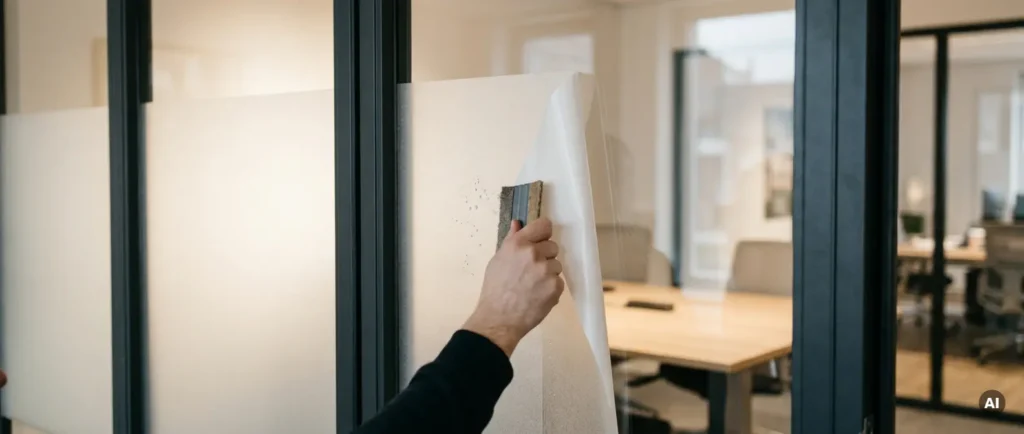
For glass surfaces, different self-adhesive digital printing media are suitable depending on the application. Typical material types and applications are clear film, milk glass or satin film, white film with reverse printing and perforated One-Way Vision film. Which medium is actually suitable depends on the product in question: the carrier, adhesive system, printing process and ink, as well as the application location (inside or outside), the desired transparency and duration of use. The following questions guide you through material selection, adhesive, bonding and removal. Detailed information can be found in the technical data and processing instructions for the specific medium.
How are interior and exterior adhesive glass films different?
The most important difference lies in the adhesive surface and the load: In interior bonding, the film is applied from the inside onto the pane and is viewed from the outside through the glass. In exterior bonding, the film is directly exposed to the elements. This results in different requirements for the carrier, pressure protection, and adhesive.
When applying the film internally, there are two variants to choose from. When applying the film from the inside with visibility from the outside, the motif is usually printed upside down so that it is visible through the glass. For this purpose, media are available that are intended for this application by the manufacturer. The glass can protect the print layer from weather and mechanical stress. When applying the film from the inside with visibility inwards, for example in the case of privacy screens or room design, the weather stress is also eliminated, but mechanical stress and cleaning must still be taken into account.
With outdoor bonding, the film is placed directly on the surface of the sheet, and the printing side faces the viewer. UV radiation, rain, temperature fluctuations, and cleaning agents all affect the material. Whether additional protection is required depends on the medium, printing process, duration of use, and the level of stress. Therefore, check the manufacturer’s information regarding outdoor suitability and recommended protective measures for the respective medium; these vary significantly depending on the product.
Which film types are suitable for shop windows and glass surfaces?
Four material types are primarily considered for shop windows and glass surfaces: transparent clear films, milk glass or satin films, white or opaque films with printed backings and perforated protective films. Each type serves a different purpose, ranging from targeted visibility to full-surface protection. The specific media within these types and their intended uses vary depending on the manufacturer and product.
- Clear film: The motif takes center stage; the background remains visible. They are often used for logos, lettering, and ornaments that are not intended to completely cover the glass.
- Milk glass films: They create a satin-like finish and can provide privacy while allowing light to pass through, for example in meeting rooms or entrance areas.
- White or blocking films: They usually cover the entire surface of the motif. For backlit applications, where the disc is illuminated from behind, separate media designed for this purpose are required.
- Perforated films: They allow a view from the inside out, while passersby see a printed motif.
Wall murals and self-adhesive wallpaper made of fleece or film also play a role in interior design; however, they are only suitable for glass in exceptional cases. For the smooth, non-absorbing glass surface, films with a dedicated adhesive system are usually the appropriate choice.
When is a perforated one-way vision film the right choice?
A perforated One-Way Vision film is suitable if you want to print a large area of glass without completely losing the view from the inside out. Typical applications include shop windows, vehicle windscreens, office fronts and glass façades with advertising messages. To determine whether a specific medium is suitable for the respective application, such as for vehicle windscreens, you should check the product specifications.
The principle: The film contains many small holes. The light-colored outer side carries the printed design, while the dark back side supports the visibility from the inside. The visibility depends significantly on the lighting conditions and usually works better when it is brighter outside than inside. In darkness and with indoor lighting, the effect may diminish or reverse, allowing passersby to see through the holes into the room.
Consider two points when planning: First, perforation can affect color brilliance, as part of the surface is made up of holes. Second, the hole pattern can restrict the reproduction of very fine details or small text. For motifs with large-area images, this is usually less critical. If you require full opacity and high detail resolution, a medium without perforation may be better suited; however, this must be without transparency.
Which adhesive is best for glass?
There is no one adhesive that is the best choice for every glass application. What is crucial are the specific medium and its adhesive system, the type of glass or existing glass coating, the intended duration of use, and the desired removability. To determine whether a adhesive system is suitable for glass, refer to the product's technical data.
Basically, the following types of adhesives can be distinguished:
- Permanent adhesive: They are designed for permanent use and are often used over a longer period of time. Residuals may remain when removing them, depending on the product, the duration of use, and the conditions of use.
- Removable adhesives (Removable): Removable adhesive systems designed for this purpose can facilitate subsequent removal, for example in promotions and temporary window displays. Whether removal is possible without leaving any residue depends on the specific product, the substrate, the duration of display, and the conditions of use.
- Repositionable adhesives: They can be moved and repositioned during installation, which can make processing larger areas easier. The manufacturer of the respective medium specifies whether and for how long this property exists.
The substrate also plays a role. Glass, mirrors, acrylic glass and coated glass behave differently. For special glazing such as coated, insulating or heat-protective glass, you should check the suitability of the material and, if necessary, obtain the specifications from the glass manufacturer. If you are unsure, test a small, inconspicuous area before gluing the entire motif down.
How is printed glass foil bonded cleanly and without bubbles?
Clean bonding begins with preparing the substrate and following the processing instructions of the respective medium. Which methods are permissible depends on the product: some media are designed for dry bonding, while others also allow for wet bonding with the application liquid. Use the processing method provided by the manufacturer for the specific product.
- Cleaning glass: Remove dust, grease and residues with a lint-free cloth and a suitable cleaner. Then allow the surface to dry completely. Also, observe any cleaning instructions provided by the media manufacturer.
- Check the conditions: Observe the processing temperature specified by the manufacturer and avoid unfavorable conditions such as direct sunlight or frost, unless the product specifications indicate otherwise.
- Positioning: First, fix the foil temporarily, for example with adhesive tape as a hinge, and check the alignment using a spirit level or markings.
- Put down and press down: Step by step, pull off the carrier material and press the film evenly with a scraper, usually from the center outwards.
- Repairs: Whether and how individual air bubbles can be repaired depends on the medium. For this purpose, please refer to the manufacturer's instructions for use.
For large formats, it is best to work in pairs. When working with split motifs, plan for a clean edge or overlap so that no gaps are created. Which variant is suitable depends on the medium and the motif.
How can glass film be removed without leaving any residue?
The recommended distance depends on the particular adhesive system and the substrate. There is no universally applicable method that is suitable for all media and glass types. Therefore, please observe the manufacturer’s specifications for the specific medium, especially regarding temperature, peel angle, and permissible cleaning agents.
The guiding principle for the approach is:
- Check in advance in the technical data whether and how the medium is intended to be removed later.
- Carefully and evenly remove the foil, following the instructions of the manufacturer for the product.
- If adhesive residues remain, choose a cleaning agent only if it is approved or compatible with the adhesive system and substrate. Test it first on an inconspicuous area.
- Avoid tools and methods that can damage the glass surface or an existing coating.
Plan the removal at the material selection stage. If a motif is only intended to be attached temporarily, a removable adhesive system designed for this is an option. How the durability, sunlight exposure, and temperature affect the subsequent removal depends on the specific product.
Glass films for your application: How com2C supports you
Choosing the appropriate self-adhesive digital printing medium for glass depends on many factors: application site, adhesive system, printing process, and duration of use. We can help you find suitable materials for your project. As a manufacturer, we develop self-adhesive films at our site in Porta Westfalica, with our own chemical laboratory for inkjet coatings. This gives us expertise in digital printing media, coatings, and adhesive systems that we incorporate into our consulting services.
- Material selection for your printing system: com2C offers various digital printing media for different printing and ink systems. We will review which medium is available for your system together with you based on the respective product release.
- Technical consulting: We will discuss the adhesive system, substrate, and processing with you based on the characteristics of the respective medium.
- Application-specific solutions: If standard material does not meet your requirements, we will work with you to explore the options available.
- PVC-free materials: In our GoGreener line, you will find PVC-free materials. We will check together with you whether they are suitable for your glass application based on the technical properties.
- After-Sales Service: Even after delivery, we are here to assist you with any questions you may have from practical experience.
In Product finder for self-adhesive films by com2C See what materials are available for your application. If you would like to discuss your project in advance, we offer a personal consultation. Consultation an.