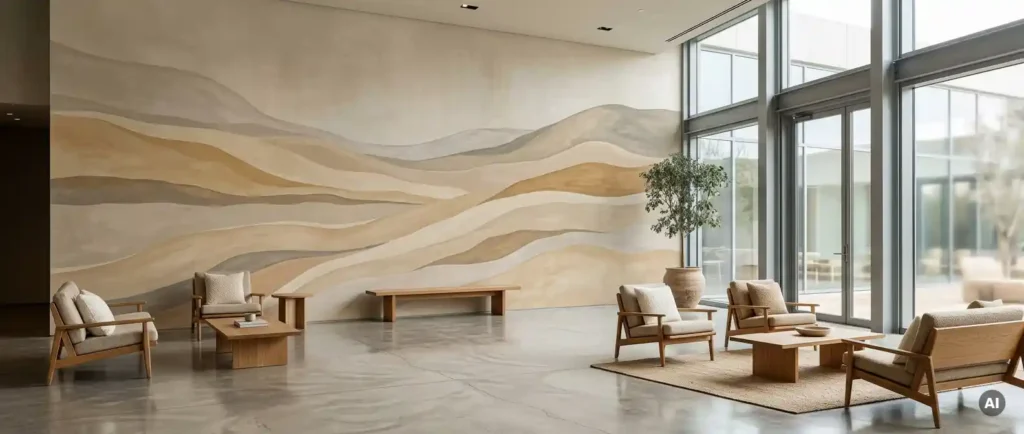
Wall art over several meters, a floor design in the showroom, or a printed textile surface in the office: Large-format motifs noticeably change rooms. At the same time, they are forgiving in a way that few other design elements are. A mistake in the planning process is immediately apparent in ten square meters of space. This article is structured as a planning guide and takes you step by step through the most important questions, from space to viewing distance, print data and material, to assembly. The key rule: Before production begins, you must coordinate the space, viewing distance, print data, substrate, medium, and processing. This way, you maintain control when digital printing is used in interior design.
Early analysis of the spatial situation and the subsurface
At the beginning of any planning, the space itself comes first. It determines which motifs, materials, and processing methods are even possible. Anyone who skips this analysis often ends up paying dearly later on.
First, check the substrate. A smooth, stable wall requires different requirements than a rough surface, concrete screed, or freshly plastered surface. Moisture, dust, old paint layers, and unevenness can affect adhesion and the final appearance. On textured substrates, irregularities can be noticeable depending on the medium and the thickness of the material.
How a particular medium behaves on a specific substrate cannot be predicted in a general way. In any case, a test area is recommended to pre-test the combination of material and substrate.
The second point is the light. If daylight shines on the surface in scattered light, gaps and irregularities become more pronounced. Direct sunlight can play a role in determining the intended use depending on the material. The lighting in the room also changes the color effect: Warm white light makes color tones appear differently than neutral white light.
A practical example: For a store concept with a six-meter-wide wall of motifs, you measure not only width and height. You also note the sockets, switches, ventilation openings, and wall transitions. These details determine how you divide the motif into sections and where the seams run.
Viewing distance and image quality: What does a large subject require?
The required resolution of a motif depends on the viewing distance, not just the area itself. The farther away the viewer stands, the lower the resolution can usually be. This is a principle for any data preparation in large format.
Consider a poster in your hand as being 30 centimeters wide, a mural in a lobby as being several meters long. Therefore, for large areas, smaller resolutions are often sufficient than in small format. For motifs that visitors see up close, such as at a reception desk, you should plan more generously. It is best to agree on specific target values with the printing company and the chosen medium.
When preparing the data, please pay attention to these points:
- File format: Vector graphics can be scaled without loss of quality; photos require sufficient pixels for the target size.
- Color space Decide early on what color space you will be working in and agree on it with the printing company.
- Cutting and addition: Plan for some reserve on the edges so that there is room for play when cutting and assembling.
- Train layout: Determine where the motif is to be separated so that important image elements do not overlap on a seam.
Build on these foundations: A technically well-prepared motif is only truly effective when the medium, background, and processing match it.
The suitable printing medium for every application
The printing medium influences how a motif looks, feels, and behaves in everyday life. No material is suitable for all applications. What matters is the specific requirements of the surface. The exact characteristics vary from product to product; therefore, it is important to check the data sheet and processing instructions of the specific product, rather than assuming characteristics based on the material group.
The common media types in the interior area and what you should pay attention to in each case:
- Self-adhesive films: Depending on the product, they are suitable for walls, glass, furniture fronts or objects. Suitability for the substrate, positioning and surface are product-dependent.
- Non-woven wallpapers: They are suitable for classic wall decoration. The processing, removability, and other properties depend on the specific product and the wall construction.
- Printable textiles: They are used, for example, for tension frames or room dividers. The feel, effect and variability vary depending on the product. Acoustic properties are only a criterion if a system or product designed for this purpose is chosen.
- Ground media: Requirements such as abrasion resistance and slip resistance depend on the application site and the project specifications. Check whether the product is approved for the intended use.
- Backlit media: They are intended for backlit areas. The result depends on the medium as well as on the lighting and system setup.
Imagine that you are designing a wall in the stairwell of an office building. There is a lot of foot traffic there, and the wall is occasionally touched or cleaned. The surface’s cleanability and mechanical durability usually take precedence over particularly fine haptics here. To determine whether a product meets these requirements, refer to the product specifications.
PVC-free materials as a project requirement
PVC-free is a material characteristic in itself: the media consist of other plastics or of non-woven fabrics and textiles. This is relevant for architects and interior designers when project specifications or tenders require a PVC-free version. From the information alone, no further benefits can be derived, neither in terms of the environment nor in terms of health or quality.
Check early on whether your project includes such specifications. Subsequent changes to the material can alter the feel, gloss level, and finish. Processing properties such as stretchability, dimensional stability, or suitability for curves depend on the specific product, regardless of whether it is PVC-free or not.
It is important that you ask specific questions about the properties of the selected material: fire behavior, application area, light resistance, and compatibility with your printing system. There is no one-size-fits-all answer regarding „the best material.“ You choose the medium that meets the technical requirements of the surface.
Plan assembly and processing realistically
The best planning fails if assembly is not considered. Large-format motifs require time, patience, and the appropriate equipment for installation. The manufacturer's instructions for the selected product provide information on the processing steps required.
Please clarify these questions in advance:
- Who is assembling the motif and bringing this person experience with the chosen material?
- Is the room dry, clean, and climate-stable at the time of installation?
- How much time is available for underground preparation, bonding, and post-inspection?
- Are there access restrictions, for example when operating the store or the office?
A common mistake: One underestimates the effort involved in preparing the substrate. Sanding, sanding, and priming often take more time than the actual installation itself. Plan accordingly to allow for buffer time.
Also consider the future of the area. If the motif is to be removed later, this requirement influences the choice of medium and adhesive system. How well a medium can be removed depends, among other things, on the adhesive system, substrate, shelf life, and usage conditions. For changing campaigns in retail, this is a key point that you need to clarify before production.
Sampling and advice for planning certainty
A sample shows you what the data sheet does not convey: the color effect, surface texture, gloss level, and feel of the real material. Especially for brand-critical colors or demanding substrates, a test print beforehand is worthwhile.
Use patterns in conjunction with the subsequent room lighting. Position the pattern against the intended wall and observe it at different times of the day. This way, you can detect early on whether the color tone and contrast are as planned. Additionally, a test area attached to the actual substrate ensures the combination of medium and wall structure.
Also seek technical advice as soon as the application deviates from the standard. This includes unusual substrates, high loads, special fire protection requirements or very large areas. By clarifying such questions before printing, you avoid unnecessary rework and delays.
How we help you with your planning at com2C
Large-format motifs in interiors are successful when space, data quality, material, and assembly all work together. Here, we support you as a manufacturer of digital printing media for large-format printing.
- Material selection: For Interior Design We offer various digital printing media, such as foils, vinyl wallpaper, textiles, and floor media. Which product is best suited for your application depends on the requirements of your project.
- PVC-free options: If your project requires a PVC-free version, you will find corresponding printing media in our range.
- Technical consulting: Our expert team discusses the substrate, stresses and processing with you before you start printing.
- Compatibility: We offer printing media for different printing and ink systems. To determine whether a product is compatible with your printer and ink, please refer to the specifications for the respective product.
You can quickly find out which material is suitable for your application with our productfinder. If you would prefer to discuss your project directly, we are happy to offer you a Consultation an.