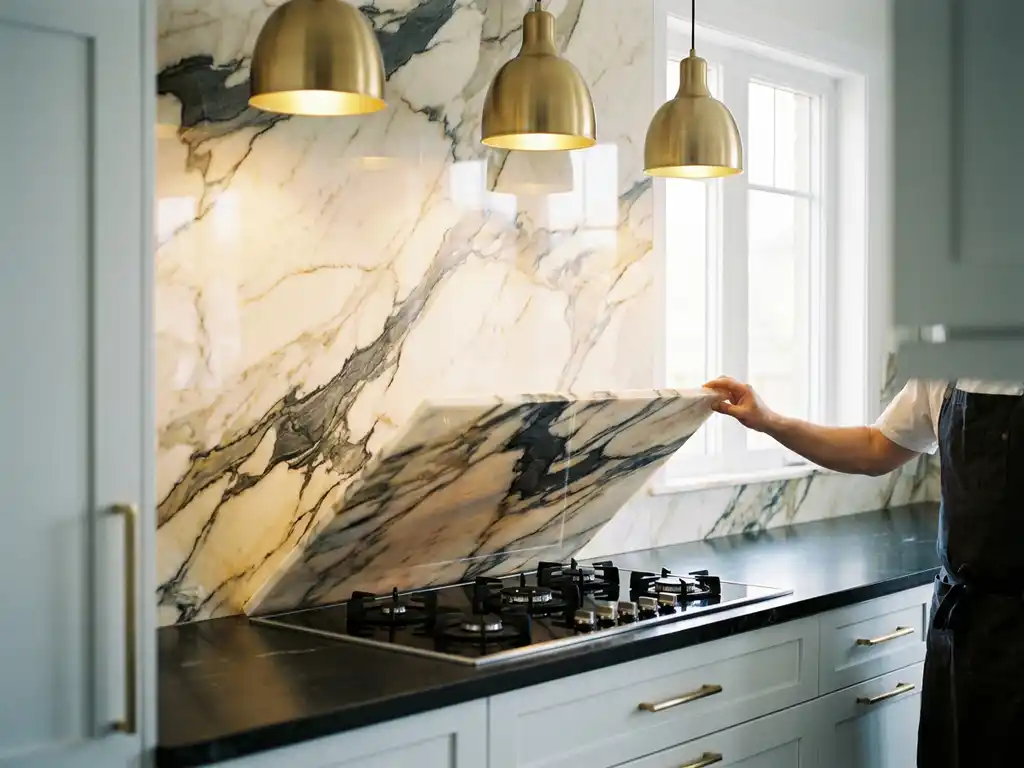
For high-quality kitchen backsplashes, UV printing and latex printing are used primarily today. Both methods deliver precise colors, high detail sharpness, and a surface that withstands the daily demands of the kitchen. Which method is better depends on the selected printing medium and the desired result. The following sections explain the key differences and help you make the right choice.
Which printing techniques are suitable for kitchen walls?
Three printing techniques are particularly suitable for kitchen backsplashes: UV printing, latex printing, and solvent-based solvent printing. All three methods work in large-format printing and produce prints that are color-accurate, detailed, and suitable for use in humid environments. The choice depends on the specific printing service provider and the printing medium used.
UV printing cures the ink immediately with UV light. The result is a highly resistant surface that is not affected by moisture or cleaning agents. Latex printing uses water-based inks that form a flexible, odor-free layer when dry. This makes latex particularly attractive for living spaces. Solvent printing is robust and inexpensive, but it requires good ventilation and is now less frequently used for indoor applications.
For kitchen backsplashes, UV and latex printing are the most reliable methods, as both can be applied without strong solvent odors and permanently adhere to self-adhesive films or other suitable carrier materials.
What is the difference between UV printing and latex printing for kitchen backsplashes?
The most significant difference lies in the ink technology and the flexibility of the printed result. UV printing produces a harder, scratch-resistant surface, while latex printing forms a more elastic layer that is better suited for materials that are stretched or laid around corners. Both methods provide comparable results for kitchen backsplashes on smooth surfaces.
UV printing: advantages and limitations
UV printing cures immediately and is therefore highly abrasion-resistant. The colors are intense and highly contrasting. This method is well suited for printing media that are applied to rigid or semi-rigid substrates. A possible disadvantage: On very flexible materials, the cured ink layer may crack under heavy bending.
Latex printing: Advantages and limitations
Latex inks are water-soluble and odor-neutral after drying. This makes them ideal for indoor applications such as kitchens or bathrooms. The surface remains slightly flexible after printing, which makes processing easier. Latex prints are also resistant to moisture and many household cleaners. The color range is somewhat narrower than with UV printing, but is perfectly sufficient for realistic motifs and photo prints.
Which printing medium is best suited for a printed kitchen backsplash?
Self-adhesive films with a smooth or slightly textured surface are best suited for printed kitchen backsplashes. These materials can be applied directly to tiles, glass, or smooth walls without the need for drilling or adhesive. It is important to choose a film with sufficient moisture resistance and a surface that is easy to wipe clean.
Two material types are particularly suitable for the kitchen backsplash:
- Self-adhesive polymer films: Robust, moisture-resistant, and suitable for latex and UV printing. It adheres reliably to smooth surfaces and can be removed without leaving any residue with careful handling.
- Self-adhesive vinyl films: A little cheaper, also moisture-resistant and available in various surface structures. Well suited for solvent and UV printing.
The material and the coating of the film are crucial for its durability. Laminating the film after printing protects the ink from oil splashes, cleaning agents, and mechanical stress.
How long-lasting are printed kitchen backsplashes made from digital printing media?
A printed kitchen backsplash made from high-quality digital printing media lasts for several years with proper handling and care. With a protective laminate, shelf lives of five years and more are realistic, provided the film is applied to a clean, smooth surface and no significant mechanical stress occurs.
The lifespan depends on several factors:
- Quality of the printing medium: High-quality films with UV-stabilized inks fade significantly more slowly than cheaper alternatives.
- Lamination: A protective layer of matte or glossy laminate significantly extends the shelf life and makes cleaning easier.
- Substrate preparation: Fat-free, smooth, and dry substrates ensure better adhesion and prevent the film from tearing at the edges.
- Cleaning: Mild cleaning agents and soft cloths protect the surface. Detergents or steam cleaners can damage the film.
Is it possible to remove a kitchen backsplash without leaving any residue?
Yes, self-adhesive film for kitchen walls can usually be removed without leaving any residue if it was designed for this purpose and adheres to a suitable surface. This makes it particularly attractive for rental properties where structural changes are not permitted.
To ensure that the removal is truly completely, you should bear the following points in mind:
- Use only films that are labeled as removable or repositionable.
- Remove the film slowly and at a slight angle, ideally at a slightly elevated room temperature.
- Avoid films with very aggressive adhesive on sensitive surfaces such as freshly painted walls or natural stone.
- Before installation, check at an inconspicuous location to see if the substrate can withstand the film.
High-quality digital printing films with specially formulated adhesives leave no residue on smooth tiles, glass, or painted surfaces. The results may vary on porous or uneven surfaces.
What color quality does digital printing provide for kitchen backsplashes?
Modern digital printing delivers a very high color quality for kitchen backsplashes with precise detail reproduction, photorealistic motifs, and consistent color gradients. The resolution ranges between 720 and 1440 dpi, depending on the printing system, which is perfectly sufficient for viewing distances of approximately 30 centimeters.
Color quality depends on several factors. First, the quality of the print file plays an important role: High-resolution CMYK files provide better results than low-resolution RGB files. Second, the printing medium significantly affects color rendering. Glossy sheets make colors appear brighter, matte surfaces reduce reflections and appear more high-quality in perception. Third, a calibrated print process with ICC profiles ensures that the printed colors match the image displayed on the screen.
For kitchen backsplashes with photo motives, stone patterns or abstract patterns, digital printing is the preferred method because it reproduces individual motifs in any size without losing quality.
Kitchen backsplashes with com2C: print media that work in practice
We develop and produce printing media that print service providers and signage professionals use for exactly such applications. Our self-adhesive films for Kitchen backsplashes are tailored to the requirements of everyday life: moisture-resistant, with precise color reproduction and formulated so that they can be removed without leaving any residue after use.
What we specifically offer:
- Self-adhesive films compatible with latex, UV and solvent printing systems from leading manufacturers
- Materials with removable adhesives suitable for rental housing and temporary installations
- Our own inkjet coatings from our chemical laboratory for optimal ink absorption and color brilliance
- Technical advice when a standard material does not fit and an individual solution is required – for example, a self-adhesive wallpaper without PVC
- Quick availability and short decision-making times, because we manufacture the products ourselves
If you would like to know which material is best suited for your specific project, please contact us. A brief Consultation This is often enough to find the right film.