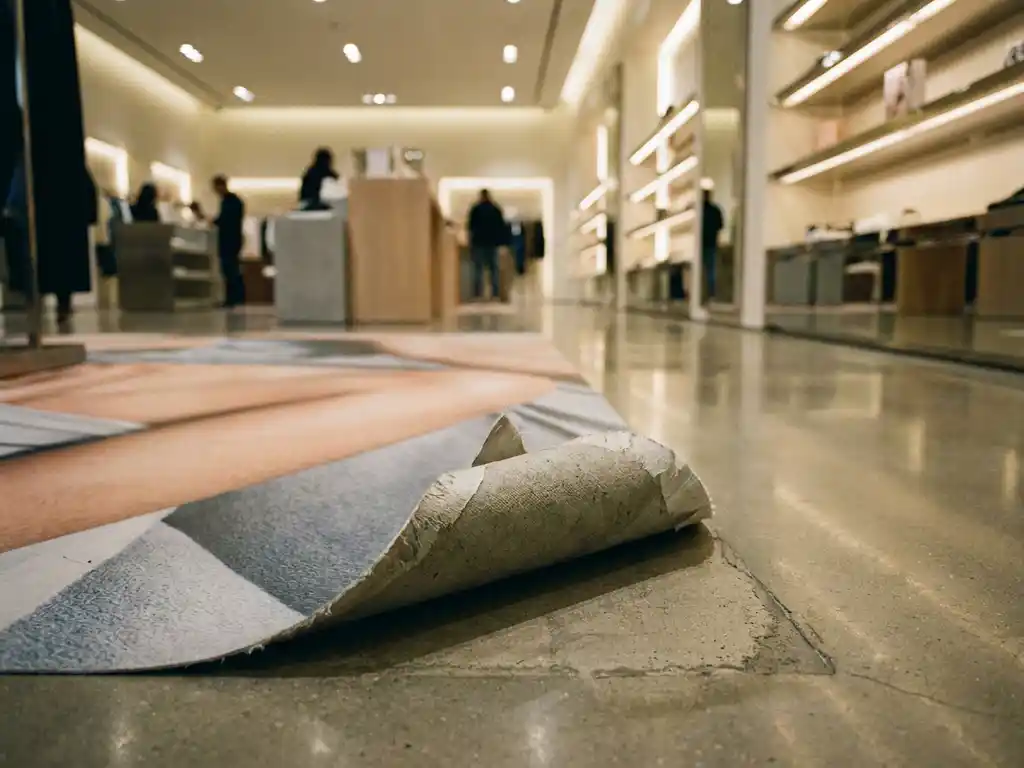
A floor mat peels off because the substrate was not adequately prepared, the mat is mechanically stressed at the edges, or the adhesive layer does not cope with the local conditions. In most cases, the problem is not the mat itself, but the combination of substrate, processing, and environmental conditions. The following questions clarify the most common causes and show what you can do specifically to address them.
Which substrates are unsuitable for floor films?
Floor films do not adhere reliably to porous, loose, highly textured or wet surfaces. Old tile floors with a rough surface, unsealed concrete floors, damaged or peeling coatings, and surfaces with remnants of wax, oil, or cleaning agents are particularly problematic. Adhesive film cannot form a stable bond on these surfaces.
Even carpets, cork, and wood planks with strong grain patterns or movement are generally unsuitable for self-adhesive floor films. Wood reacts to humidity and temperature, which means that the substrate expands and contracts. This movement directly transfers to the film and eventually breaks the adhesive bond over time.
Smooth, clean, and solid surfaces such as polished stone, engineered stone, or well-sealed floors provide the best conditions. The more uniform and stable the substrate, the longer the film will last.
How does the underground preparation affect the adhesion of the film?
Underground preparation is the most important step for a permanently adhesive floor film. Even a high-quality film with a strong adhesive layer fails if the substrate is oily, dusty, or wet. Dirt and residues prevent direct contact between the adhesive and the floor and significantly reduce the adhesive strength.
Before assembly, the substrate should be thoroughly cleaned, ideally with a degreaser. Then the surface must be completely dry. Even slight residual moisture is sufficient to impair adhesion. In the case of porous substrates, a primer can be useful, sealing the surface and creating a smooth base.
Unevenness of more than two millimeters should be compensated for before gluing. Small elevations or depressions create stress points in the film, which in the long run result in bubbles or separations. Careful preparation takes time, but prevents the film from causing problems after just a few weeks.
Why do floor coverings peel off especially at the edges?
The edges of a floor film first peel off because they are subjected to the greatest mechanical stress and at the same time have the least adhesive surface. Every time someone walks over the edge or an object is pulled over it, a shearing force is created that stresses the adhesive bond at that point. If the edge is not properly bonded or easily lifted, the peeling begins there.
A common mistake when installing the film is not pressing it firmly to the edge. Air inclusions directly at the edge result in the film not having any contact with the substrate there. Even slight forces are enough to initiate the detachment.
To prevent this, the edges should be firmly pressed in place after installation with a pressure tool or a spatula. In areas that are subject to heavy use, such as near doors or in passageways, a transparent edge sealant can be applied in addition to fix the film at the edge and prevent the ingress of moisture.
What role do temperature and humidity play in adhesion?
Temperature and humidity directly affect the adhesion of a floor film because adhesive layers based on acrylate or other polymers react temperature-dependently. At too low temperatures, the adhesive hardens and cannot form a sufficient bond with the substrate. At too high temperatures, it can become soft and the film begins to move.
Most self-adhesive floor films should be applied at temperatures between 15 and 25 degrees Celsius. Below 10 degrees, reliable adhesion is hardly possible. This applies both to room temperature and the temperature of the substrate itself, which can vary with underfloor heating systems.
High humidity is also problematic. In rooms with permanently elevated humidity, for example in bathrooms without adequate ventilation, moisture can get under the film and weaken the adhesive bond. Anyone who wants to install a floor film in such areas should be careful to choose products that are specifically designed for humid environments and ensure proper room ventilation.
How do you recognize a high-quality floor film?
A high-quality floor mat is recognized by its thickness, slip resistance, quality of the adhesive layer, and the durability of the surface. Thin films under 150 micrometres are generally not suitable for heavily used areas in the home, as they tear more easily and peel off more quickly. Sufficient thickness also ensures that the film remains stable in shape during installation.
Adhesive layer and carrier material
The adhesive layer should be applied evenly and suitable for the respective substrate. High-quality floor films use adhesives that remain stable even under temperature fluctuations and can be removed without leaving any residue. The carrier material itself should be dimensionally stable, meaning that it does not shrink or deform under heat.
Surface protection and anti-slip properties
The surface of a floor film must be abrasion-resistant and easy to maintain. Look for a protective coating that seals the printing inks and protects the film from scratches and moisture. For public areas or highly frequented areas, slip resistance according to DIN EN 13893 or similar standards is an important quality feature that serious manufacturers indicate in their technical data sheets.
What to do if the ground sheet is already peeling off?
If a ground sheet has already detached, the further course of action depends on how far the detachment has progressed. Small detachments at the edges can often be repaired if the underlying substrate is clean and dry. Large-scale detachments or bubbles in the middle of the sheet are more difficult to repair and often require a complete replacement.
Repair of minor detachments
For small detached edges, you can carefully lift the film, clean the underlying surface and let it dry. Then the film can be re-fixed with a suitable contact adhesive or double-sided adhesive tape for floor coverings. After that, press the edge firmly and allow it to dry for a few hours so that the adhesive can set.
Blisters and large-area detachments
Bubbles usually result from trapped air or moisture under the film. Small air bubbles can sometimes be punctured with a fine needle and then pressed out. However, moisture bubbles do not disappear permanently as long as the source of the moisture is not resolved. In this case, you should remove the film completely, allow the substrate to dry, and clear up the source of the moisture before applying a new film.
Floor coverings for living rooms: What com2C has in store for you
If you are looking for self-adhesive floor film that adheres reliably, installs cleanly, and looks great, you need a material that has been developed specifically for these requirements. We at com2C Support printing service providers and advertising technicians in creating custom-made floor films that will also function permanently in demanding living environments.
- Floor films with a tested adhesive layer for smooth and textured surfaces
- Materials that can be removed without leaving any residue, without damaging the underlying surface
- Compatibility with common large-format printers for precise, color-accurate results
- Technical advice on the correct choice of material, depending on the underlying ground and the intended use
- Also available in smaller quantities for individual residential projects
If you are unsure which material is best suited for your specific application, we are happy to help you. Simply contact us. Contact and tell us about your project.