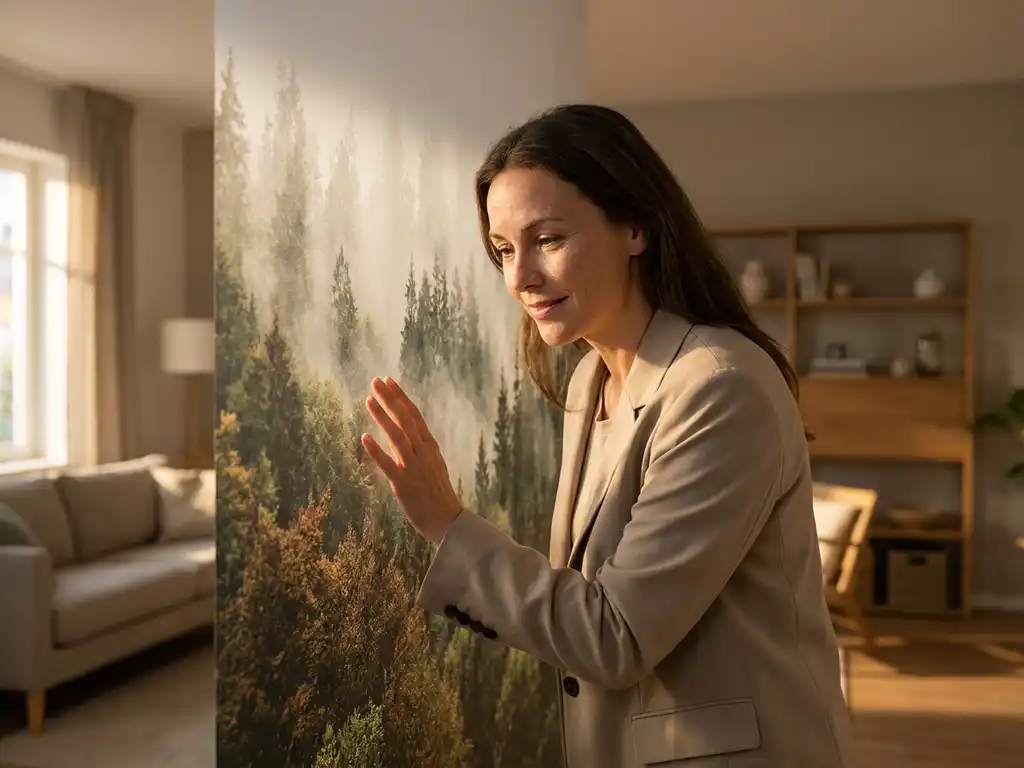
For a photorealistic wall film, you generally need a print resolution of 720 to 1440 DPI, depending on the viewing distance. At normal living space distances of one to two meters, 720 DPI is sufficient for a convincing result. The deciding factor is not just the resolution, but the interplay between the print file, the printing process, and the film material. This article answers the most important questions regarding print quality, resolution, and material selection for wall films.
How much DPI does a wall film really need?
For a wall film with a photorealistic effect, 720 DPI is sufficient in most cases. For very small details or close-up applications at a viewing distance of less than one meter, 1440 DPI can be useful. For large-scale wall designs viewed from a distance of two meters or more, 360 to 720 DPI already deliver a sharp, natural image.
The reason for this lies in human vision: beyond a certain distance, the eye can no longer distinguish individual print dots. A wall vinyl with 1440 DPI does not look better from a distance of one meter than one with 720 DPI if the print file itself only has a resolution of 150 PPI. The printer's specification in DPI describes the output resolution of the device, not the quality of the source file.
As a rule of thumb: the larger the format and the greater the viewing distance, the lower the print resolution can be without the image quality suffering. A 150 x 100 cm wall film for a living room requires different parameters than a small-format kitchen backsplash sticker.
What influences the image quality of wall films besides DPI?
The image quality of a printed wall film depends on several factors, not just the print resolution. The quality of the source file, color profiling, the printing process, and the surface texture of the film material all directly affect the final result.
Particularly important is the resolution of the image file itself, measured in PPI (pixels per inch). Even at a print resolution of 1440 DPI, a file with 72 PPI will appear pixelated because the printer simply lacks the image information to output it sharply. For wall films, an image file with at least 100 to 150 PPI at final size is recommended.
Other relevant factors are:
- Color profile: A correctly embedded ICC profile ensures that colors on the film appear exactly as planned on the screen. Without color management, color shifts occur that distort the image even at high resolution.
- Printing ink Solvent, latex, and UV inks behave differently on film. The ink must match the coating of the medium for colors to be vibrant and adhere durably.
- Surface texture of the film: Matte surfaces absorb light and appear softer, while glossy surfaces enhance contrasts and color depth. Both variants are suitable for photorealistic subjects, depending on the desired effect.
- Printer profile and calibration: An uncalibrated printer produces uneven color densities that make the image look washed out or have a color cast.
Which printing method is best suited for photorealistic wall films?
For photorealistic wall murals, latex and UV printing are best suited. Both methods deliver high color density, great detail sharpness, and durable results on self-adhesive films. Latex printing has the advantage of being odorless and safe for indoor spaces. UV printing scores points with particularly high color fidelity and scratch resistance.
Solvent printing is also widespread and delivers vibrant colors, but requires a degassing period after printing before the film can be processed indoors. For living spaces, latex printing is therefore the preferred choice because no volatile organic compounds are produced.
Water-based inkjet printing is less suitable for wall films because the inks often do not achieve the necessary adhesion and color fastness on coated films. Anyone who produces or commissions a digital printing film for walls should specifically ask for latex or UV printing and choose the film material accordingly.
How must the print file for wall film be prepared?
A print file for wall film should be created in the CMYK color space, contain an embedded ICC profile, and have a resolution of at least 100 PPI at final size. File formats such as PDF/X-4 or TIFF are suitable for large-format printing. Bleed margins of at least 5 mm on all sides are standard for wall films.
Specifically, this means for file preparation:
- Color space Always work in CMYK, not RGB. RGB files are automatically converted during printing, which can lead to unexpected color shifts.
- Resolution: At least 100 PPI at the output size. For a subject printed at 150 x 100 cm, this corresponds to a pixel dimension of approximately 5906 x 3937 pixels.
- Bleed 5 mm bleed on all sides to prevent white borders during trimming.
- Fonts and Vectors: Convert text to outlines, embed vector graphics or include them as a separate layer.
- Black levels: For rich blacks in large format printing, a composite black (e.g., C60 M40 Y40 K100) is recommended rather than pure K100.
Anyone exporting the file from a graphics program such as Adobe Illustrator or Photoshop should request the print production specifications from the respective print service provider in advance, as color profiles and bleed settings can vary.
What role does the print medium play in the final result?
The print medium, meaning the film itself, significantly influences the final result of a wall decal. A high-quality coated film absorbs ink evenly, reproduces colors precisely, and prevents bleeding or color deviations. Inferior films without a suitable inkjet coating produce a dull, patchy, or washed-out result even with a perfect print file.
For self-adhesive wall films, there are various material types that differ in feel, appearance, and application:
- Glossy film Vibrant colors, high contrast, ideal for photorealistic subjects with deep black and saturation levels.
- Matte film: Reflective arm, looks higher quality in bright rooms, slightly softer color rendering.
- Structured surfaces: Linen- or stone-effect films give the design a tactile dimension, but slightly reduce the sharpness of detail.
- PVC-free alternatives: Particularly relevant for interiors and rental apartments, as they do not release plasticizers and can be removed without leaving any residue.
The coating of the film must also be compatible with the ink system used. A film that is optimized for latex ink may yield poorer results on a UV printer. Print service providers should therefore always check whether the selected medium is approved for their printing system.
How do you recognize a truly photorealistic wall decal?
A photorealistic wall mural can be recognized by its uniform color density without banding, sharp contours without bleeding, natural color reproduction across the entire tonal range, and a surface free of bubbles or coating defects. From a normal viewing distance, the motif looks like a high-quality photo or professional illustration.
Concrete quality features at a glance:
- No banding: No visible horizontal or vertical streaks indicating an uncalibrated printer or clogged nozzles.
- Sharp edges: Fine lines and text details are clearly defined, not frayed or blurred.
- Color depth: Dark tones appear rich, light tones remain differentiated and do not get lost in the white.
- Even surface: No ink buildup, streaks, or smudges on the film.
- Color fastness: The motif corresponds to what was planned on the screen, without strong color shifts toward yellow, red, or greenish.
A simple practical test: Hold the finished film under various light sources, both daylight and artificial light. High-quality wall films show stable, natural colors under both conditions. Significant color shifts depending on the light source indicate an issue with the color profile or ink quality.
Photorealistic wall films with com2C: print media that ensure the result
We know from our daily work with print service providers and sign makers that film material is often the underestimated factor when a print does not deliver the desired result. That is why we develop and produce our print media with our own inkjet coating, which is tailored to the most common ink systems.
What we offer for photorealistic wall films:
- Self-adhesive films with precise inkjet coating for latex, solvent and UV printing
- PVC-free materials from our GoGreener line, removable without leaving residue and suitable for rented apartments
- Compatibility with leading large-format printers from HP, Epson, Roland, Mimaki, and other manufacturers
- Technical advice on material selection so that the printing process and film truly match
- Quick availability and short delivery routes from our location in Porta Westfalica
Our com2C interior design range includes materials specifically developed for wall and interior design applications, with a focus on color quality, ease of processing, and durability indoors. If you are unsure which material best suits your printing system and application, please contact us. A brief Consultation often helps to find the right path faster.