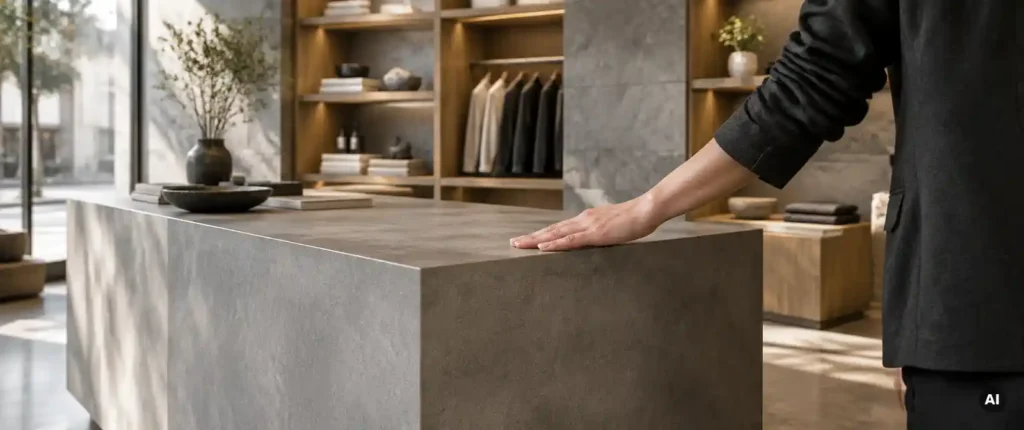
The choice of materials in store concepts directly influences how customers perceive a brand. High-quality print media convey a commitment to quality, brand values, and atmosphere, while inferior materials visually undermine even the strongest concept itself. For Concept Stores that sell aesthetics and experience, The right material choice is a central component of the brand strategy.
The following questions show what is really important when choosing materials for commercial construction.
Which materials are best suited for concept stores?
Self-adhesive films for shop windows and wall surfaces, floor coverings for wayfinding and staging, printable textiles for soft room elements, and vinyl wallpaper for large-scale themed walls are particularly suitable for Concept Stores. These materials can be quickly replaced, precisely printed, and adapted to changing collections.
Concept stores work through staging. This means that the materials not only need to look good, but also be flexible to use. Window displays allow for seasonal campaigns without permanently changing the glass surface. Floor coverings draw attention and guide traffic. Printed textiles create depth and warmth in the design of the space.
The quality of the printing is crucial here. Colors must be exactly matched under lighting conditions, edges must appear clean, and surfaces must remain scratch-resistant. Materials that quickly fade or peel off under everyday conditions directly damage the overall impression.
- Shop window films: Perforated or transparent, suitable for alternating campaigns
- Floor coverings: Non-slip, durable, easy to print
- Non-woven wallpapers: For large-area wall designs with high detail sharpness
- Printable textiles: For displays, room dividers and decorative elements
- POS materials: For price tags, product presentations and promotional areas
How does the quality of the materials influence the perception of a brand in the store?
Material quality influences brand perception in the store because customers not only see surfaces but also touch them, enter them and view them from a close distance. A poorly printed banner, a flimsy foil or faded floor covering signal negligence, regardless of how strong the brand concept behind it is.
In retail, seconds matter. Customers form an unconscious judgment about a brand before taking a product in their hands. High-quality print media with precise colors, sharp edges, and stable surfaces convey care and reliability. Cheap materials that show signs of wear after a short time do the opposite.
Consistency is particularly important. When wall design, floor coverings, and shop window film match in color tone and print quality, a harmonious overall image is created. Deviations, even minor ones, detract from this impression and appear unprofessional.
What are the most common mistakes when choosing materials in commercial construction?
The most common mistakes when choosing materials in shopfitting are: selecting materials solely based on price, ignoring application conditions, ignoring compatibility with the printing system, and not planning replacement intervals. These errors lead to quality problems that directly affect the brand image.
Many store owners underestimate how strongly environmental factors influence material selection. Floor films in areas with high pedestrian traffic need a different specification than wall films in quiet areas. Shop window films are exposed to UV radiation and temperature fluctuations, which not every material can withstand permanently.
Another common mistake is the lack of alignment between the printing medium and the ink system. Not every film works with every printer. Anyone who fails to check this risks color deviations, poor adhesion, or premature wear of the material.
- Select materials without regard to load and location
- Not tested for compatibility with the pressure system used
- No planning for seasonal material changes
- Refuse advice and decide solely on the list price
- Not include sustainability and environmental compatibility in the selection process
What role do environmentally friendly print media play in modern retail?
Environmentally friendly print media play an increasingly important role in modern retail, as customers are increasingly paying attention to the material selection of their shopping locations. PVC-free films, solvent-free coatings, and recyclable materials not only reduce the ecological footprint but also strengthen a brand’s credibility.
For concept stores that often appeal to a conscious consumer mindset, choosing sustainable print media is not an optional addition, but part of the brand message. Anyone who communicates sustainability in the store but uses PVC materials with solvent-based coatings creates a contradiction that critical customers perceive.
Technically, PVC-free alternatives have developed significantly in recent years. Today, they achieve comparable printing results in many applications as conventional materials, but are easier to dispose of and cause less pollution of the indoor air. This is a concrete advantage for indoor spaces where customers and employees spend time daily.
How often should store owners replace their print materials?
Store owners should check their print materials at least seasonally, that is, every three to four months, and replace them if necessary. Window displays and POS materials for campaigns change more frequently, while wall graphics and floor coverings can last one to two years depending on the load.
The replacement cycle depends on several factors: material quality, location, exposure to light and customer contact, as well as the timeliness of the brand message. A floor covering in the entrance area of a well-visited store shows more signs of wear and tear more quickly than a wall mural in a quiet area.
It is important not to wait until materials are visibly damaged. Discolored colors or easily peeling edges are noticed by customers before they become visible as obvious damage. Therefore, a regular material check is advisable, even if no immediate campaign changes are planned.
What should one consider when choosing a print media provider?
When choosing a print media supplier, store owners should look for technical consulting expertise, material variety, delivery reliability, and the ability to accommodate specific requirements. A supplier that offers only standard products from the catalog will quickly reach its limits when dealing with complex projects.
Especially in the retail sector, the requirements are rarely identical. Different printing systems, special room conditions or specific design specifications require suppliers who think ahead and, if necessary, develop individual solutions. Those who only look for the cheapest offer often forgo this very specific expertise.
Reliability is another important factor. If materials for a campaign do not arrive in time or the quality fluctuates, costs and delays arise that quickly offset the price advantage. A good supplier not only delivers the product, but also provides planning certainty.
- Technical advice before and after purchase
- Compatibility of materials with the own printing system
- Availability even for short-term needs
- Experience with specific application areas in retail
- Ability to adapt to individual requirements
How com2C Concept Stores supports itself with the right print media
We know that Concept Stores do not need standard solutions. Each store concept has its own design requirements, different printing systems in use, and different turnaround times. That is exactly why we do not work as a pure product supplier, but as a partner that coordinates technical and design requirements.
- We offer a wide range of products Digital printing media for shopfitting, Including window film, floor coverings, vinyl wallpaper and POS materials for changing campaigns
- Our materials are compatible with all common printing systems, from solvent to latex to UV.
- We advise you specifically on material selection, application conditions and replacement intervals, not just the product itself.
- With our GoGreener line, we offer PVC-free alternatives that are technically convincing and fit into your store's sustainability strategy.
- Short decision-making processes mean for us: fast availability, even if a project comes in at short notice.
If you are facing a specific material decision or planning a project where standard solutions do not fit, please contact us. Consultation helps to find the right solution quickly.