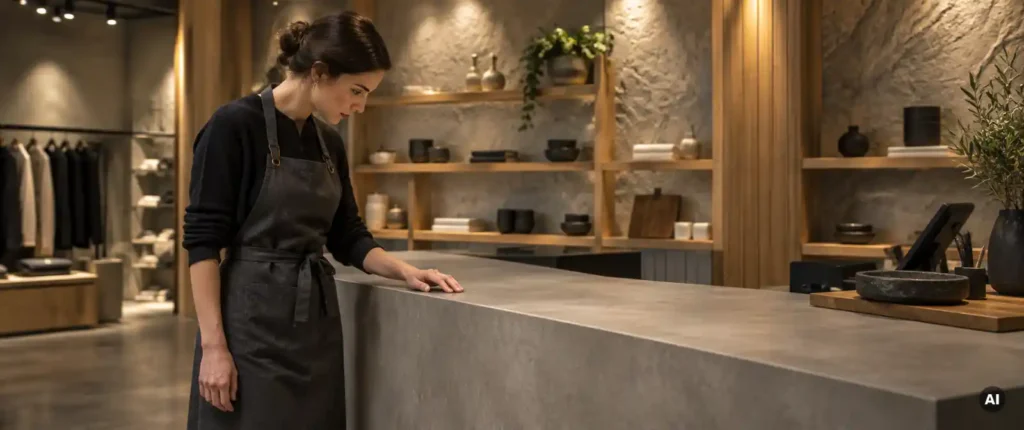
Creating a concept store that truly attracts customers is achieved through a consistent interplay of visual identity, flexible printing materials, and clear spatial dramaturgy. The store must communicate the brand’s values at first glance before a customer even crosses the threshold. The following questions highlight what is specifically important in concept store design.
What makes a concept store visually distinctive?
A concept store is visually distinctive when every design element, from the shopfront to the floor, creates a uniform visual language that is immediately associated with the brand. It is not the sum of individual decoration elements that makes the difference, but the consistency with which colors, materials, and typography are maintained throughout the space.
Concept stores differ from traditional store concepts in that they embody a mindset, not just present products. This means that wall designs, floor coverings, and POS materials are not decoration but part of the brand communication. Those who rely on standard solutions here lose precisely the independence that makes a concept store unique.
Large-format wall motifs that convey moods are particularly effective, as are floor coverings that simultaneously create a sense of direction and atmosphere. Retail design does not begin with furniture but with the space itself.
Which printing materials are suitable for Concept Store design?
Self-adhesive films, vinyl wallpaper, floor films and shop window films are particularly suitable for the design of concept stores because they create a large-scale visual effect, can be flexibly repositioned and work on a wide variety of surfaces. The choice of material depends on the substrate, the duration of use and the desired appearance.
In particular, the following materials are available:
- Self-adhesive films for shop windows, walls and furniture surfaces: easily removable without residue, ideal for seasonal campaigns
- Vinyl wallpaper for large-format wall designs: high-quality print image, easy to handle, also suitable for temporary installations
- Floor films with anti-slip surface: for path guidance, themed areas and action areas
- Backlit films for backlit displays and light boxes: ensure attention even in poor lighting conditions
- Textile prints for hanging displays and dividers: lightweight, portable and reusable
When selecting materials, it is important to ensure compatibility with the printing system used. Materials designed for solvent, latex or UV printing yield different results. By relying on proven printing media in these cases, you save time in production and avoid complaints.
How often should a concept store change its design?
A concept store should change its design at least four times a year, i.e., seasonally, to keep regular customers coming back for new experiences and to stay visible with current collections or campaigns. Stores with high footfall benefit from even shorter cycles, about six to eight weeks.
The rhythm depends on the business model. Stores that carry curated collections are guided by the seasons in the fashion industry. Stores with a strong event character change more frequently to always create an occasion for a repeat visit.
To keep frequent replacements economical, materials need to be used that can be produced quickly and easily assembled. Self-adhesive films and modular printing systems are clearly an advantage over complex assembly components. By incorporating design changes from the outset into the planning process, you can save significantly in time and costs in the long run.
How can you design shop windows that really stop passers-by?
Shop windows catch passers-by’s attention if they make a clear visual statement within two to three seconds, arouse curiosity and create a contrast to the surroundings. Overloaded windows with too much information are overlooked; clear imagery with a strong motif remains unappealing.
Visual hierarchy in the shop window
Every shop window needs a dominant element that captures attention first. This can be a large-format print, a color accent, or an unusual material texture. Everything else is arranged under this main element. Anyone who tries to communicate products, prices, and brand message simultaneously loses the viewer.
Shop window films as a flexible means of design
Shop window film allows glass surfaces to be transformed into communication spaces without completely blocking the view. Perforated films allow light to pass through from the inside, but appear as full-surface printing from the outside. Seasonal motifs can be quickly changed without requiring any structural modifications. This makes shop window film one of the most flexible tools in window design.
What mistakes destroy the effect of a concept store?
The most common mistakes that destroy the effect of a concept store are visual inconsistencies, a lack of care for the design elements, and the use of standard materials that do not match the brand identity. A store that promises exclusivity on the outside but works with worn-out or generic printing materials on the inside immediately loses credibility.
Specific errors in summary:
- Too many messages at once: Placing information on every surface creates confusion instead of orientation.
- Poor print quality: Pixelated motifs or faded colors signal a lack of care
- Lack of care: Peeling off foils or damaged floor coverings look unprofessional and damage the brand image
- Inconsistent materials: If the shop windows, walls and floor do not match visually, the store lacks a cohesive design.
- Neglected soil: The floor is one of the largest areas in the store and is often underestimated in terms of design.
Many of these errors do not arise from a lack of design intent, but because materials are used that are not suitable for the specific application. A material designed for short-term use cannot withstand sustained use.
What sustainability requirements apply to printed materials in retail?
In retail, there are increasingly specific requirements regarding the environmental compatibility of printing materials: PVC-free materials, solvent-free production processes, and recyclable substrates are gaining in importance, both for regulatory reasons and because customers and brands are increasingly placing value on sustainable design.
For Concept Stores that represent an environmentally conscious brand profile, the choice of materials is part of the brand communication. PVC-free films and vinyl wallpaper based on renewable raw materials are today technically advanced alternatives to traditional materials and deliver comparable print results.
Relevant criteria for material selection:
- PVC-free composition for films and banner media
- Certifications such as Oeko-Tex or FSC for textile and paper substrates
- Solvent-free or water-based ink compatibility
- Recyclability or compostable material options for short-lived applications
Sustainability in retail design does not mean sacrificing quality or glare. It means choosing materials that function technically while also meeting your own standards of responsibility towards the environment.
Concept Store Design with com2C: Printing materials that really work
We know that Concept Stores don’t need standard solutions. They need materials that fit the brand, are quickly produced, and work reliably with every change. That’s exactly our approach.
Our Interior Film Collection by com2C offers printing media specially developed for demanding retail and interior applications, ranging from self-adhesive films for shop windows and walls to floor films and vinyl wallpaper for large-format wall designs. All materials are compatible with common large-format printers and are designed for solvent, latex and UV systems.
What we specifically do for Concept Stores:
- Print media for shop window films, wall designs, floor coverings and POS materials from a single source
- PVC-free alternatives from our GoGreener line for stores with a commitment to sustainability
- Quick availability and short delivery times to ensure that seasonal campaigns can be implemented on time
- Technical advice that goes beyond pure material sales, also for complex substrates or unusual applications
- In-house production with a chemical laboratory for inkjet coatings, which means quality control and adaptability that standard suppliers do not offer
If you are planning a project or have specific questions about material selection, please contact us. contact us It is worth it, especially if standard materials have not yet delivered what you needed.