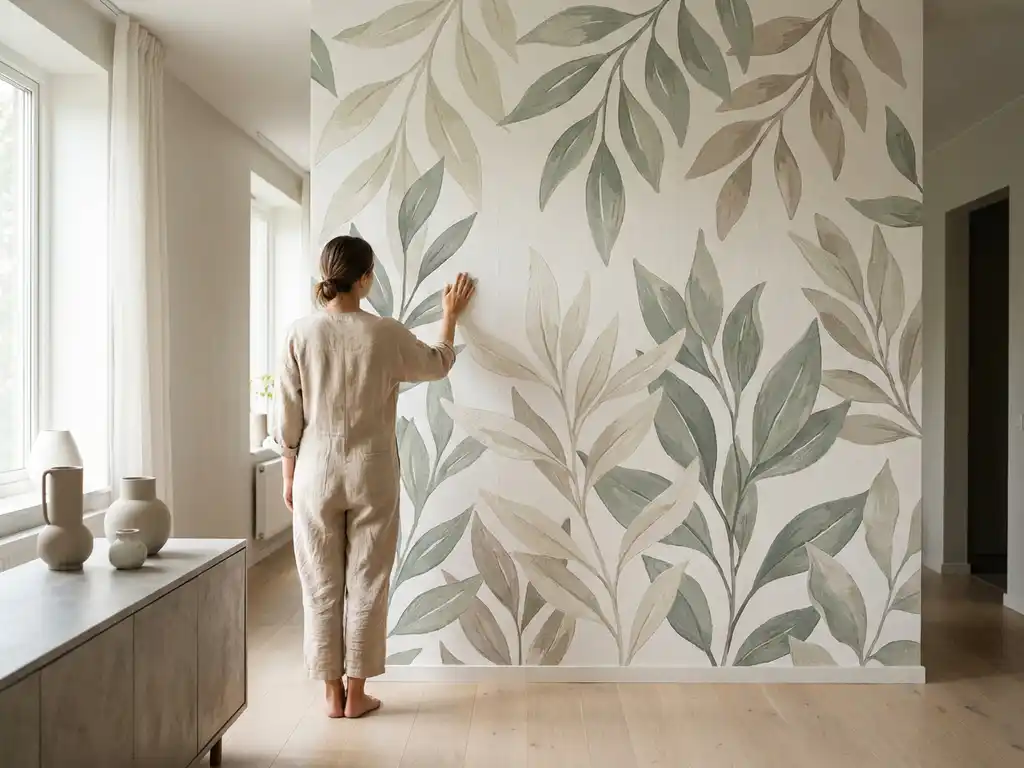
Wallpapers that can be directly pasted onto the wall are self-adhesive wallpapers with an integrated adhesive layer on the back. They do not require any additional adhesive and can be installed without tools or specialist knowledge. They are particularly practical for rental properties, as there are many variants available. removable without leaving residue They are. The following questions clarify everything important regarding selection, processing, and removal.
Which wallpaper can be processed without adhesive?
Self-adhesive wallpaper can be applied directly to the wall without adhesive. They have a pre-applied adhesive layer on the back that is activated by peeling off a protective film. These include self-adhesive vinyl wallpaper, printed adhesive films, and so-called peel-and-stick wallpaper from the decorative category.
The essential difference to traditional wallpaper lies in the processing process. While conventional wallpaper must be soaked or coated with glue, self-adhesive variants are simply applied dry. This saves time, prevents dirt from building up, and makes the process accessible even to beginners. Vliestapeten without self-adhesive functionality still require glue, which is applied directly to the wall, which simplifies the process but does not constitute a glue-free solution.
In digital large-format printing, self-adhesive foils and printable wallpaper materials are used to bring individual motifs to life on the wall in photo quality. These materials combine decorative design freedom with ease of handling.
What is the difference between self-adhesive film and self-adhesive wallpaper?
Self-adhesive films usually consist of PVC or PVC-free plastic substrates and are smoother, thinner, and more water-resistant. Self-adhesive wallpaper often rely on non-woven fabric or paper, have a softer surface, and mimic the appearance of classic wallpaper. The main difference lies in the material, the appearance, and the application area.
Films are particularly suitable for areas prone to moisture, such as the kitchen or bathroom, as they are wipeable and water-repellent. They can also be used on furniture, tiles, or glass. Self-adhesive wallpapers, on the other hand, have a more homely and textured appearance, but are generally less moisture-resistant.
Another difference lies in their printable properties. Both materials can be individually printed using digital printing; however, the requirements for ink and printer differ. Films are often printed with solvent, UV, or latex inks, while wallpaper materials based on nonwoven materials are often optimized for water-based ink systems.
Can you use self-adhesive wallpaper in rental apartments?
Yes, self-adhesive wallpaper is suitable for rental apartments, provided they can be removed without leaving any residue. High-quality products do not leave adhesive residue when removed and do not damage the underlying surface. This makes them the preferred solution for anyone who wants to customize their apartment without making structural changes.
It is important to check before installation that the substrate is suitable and that the wallpaper does not remain on the wall for too long. The longer a adhesive film or wallpaper remains on the wall, the more difficult it can be to remove, even with high-quality materials. Products that are explicitly labeled as being removable without residue are recommended for temporary installations.
Tenants should also ensure that the wall paint underneath is stable and not peeling off. On freshly painted walls, you should wait at least four weeks before applying self-adhesive wallpaper, so that the paint has fully cured.
On which surfaces do self-adhesive wallpapers adhere reliably?
Self-adhesive wallpaper adheres reliably to smooth, clean, and dry surfaces. These include smooth walls with dispersion paint, tiles, glass, painted surfaces, and wood. Rough plaster, highly textured surfaces, or porous substrates significantly reduce adhesion and should be avoided.
The surface must be free of grease and dust before applying the adhesive. Clean the surface with a mild detergent and allow it to dry completely. Even small amounts of grease or dust can cause the wallpaper to peel off or form bubbles.
Self-adhesive wallpaper usually does not adhere well to freshly painted walls, rough-textured wallpaper or highly absorbent surfaces. In such cases, primer or the application of a smooth intermediate layer helps. Some products are specially designed for textured surfaces and have a stronger adhesive layer.
How to apply self-adhesive wallpaper to the wall without bubbles?
Self-adhesive wallpaper is applied without bubbles by applying it gradually from the top down, smoothing it evenly from the center outwards with a spatula or a soft cloth. The protective film is removed piece by piece, not all at once.
The following steps help ensure a clean process:
- Clean the underlay and let it dry completely
- Align the wallpaper on the wall before removing the protective film
- Remove the protective film only in the upper area and first fix the wallpaper in place at the top.
- Work gradually downward and continuously smooth out the lines along the way
- Move the rake or straightener from the center outward to push out the air
- Insert a fine needle into the small bubbles after assembly and press down
For larger areas, it is advisable to work in pairs. One person holds the wallpaper in place while the other applies and smooths the adhesive. This prevents the material from unintentionally folding or sticking to itself.
How to remove self-adhesive wallpaper residue without leaving any marks?
Self-adhesive wallpaper is removed without leaving any residue by slowly and evenly pulling it off the wall at an angle of about 30 to 45 degrees. An angle of about 30 to 45 degrees prevents the adhesive layer from remaining on the wall. Heat from a hairdryer can facilitate the process in stubborn areas.
If adhesive residue still remains on the wall, the following methods can help:
- Treat residues with isopropyl alcohol or a special adhesive remover
- Wait for the effect to take effect and then rub it off with a soft cloth
- Do not use sharp blades that could damage the ground
The quality of the material plays an important role here. High-quality self-adhesive wallpaper and films are designed so that the adhesive layer remains completely on the material when removed and not on the wall. Cheap products, on the other hand, can leave residues or tear when removed, which makes removing them significantly more time-consuming.
If the wallpaper has been on the wall for a long time, the adhesive layer can harden due to temperature and time. In this case, it helps to heat the wallpaper evenly with a hairdryer before removing it, until the adhesive becomes soft again.
Self-adhesive wallpaper and films from com2C
At com2C, we develop and produce print media that serve as a basis for customized, individually printed wall designs for print service providers and advertising technology companies. Those who want to create self-adhesive wallpaper or film in photo quality can find materials that function reliably technically – even in a PVC-free version.
Our Wallpaper materials The GoGreener line offers a PVC-free alternative to conventional PVC products. They are optimized for water-based, latex, and UV ink systems and deliver precise color reproduction even for demanding motifs.
What we specifically offer:
- Self-adhesive and non-self-adhesive wallpaper materials based on non-woven fabric, PVC-free
- Materials compatible with HP, Epson, Roland, Mimaki and other large format printers
- Our own inkjet coatings from our chemical laboratory for stable adhesion and color quality
- Rapid product development for custom requirements, even in small print runs
- Technical advice from experienced experts who know your application
If you have any questions about suitable materials for your wall decoration projects, we are happy to help. contact us and find the right solution together.