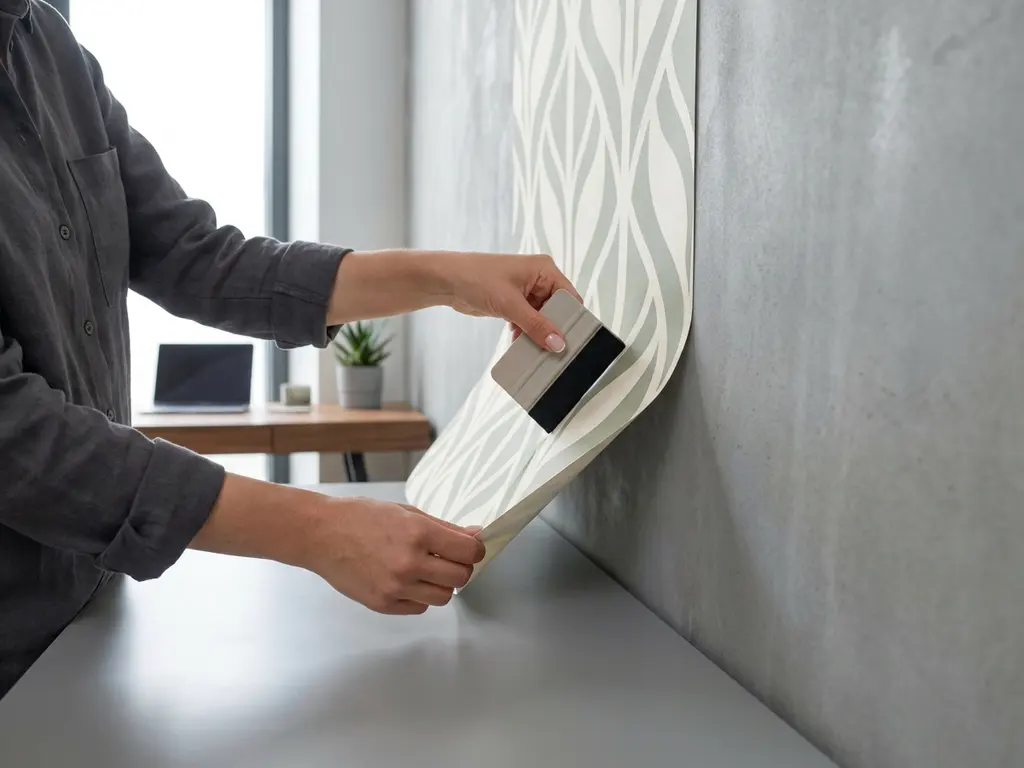
Yes, self-adhesive wallpapers can in most cases be removed again without leaving any residue. Whether this succeeds depends primarily on the adhesive used, the condition of the substrate, and the duration of adhesion. The following sections answer the most important questions regarding removability, substrate suitability, and damage-free removal.
What factors determine whether wallpaper can be removed without leaving residue?
Whether self-adhesive wallpaper can be removed without leaving residue depends on three central factors: the type of adhesive, the quality and condition of the surface, and the length of time the material has been adhered. High-quality products with removable adhesive are specifically designed to leave no residue.
The adhesive plays the most important role. Removable adhesives are formulated to develop sufficient bonding strength without permanently bonding to the substrate. Permanent adhesives, on the other hand, build up their bonding strength over time and can cause residue or even wall damage when removed.
The surface significantly influences the result. Smooth, non-porous surfaces such as painted walls, glass, or tiles allow for clean removal. Rough, porous, or sensitive surfaces such as unpainted plaster, woodchip wallpaper, or freshly painted walls significantly increase the risk of residue or chipping.
Also the Processing temperature and storage has an effect. Very high temperatures can cause the adhesive to soften and penetrate deeper into the substrate, making removal more difficult.
How long can peel-and-stick wallpapers adhere without leaving residue?
Self-adhesive wallpapers with removable adhesive can last between a few months and several years, depending on product quality and the substrate, without leaving residue. Most high-quality products are designed for a bonding duration of one to three years before removal becomes more difficult.
As the duration of adhesion increases, the risk that the adhesive hardens or chemically reacts with the substrate rises. This process accelerates particularly in rooms with strong sunlight or changing temperatures. UV light can alter the adhesive structure and make residue-free removal more difficult.
For temporary applications such as trade shows, events, or seasonal decorations where the wallpaper is only attached for a few weeks or months, the risk of residue is very low. For long-term installations, it is recommended to inspect the product regularly and, if necessary, replace it early before the adhesive hardens too much.
What is the difference between removable and permanent adhesive films?
Removable adhesive films use a lower-tack adhesive that can be cleanly peeled from the substrate after application without leaving residue. Permanent adhesive films are equipped with a high-performance adhesive that forms a strong, long-term bond with the substrate and is not designed for residue-free removal.
The difference lies in the adhesive formulation. Removable adhesives often use a micro-structured or pressure-sensitive technology that creates a controlled bonding strength. They hold reliably as long as the wallpaper stays on the wall, but can be completely removed again when peeled off.
Permanent adhesives continuously build up their bonding strength. They are intended for applications where the film is to remain permanently on the substrate, for example in vehicle graphics or long-term outdoor applications. Subsequent removal requires heat, solvents, or mechanical aids and often leaves residues.
For wall designs in rented apartments, offices, or exhibition spaces, removable products are the right choice. Permanent adhesive films are used where a long-term, resilient bond is required and removal is not planned.
How to remove self-adhesive wallpaper without wall damage?
The most gentle way to remove self-adhesive wallpaper is to peel it off slowly and at a shallow angle of about 30 to 45 degrees. Heat from a heat gun softens the adhesive and makes removal much easier, especially for products that have been adhered for a longer time.
The following procedure has proven effective in practice:
- Search for corner or edge: Start at a corner or seam where you can easily lift the wallpaper.
- Maintain flat angles: Peel the wallpaper off at a 30 to 45 degree angle to the wall, not vertically. This reduces the pulling force on the substrate.
- Pull slowly and evenly: Rapid tearing increases the risk of wall damage. Pull evenly and without jerky movements.
- Apply heat: For stubborn spots, a heat gun on a low setting helps. Briefly warm up the area before moving on.
- Remove residue: If any adhesive residue remains, remove it with a little isopropyl alcohol or a special adhesive remover. Test the product beforehand on an inconspicuous area.
Avoid removing wallpaper in the cold. Low temperatures make the adhesive brittle and increase the risk that parts of the substrate will come off with it.
Which surfaces are best suited for self-adhesive wallpaper?
Self-adhesive wallpapers adhere most reliably and can be removed most cleanly on smooth, clean, and non-porous surfaces. These include freshly painted walls with latex paint, glass, tiles, painted wood surfaces, and smooth plastic panels.
It is crucial that the surface is completely dry, free of grease, and free of dust. Even on suitable substrates, an insufficiently cleaned area can cause the wallpaper not to adhere evenly or to leave residue when removed.
The following substrates are less suitable:
- Woodchip wallpaper: The rough texture prevents even adhesion and makes residue-free removal difficult.
- Freshly painted walls: Paint that is less than four weeks old is not yet fully cured and can come off when removing the wallpaper.
- Porous plaster or unpainted masonry: The adhesive penetrates the pores and can hardly be removed without leaving a residue.
- Wallpapers with textured surfaces: Similar to woodchip wallpaper, textured surfaces do not provide a uniform bonding surface.
If you are unsure whether a surface is suitable, we recommend performing an adhesion test on an inconspicuous area. Apply a small piece of the wallpaper, wait a few days, and then check how easily it can be removed.
Self-adhesive wallpaper from com2C: PVC-free and residue-free removable
We develop self-adhesive wallpapers that work in practice. Our peel-and-stick wallpaper is PVC-free, features a removable adhesive and is specially optimized for professional large-format printing. For you, this means: reliable printing results, clean processing and removal without residue or wall damage.
What distinguishes our product in daily use:
- Removable adhesive: The material can be removed cleanly and without leaving any residue, even after a longer period of adhesion.
- PVC-free: A PVC-free alternative to conventional adhesive films, without compromising on quality or usability.
- Compatible with leading print systems: The wallpaper works reliably on latex, solvent, UV, and water-based printers from HP, Epson, Roland, Mimaki, and other manufacturers.
- Suitable for demanding surfaces: Designed for professional use in offices, showrooms, trade fairs, and retail spaces.
- Technical consulting included: We support you in choosing the right material for your specific substrate and application.
If you have any questions about our wallpaper or are planning a sample order, please feel free to contact us. Just take Contact.