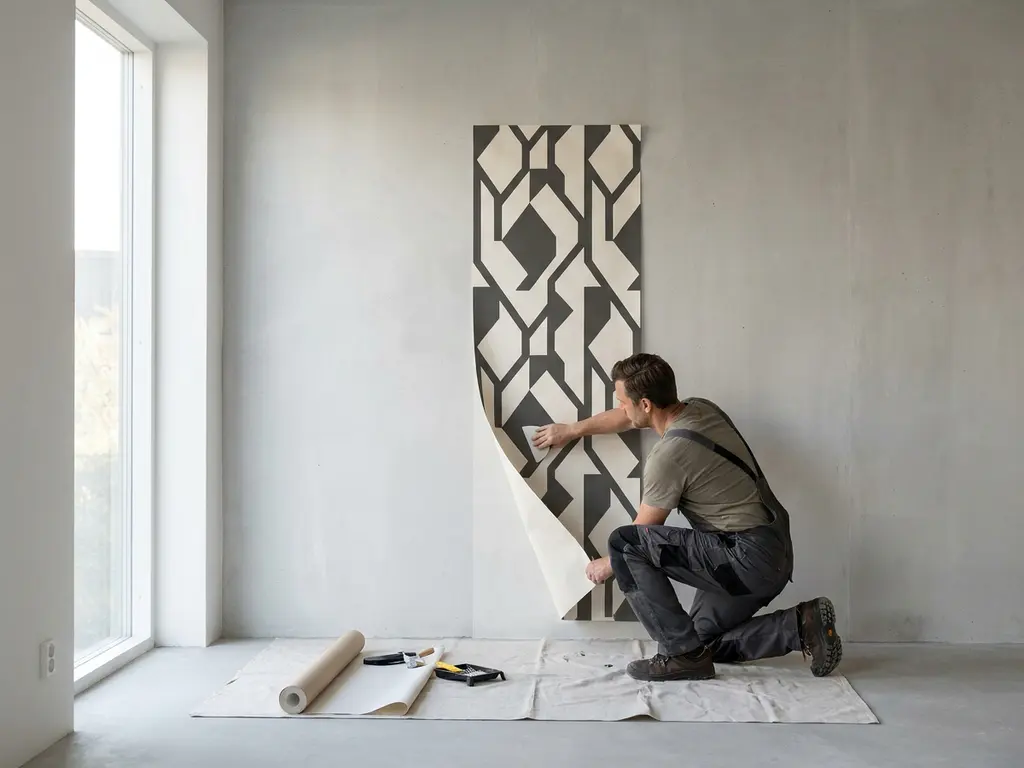
Self-adhesive wallpaper is applied by thoroughly cleaning and degreasing the wall, gradually sticking the wallpaper strip from top to bottom while smoothing out air bubbles evenly towards the outside with a squeegee. Application works best at room temperatures between 15 and 25 degrees Celsius. In this article, we answer the most frequently asked questions regarding preparation, application, and removal.
What wall preparation is necessary before installation?
Before applying self-adhesive wallpaper, the wall must be clean, dry, smooth, and free of grease. Dust, moisture, grease, or old paint residue prevent the adhesive layer from bonding permanently. Thorough wall preparation is the most important step for a durable result.
Start by wiping the wall with a damp cloth or a mild detergent, and then let it dry completely. Freshly painted walls should cure for at least four weeks before applying self-adhesive wallpaper. A primer is recommended on fresh plaster to reduce the absorbency of the surface.
You should repair unevenness, cracks, or peeling paint before application. Self-adhesive wallpaper follows the wall surface and makes unevenness visible instead of concealing it. The smoother the surface, the cleaner the result. Especially with textured wall surfaces like woodchip wallpaper liability may be limited. In such cases, it is worth smoothing the surface beforehand or using a suitable adhesive.
How to apply peel-and-stick wallpaper without air bubbles?
Self-adhesive wallpaper is applied without bubbles by gradually peeling off the protective backing and smoothing the strip evenly from top to bottom using a squeegee or a soft pressure roller, working from the center outward. This procedure prevents air from being trapped.
First, align the wallpaper strip with a spirit level or plumb line before completely removing the protective film. Only peel off as much of the film as you are currently working with. Use a squeegee to press the strip down in even, overlapping strokes from the center to the sides. Work in sections of about 20 to 30 centimeters at a time.
Small bubbles that form when pressing down can still be corrected with many self-adhesive wallpapers: Carefully lift the panel back and smooth out the affected area again. With air-permeable materials, you can use a fine needle to puncture stubborn bubbles and press the air out. It is important not to stretch the wallpaper too much, as this will lead to distortion and visible tension in the material.
What to do when wallpaper peels off or forms bubbles?
If self-adhesive wallpaper peels off or forms bubbles, the cause is usually an insufficiently prepared wall, excessive humidity, or an application temperature that is too low. In many cases, the problem can be fixed afterward without replacing the entire strip.
If a corner or edge is peeling off, you can gently warm it with a hair dryer to reactivate the adhesive layer and then press the area down firmly. Alternatively, a small drop of transparent adhesive under the peeled edge will help. Make sure to remove any excess glue immediately before it dries.
Bubbles that form after application are often caused by temperature fluctuations or residual moisture in the wall. Pierce the bubble with a fine needle, press out the air, and smooth the area with your finger or a squeegee. If bubbles keep forming again, it indicates a moisture problem in the wall. In this case, you should determine the source of the moisture before applying the wallpaper again.
How do you precisely cut and fit strips together?
Self-adhesive wallpaper strips are cut precisely by using a sharp utility knife with a fresh blade and a sturdy ruler or cutting guide. For clean joints between strips, overlapping and subsequent double-cutting is recommended.
Measure each length with a little excess at the top and bottom, about two to three centimeters on each side. This gives you room for alignment and allows you to trim the edges cleanly. Cut the lengths on a clean, firm surface and change the blade tip regularly, as dull blades tear the material instead of cutting it.
When matching patterns, align the first length vertically and position the second one so the pattern continues seamlessly. For an invisible seam, place the second length slightly overlapping the first and cut through both layers at the same time along a straight line with a utility knife. Then remove the excess strips from both lengths and press the edges down firmly. The result is a clean, nearly invisible transition.
How do you remove peel-and-stick wallpaper without leaving residue?
Self-adhesive wallpaper can be removed without leaving residue by carefully lifting a corner or edge and slowly and evenly peeling the strip off the wall at a shallow angle. Heat from a hair dryer makes removal easier and significantly reduces adhesive residue.
Heat the area you are currently peeling off with the hair dryer on medium heat. The heat softens the adhesive layer and makes it more pliable so that the wallpaper comes off cleanly and in one piece. Always pull the strip at a flat angle, not perpendicular to the wall. Too steep an angle increases the risk of the wallpaper tearing or adhesive residue remaining on the wall.
Should adhesive residue still remain on the wall, it can usually be removed with a damp cloth and a little dish soap or a commercially available adhesive remover. Test the cleaning agent on an inconspicuous area beforehand to ensure it does not damage the wall paint. On sensitive surfaces such as lime or clay plaster, you should proceed with particular care and avoid aggressive solvents.
Self-adhesive wallpapers by com2C: Quality that works in practice
We develop and produce self-adhesive wallpapers that not only look good, but also perform reliably during daily application. Our focus is on materials that are easy to work with, adhere permanently, and can be removed without leaving any residue if needed.
- Our peel-and-stick wallpaper is PVC-free – an alternative to conventional PVC films, without compromising on adhesion or print quality.
- The materials are compatible with all standard large-format printers and ink systems, including latex, UV, and solvent.
- We rely on our own inkjet coatings from our laboratory, which we specifically optimize for processability and adhesion.
- Our products are suitable for professional applications in exhibition stand construction, sign making, and interior design projects.
- For specific requirements, we develop customized solutions together with you, quickly and without lengthy procedures.
If you have any questions about our materials or would like advice on your project, we look forward to hearing from you Contact.