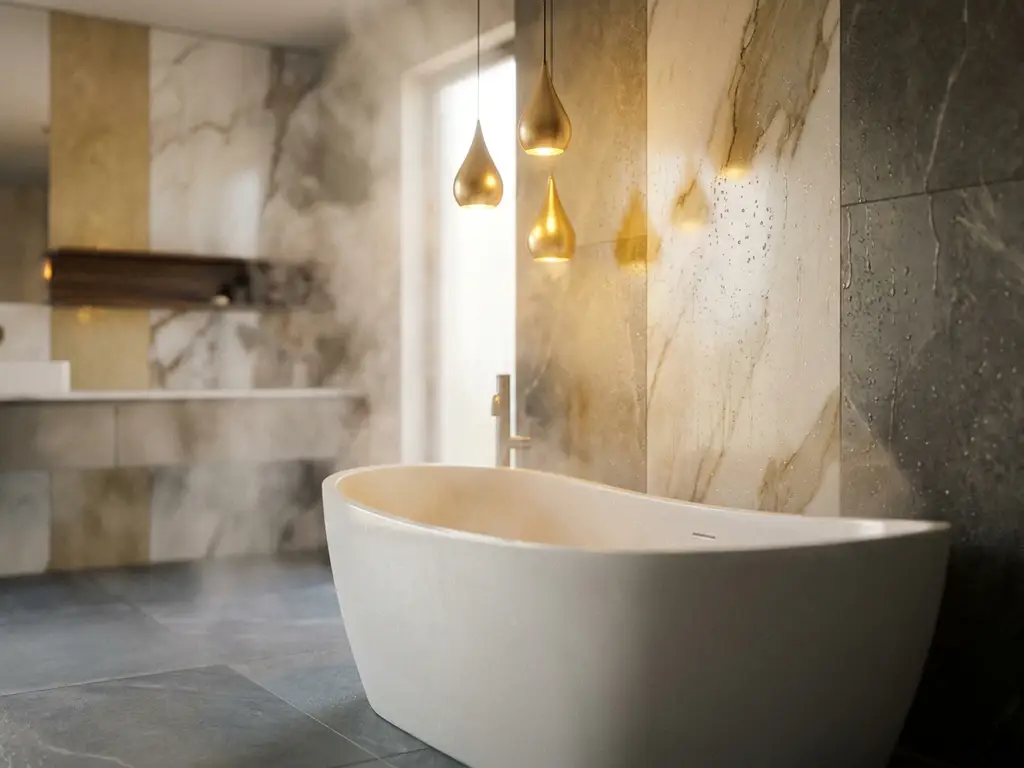
Self-adhesive films specially designed for wet areas reliably hold in the bathroom. The material is crucial: High-quality bathroom films are moisture-resistant, vapor-permeable coated and permanently adhere to smooth surfaces such as tiles. For rental properties, residue-removable variants are particularly practical. The following questions clarify what you should specifically consider when selecting, installing, and choosing the material.
Which materials can withstand moisture and steam in the bathroom?
In the bathroom, PVC films, PVC-free polymer films, and specially coated self-adhesive films are particularly durable. These materials are water-repellent, dimensionally stable under temperature fluctuations, and do not react to the steam generated during showering. Wallpaper on paper or fleece-based backing, however, is unsuitable for shower walls, as they swell and peel off.
Not only the carrier material itself is important, but also the coating of the surface. A closed, water-repellent surface prevents moisture from entering the material and causing mold or stains. For the direct splash water area, i.e. shower walls and areas directly next to the bathtub, you should use only materials that are explicitly approved for wet areas.
The adhesive layer also plays a role: acrylic-based adhesive tapes are more moisture-resistant than solvent-based variants and retain their adhesive strength even under sustained steam exposure. Materials with an air channel technology in the adhesive layer also facilitate the bubble-free application process, which is particularly useful for large-area wall surfaces.
How well do self-adhesive films stick to tiles and wet zone walls?
Self-adhesive films adhere very well to clean, smooth tiles, provided the surface is free of grease, dust and dry. On textured or porous tiles, the adhesive strength decreases significantly because the adhesive layer does not fully adhere to the surface. In the shower itself, you should only apply the film after thoroughly drying the tiles.
Smooth ceramic tiles, porcelain stoneware and painted wall surfaces are ideal substrates. However, they are problematic in the following cases:
- Stably structured or rough tile surfaces
- Surfaces with old silicone residues or lime deposits
- Freshly painted walls that have not yet fully hardened
- Moist or not completely dried substrates
A practical test before installation: Stick a small piece of film in an inconspicuous place and check after 24 hours whether the adhesion is stable. This way you can detect early on whether the substrate is suitable before you apply the adhesive to the entire surface.
Can printed wall foils be removed residue-free?
Yes, high-quality self-adhesive wall films can be removed without leaving any residue when designed for this purpose. A stable, undamaged surface is required. Films with a weakly adhesive or repositionable adhesive are specifically designed for rental apartments and leave no adhesive residue on smooth tiles.
When removing the film: Carefully peel the film slowly and at a slight angle from the wall, ideally at room temperature. Cold temperatures can make the adhesive layer brittle, making removal more difficult. For older films that have remained on the wall for a long time, a hot air gun can help warm the adhesive layer and make the film easier to remove.
Important: Not every film is designed for residue-free removal. When purchasing, be sure to check the manufacturer's information regarding repositionability or residue-free removal. Films with permanent adhesive are intended for long-lasting applications and may leave residues when removed or damage the substrate.
What is the difference between PVC film and PVC-free film in the bathroom?
PVC films are classic vinyl films based on polyvinyl chloride. They are robust, water-resistant, and inexpensive to manufacture. PVC-free films are made from alternative polymers such as polyolefins or other plastic compounds and avoid chlorine-containing compounds that can be environmentally harmful during production and disposal.
Both variants are technically suitable for use in the bathroom, provided they have the necessary moisture-retaining properties. The difference lies primarily in the environmental impact:
- PVC films They are proven, inexpensive, and widely used. However, they contain plasticizers and chlorine-containing compounds that are problematic during combustion.
- PVC-free films They are more environmentally friendly in production and disposal, often recyclable and free of harmful substances. They are particularly suitable for applications where sustainability plays a role.
For rental apartments and private living spaces where the film is removed again after a few years, a PVC-free variant is a sensible choice. The optical and technical properties of modern PVC-free materials are comparable to conventional PVC films.
How is a bathroom film properly installed?
You can apply bathroom film correctly in five steps: clean the substrate, cut the film, peel off the protective film, position the film, and press it firmly with a hairdryer. Careful preparation of the substrate is the most important step, because grease, lime, or dust directly affect adhesion.
- Prepare the substrate: Clean the tiles thoroughly with a degreasing cleaner, rinse them off and let them dry completely. Remove any silicone residue or lime deposits beforehand.
- Cut the film: Measure the area exactly and cut the film with some excess. The excess can be cleanly trimmed after assembly.
- Positioning: Only partially remove the protective film and position the film first without fully applying it. This allows you to correct the alignment further.
- Pushing: Work with a spatula from the center outwards to distribute the air evenly. Avoid pressure from the edges, as otherwise bubbles will form in the center.
- Sealing edges: In the spray water area, a transparent sanitary silicone is recommended on the edges to prevent water from penetrating behind the film.
The following applies especially to the wallpaper in the shower: Work at room temperature and avoid direct sunlight during installation, as heat causes the film to become elastic and makes alignment more difficult.
Which wall cladding is best suited for rental apartments?
Self-adhesive films with repositionable adhesive are best suited for rental apartments because they can be removed without leaving any residue and do not require any structural modifications. They can be applied to existing tiles and removed again when they are removed without damaging the underlying substrate.
Compared to other wall coverings such as wall panels, moisture-resistant wallpaper or ceramic tile stickers, film products in the rental context have clear advantages:
- No holes or adhesives that permanently alter the ground beneath
- Assembly possible without a craftsman
- Individual design through printed motifs or colors
- Quick disassembly when moving out
- Less effort and lower costs than a bathroom renovation
Shower walls can be completely redesigned with suitable films without the need to remove tiles or permanently install new wall coverings. It is important to choose a film that is specifically approved for wet areas and for use on tiles. Inexpensive universal films from the DIY store are often not designed for continuous exposure to moisture and will peel off after a few weeks.
Wall decoration in the bathroom with com2C
We develop and produce printing media that serve as the basis for custom-made bathroom wraps. Our materials are used by printing service providers and advertising technology companies to create individual wall designs for private customers. If you are looking for a printed film for your shower wall or kitchen backsplash, you will find it on our page for Kitchen backsplashes a good starting point for material questions and application examples.
What sets us apart from general film suppliers:
- In-house production with a chemical laboratory for inkjet coatings, thereby providing precise control over adhesion, moisture resistance, and print quality
- PVC-free materials from the GoGreener line for environmentally conscious applications
- Compatibility with all common digital printing systems for precise color reproduction, even for individual motifs
- Technical advice when standard solutions are not suitable
If you have specific questions about materials for wet areas or would like to know which printing service provider in your area works with our media, we are happy to assist you. contact us and we will help you further.