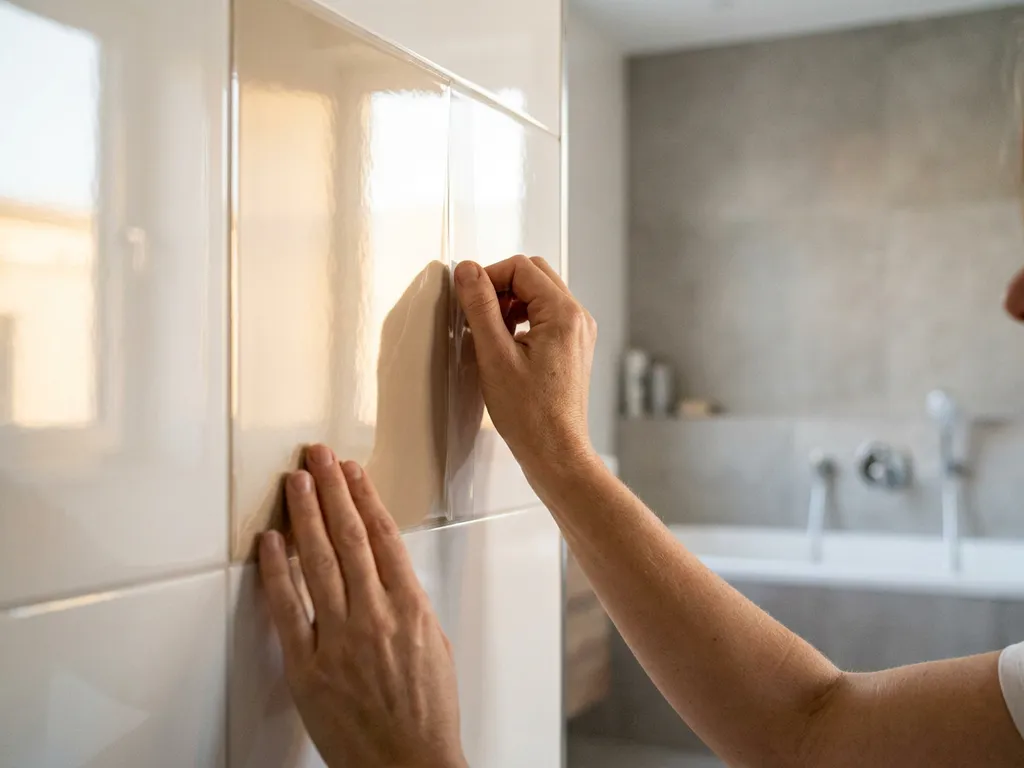
Yes, you can stick bathroom tiles with foil without damaging the tiles or the substrate. The prerequisite is that the tiles are clean, dry and free of grease, and a foil suitable for humid environments is used. Removable films that are easy to remove without leaving residue are particularly suitable for rental properties. The following questions answer everything you should know before installation.
Which films are suitable for applying to bathroom tiles?
Self-adhesive vinyl films with a water-repellent surface and a adhesive layer specially developed for smooth, non-porous substrates are suitable for bathroom tiles. It is important that the film withstands moisture, temperature fluctuations and occasional contact with water without warping, peeling or fading.
Specifically, you should pay attention to the following properties:
- Moisture tolerance: The film must be explicitly approved for bathrooms or wet rooms. Standard films for living rooms are often not sufficiently vapor-tight.
- Smooth, non-porous surface: A closed surface prevents moisture or mold from forming behind the film.
- Repositionable adhesive layer: Films with an air channel-based or repositionable adhesive layer can be applied without bubbles and removed residue-free if necessary.
- Printable quality: If you want to apply individual motifs or photo subjects, the film for digital printing should be suitable so that colors are reproduced precisely and durably.
Transparent or white base foils are often used for kitchen walls and bathrooms, onto which a printing service then prints your desired motif. The result is hardly distinguishable from real tiles or wall coverings visually.
Do adhesive films cause damage to the substrate when applying tiles?
When applied correctly, adhesive film does not cause damage to the underlying surface when applied to bathroom tiles. High-quality self-adhesive films do not leave any adhesive residue when removed and do not damage the glaze of the tiles, provided that the film is not subjected to extreme heat or steam for extended periods of time.
In practice, damage almost always results from avoidable errors:
- Incorrect film quality: Cheap films with aggressive permanent adhesive can leave adhesive residue when removed or, in the worst case, peeling off the tile glaze.
- Prolonged stay: The longer a film sticks, the stronger the adhesive bonds to the substrate. With repeated use, removal can become more complicated.
- Moisture behind the film: If the tiles were not completely dry before installation or if the joints are leaking, mold can form. This is not damage caused by the film itself, but a risk that you can avoid by preparing carefully.
Those who want to be sure choose films with a specially developed, residue-free adhesive layer. These are designed for smooth surfaces such as tiles, glass or painted surfaces and leave no marks when removed.
How long does film last on bathroom tiles?
High-quality films usually last between three and seven years on clean-prepared bathroom tiles, depending on the humidity, temperature, and quality of the adhesive layer. In areas with direct contact with water, such as directly in the shower, the lifespan is shorter than on dry wall surfaces.
The shelf life depends on several factors:
- Substrate preparation: Tiles that have been thoroughly cleaned and degreased before installation offer significantly better adhesion than untreated surfaces.
- Ventilation behavior: Bathrooms with good ventilation load the film less than poorly ventilated rooms with permanently high humidity levels.
- Edge sealing: Open film edges, especially at joints or corners, are the most common cause of premature peeling. A clean seal with a suitable silicone or finishing strip significantly extends the shelf life.
- Film quality: Films designed for humid environments are significantly more durable than standard products.
How to apply film without bubbles to bathroom tiles?
The film adheres to bathroom tiles without bubbles when the substrate is clean and dry; it is applied to the tiles with a hairdryer from the center outwards and any air bubbles are immediately removed during application. Films with an air channel system greatly facilitate this process.
Here's how to proceed step by step:
- Cleaning tiles: Clean thoroughly the tiles and joints with a degreasing cleaner. Soap residues, lime deposits and grease prevent reliable adhesion.
- Let dry: The substrate must be completely dry. In the bathroom, a waiting period of at least 24 hours after cleaning is recommended.
- Cut the film: Cut the film slightly larger than the area to be adhered to, so that you have some leeway at the edges to adjust it.
- Step by step remove the carrier paper: Start at an upper corner and peel off the carrier paper by only a few centimeters. Glue this area firmly and then work your way down step by step.
- With Rakel pushing: Smooth the foil with a comb or credit card from the center to the side. Work in even overlapping patterns.
- Eliminate the bubbles: Small remaining air bubbles can be punctured with a fine needle and then smoothed out.
Is it allowed to stick film over tiles in rental apartments?
In most rental apartments, pasting tiles with residue-removable film is permitted because it is a non-permanent measure that can completely restore the original condition. An express approval from the landlord is usually not required as long as no structural changes are made.
Nevertheless, you should keep a few things in mind:
- Removable without residue: Use only films designed for smooth surfaces that leave no adhesive residue. This is the crucial difference compared to a structural modification.
- Check the rental agreement: Some rental agreements contain extensive clauses regarding changes to the apartment. In case of doubt, it is worth asking the landlord a short question, even though this is usually not legally necessary.
- Condition at the time of departure: When removing the tiles, they must be returned in their original condition. With the right film, this is easily possible.
Self-adhesive films are therefore one of the most popular solutions for rental apartments: they enable a complete visual redesign without permanently interfering with the building structure.
How to remove tile film residue in the bathroom without leaving any marks?
Tile film can be removed without leaving any residue by slowly and evenly pulling it off the tile at a slight angle, ideally at a slightly elevated room temperature. Heat softens the adhesive and makes removal easier without leaving any residue.
Here's how to remove the foil safely:
- Warm up room: Heat the room to about 20 to 25 degrees Celsius. Alternatively, you can briefly heat the foil with a low-power hair dryer.
- Solve the corner: Start at an edge or corner and carefully peel off the film with a fingernail or plastic spatula.
- Peel off flat: Slowly and evenly peel off the film at an angle of about 30 to 45 degrees. Rapid movements increase the risk of adhesive residue.
- Remove residue: If any small adhesive residues remain, they can be easily removed with isopropyl alcohol or a commercially available adhesive remover without damaging the tile grout.
- Cleaning tiles: Finally, wipe the tiles with a mild cleaner to completely remove any residue.
With high-quality films with a peelable adhesive layer, this process is usually straightforward. Problems almost exclusively arise with inferior products or when the film has been subjected to intense heat and steam for many years.
Bathroom films from com2C: Quality that works in everyday life
We know that a bathroom film needs to do more than just look good. It must withstand moisture, display precise colors, be easily removed without leaving residue, and allow for clean processing. That’s exactly what we develop our printing media for.
- Moisture-resistant materials: Our films are designed for use in wet rooms and can withstand temperature fluctuations and prolonged humidity levels.
- Non-residue adhesive coatings: We rely on adhesive technologies that have been specifically developed for smooth surfaces such as tiles, glass and painted surfaces.
- Precise color reproduction: Our print media are optimized for high-resolution digital printing, so that motifs, patterns, and photo effects appear exactly as you imagine them.
- PVC-free alternatives: With our GoGreener line, we offer sustainable materials that rely on environmentally friendly raw materials without compromising on quality.
- Technical consulting: We help printing service providers and advertising technicians find the right material for their specific application, whether it’s kitchen backdrops, bathroom film or wall decoration.
If you would like to create individual bathroom decals or wall designs, you will find the appropriate printing media for your printing service provider with us. Learn more about our products for custom-made wall solutions here. com2C kitchen back panels and wall foils. For specific questions about materials and applications, we are happy to assist you. Consultation available.