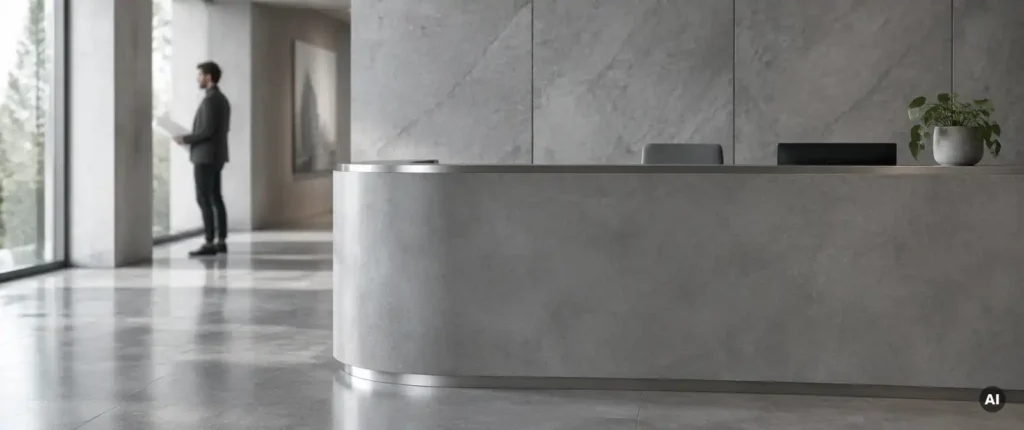
Office furniture can be quickly and cost-effectively upgraded with self-adhesive foils, glass decorative foils and printable materials without having to replace them. This applies to desks, cabinets, partitions, glass surfaces and even floors. The following questions answer which materials are suitable, how long they last and when the investment is truly worthwhile.
Which office furniture is easiest to tape with film?
The easiest way to apply smooth, flat surfaces is with films. These include desk tops, file cabinets, sliding doors, partitions and glass surfaces. Locker rooms, reception counters and meeting tables are also suitable. The prerequisite is a clean, grease-free and as smooth a surface as possible, without deep pores or strong structures.
Self-adhesive furniture films adhere to most common materialsWood, MDF, metal, plastic and glass. The application is particularly straightforward on flat surfaces because no edges or curves make processing difficult. For textured or heavily curved surfaces, there are specially formulated films with increased stretchability that can also be applied around edges.
Glass surfaces in offices, such as partitions, doors, or meeting room glazing, are particularly suitable for film applications. Here, either glass decorative films for privacy and design purposes or transparent full-view films for printing motifs are used.
How long does a furniture film last in everyday office use?
High-quality self-adhesive furniture film typically lasts between three and seven years in office everyday use. The exact lifespan depends on the quality of the material, the care in its processing, and the intensity of daily use. On desk tops with high contact, the durability is reduced; on cabinet fronts or partitions, it is significantly longer.
Important influencing factors on durability are:
- Surface preparation: Cleanly degreased and dry surfaces provide significantly better adhesion and noticeably extend the lifespan.
- Film quality: Cheap mass-produced products lose their adhesion and color more quickly. Professional printing media are designed for long-term use.
- Mechanical stress: Areas that are used intensively daily, such as table tops or door handle areas, wear out more quickly than decorative wall surfaces.
- Cleaning agents: Aggressive solvents can cause the film to peel off or fade. Mild cleaners extend its lifespan.
For particularly exposed areas, a film with protective laminate is recommended, which protects the surface from scratches, moisture and UV light.
What is the difference between glass decorative film and full-tinted film?
Glass decorative films are translucent or opaque films primarily used for privacy, room separation, and decorative design on glass surfaces. Full-view films, on the other hand, are fully printable, usually transparent or white carrier films on which motifs, logos, or graphics are printed that are intended to remain visible through the glass.
Glass decorative film: privacy protection with design appeal
Glass decorative films are used primarily in meeting rooms, office partitions and entrance areas. They diffuse light, create visual privacy and can be chosen in various structures and transparency levels. Typical variants include matte films, milk glass optics or textured patterns. Many can also be combined with logos or lines by cutting out or overprinting areas.
Full-view film: print motif on glass
Full-view films are suitable when a full-surface print motif is to be applied to glass, such as a large-format brand image, a city view, or an abstract pattern. They are usually visible on both sides or are specifically optimized for a viewing side. In the office context, they are often used for reception area glazing, conference room walls, or the shop windows of concept stores.
Can office furniture be painted with individual motifs or corporate design elements?
Yes, office furniture can be fully personalized with corporate design elements, logos, color schemes, or motifs. Self-adhesive printing media are used for this purpose, on which the desired motif is printed in large format. The result is a custom-made film that is precisely tailored to the furniture piece.
Applications that are particularly frequently used in the office are:
- Table tops and reception counters with branded colors or logo applications
- Cabinets and room dividers with patterned prints or corporate image worlds
- Glass surfaces with slogans, values or graphic elements
- Floor films in entrance areas with guidance systems or welcome motifs
- Wall surfaces behind the reception or in meeting rooms as printed vinyl wallpaper
For consistent results, it is important that print files are delivered in the correct resolution and with the correct color profile. Professional printing services can work based on CI specifications and ensure color consistency.
What eco-friendly alternatives are there for furniture design in the office?
For environmentally friendly furniture design in the office, there are PVC-free films, solvent-free adhesive coatings, and materials based on textile or fleece. These alternatives reduce the use of plasticizers and pollutants and are in many cases recyclable or at least easier to dispose of than conventional PVC films.
Concrete alternatives at a glance:
- PVC-free self-adhesive films: Based on polyester or polyolefin, without any plasticizers, suitable for furniture and walls.
- Non-woven wallpapers: Consist of vinyl backing without PVC, are diffusion-resistant and can be removed without leaving any residue on a stable surface. Well suited for office walls and meeting rooms.
- Textile prints: Printable fabrics for partitions, back panels or acoustic panels combine design with function.
- Water-based inks: The choice of the ink system itself makes a difference when printing. Water-based and latex inks are less polluting than solvent inks.
For companies that communicate sustainability goals or aim to obtain certifications, material selection is a relevant factor. PVC-free materials can be documented in sustainability reports and communicated transparently to customers or employees.
When is it worth it to re-glue furniture instead of replacing it?
It is always worth re-sticking furniture if the structure is still intact but the surface or appearance no longer matches. This is often the case with outdated colors, worn coatings, a rebrand, or a move to new premises. The cost of applying a film coating is usually significantly lower than the purchase price.
Typical situations where coating makes sense:
- Rebranding: The company changes colors or logos. Instead of replacing all the furniture, the surfaces are repainted and designed in accordance with the CI standard.
- Relocation or remodeling: Existing furniture is adapted to the new space concept without the need for new purchases.
- Used surfaces: Scratches, stains or faded coatings can be completely covered with a film.
- Temporary design: For temporary projects, events, or seasonal campaigns, a temporary banner is more flexible than a permanent solution.
Adhesive taping is not advisable if the piece of furniture has structural damage, has severely deformed surfaces, or the film does not adhere to a surface, such as on highly porous or oily wood without pretreatment. In such cases, a new purchase is the better choice.
Enhance office furniture with com2C: materials that really fit
We know that office design is more than just decoration. Whether it’s the implementation of corporate design, the choice of sustainable materials or technically sophisticated glass cladding: We support you with printing media that have been developed specifically for these applications.
- Self-adhesive films for furniture, walls and glass surfaces, compatible with all common large-format printers
- PVC-free materials from our GoGreener line for environmentally conscious office projects
- Vinyl wallpaper and glass decorative films for professional office and reception area design
- Technical advice on material selection, also for complex or unusual surfaces
- Quick availability and individual customization for project-specific requirements
Our Interior Film Collection gives you a structured overview of all the materials we offer for interior applications. If you are planning a specific project or are unsure which material suits your requirements, please contact us. A brief Consultation This is often enough to find the right solution.