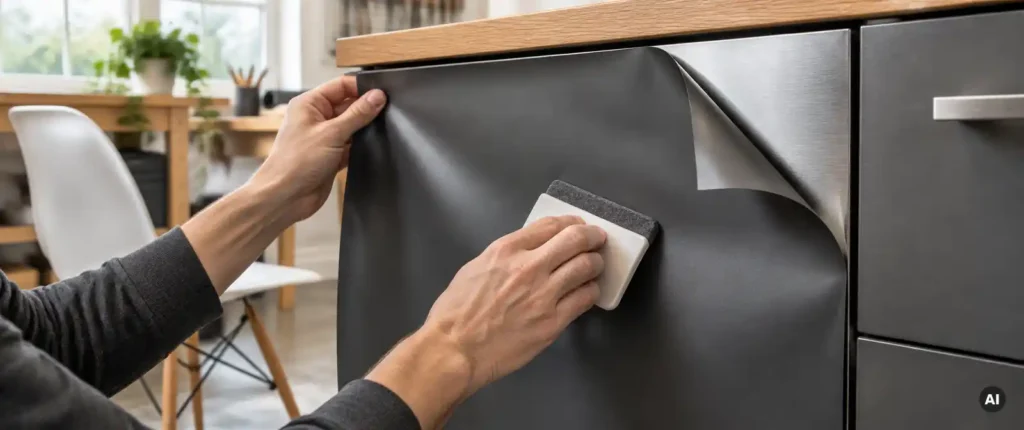
Yes, metal and plastic furniture can be easily glued in most cases. Self-adhesive films adhere very reliably to smooth, grease-free metal surfaces and also well to many types of plastic, provided the surface is properly prepared. You can learn which film is suitable, how the preparation looks like, and what you should pay attention to when using certain plastics in this article.
Which films are suitable for applying to metal and plastic furniture?
For metal and plastic furniture, high-quality self-adhesive adhesive films based on polymers are particularly suitable: so-called cast films or calendared films. Cast films are thinner, more flexible, and better able to adapt to slight curvatures or edges. Calendered films are more stable and are well suited for flat, straight surfaces.
For metal surfaces such as steel, aluminum, or painted metal furniture, solvent-based or acrylic-based adhesives are best suited because they form a strong, durable bond. For plastic surfaces, films with a softer, more adaptable adhesive are recommended, which also adheres to less porous substrates.
For interior spaces, such as hotels, offices or concept stores, it is often used matte, silky matte or textured films For applications that look visually high-quality and are at the same time functional. Transparent or printable films offer additional design options for individual brand presence.
How well does adhesive film adhere to metal and plastic surfaces?
Adhesive film usually adheres very well to metal surfaces because metal offers a smooth, non-porous surface. On plastic, the adhesion varies significantly depending on the type of plastic. Smooth, hard plastics such as ABS or PVC absorb the film well, while soft or flexible plastics such as polypropylene (PP) or polyethylene (PE) offer significantly lower adhesion.
The surface energy of the material is crucial for the bond quality. Metals and hard plastics generally have a high surface energy, which means that the adhesive is well-wetting and forms a strong bond. Soft polyolefins such as PP and PE have a low surface energy, which is why commercial adhesive films often do not adhere sufficiently well there.
Surface texture also plays a role: slightly textured or matte surfaces can even improve adhesion because the adhesive has more surface area to attack. On the other hand, strongly textured, rough or porous surfaces make bubble-free bonding more difficult.
How do you properly prepare metal or plastic furniture before applying the coating?
Proper surface preparation is the most important step for a permanently adhesive adhesive film. First, thoroughly clean the surface with a degreaser or isopropanol to completely remove dust, grease, oil, and residues from cleaning agents. Then, allow the surface to dry completely.
You should also pay attention to rust, scratches, or peeling paint layers on metal surfaces. Loose areas must be removed or repaired before gluing, as the film will not have a stable base otherwise. Slightly sanded metal surfaces often provide better adhesion than highly polished surfaces.
For plastic furniture, a primer is recommended if the surface is made of a difficult plastic such as PP or PE. This primer increases the surface energy and significantly improves the adhesive bond. Apply the primer thinly and evenly and allow it to dry completely before applying the film.
Work as much as possible at room temperature between 15 and 25 degrees Celsius. Too cold surfaces reduce the adhesive performance, and too warm temperatures can cause the film to stretch during application.
Which plastic furniture can't be glued down?
Furniture made of polypropylene (PP), polyethylene (PE) and Teflon (PTFE) cannot be reliably bonded with commercial adhesive films because these plastics have very low surface energy. Without special pretreatment such as flame treatment, corona treatment or a suitable adhesive primer, the film will not adhere permanently to these materials.
Also, highly flexible or rubber-like plastics such as TPE or silicone are problematic because the expansion of the substrate causes the adhesive bond to deteriorate over time. Furniture with highly textured, carved, or rough plastic surfaces is also difficult to glue because air inclusions under the film are difficult to avoid and the appearance of the furniture suffers.
If you are unsure whether your piece of furniture is made of a suitable plastic, a simple test can help: attach a small piece of foil to an inconspicuous spot and after 24 hours, check if the adhesion is stable and the foil does not peel off.
How long does a adhesive film last on metal or plastic furniture?
High-quality adhesive film usually lasts three to seven years on well-prepared metal or plastic furniture indoors. The actual durability depends on the quality of the film, the care in the preparation process, and the conditions of use. In the outdoor environment, durability is significantly reduced by UV radiation and weathering.
In indoor environments, such as offices, hotels, or retail spaces, the conditions for adhesive films are significantly more favorable. However, high humidity levels, direct sunlight through windows, or frequent mechanical stress such as scratching or rubbing can reduce the lifespan.
Films with a UV-stabilized protective layer or lamination last longer and are more resistant to abrasion. For heavily used areas such as table tops or chair backs, an additional protective lamination is recommended to protect the film from scratches and moisture.
How to remove adhesive film residue from metal or plastic furniture without leaving any marks?
Adhesive film can be removed without residue from metal and plastic furniture by peeling it off slowly and with even pressure. While heating the film with a hot air gun to about 40 to 50 degrees Celsius, ensure that the adhesive becomes soft and easier to remove. Peel the film at an angle of about 30 degrees, not perpendicular.
Residual adhesive residues can be removed with isopropanol, a special adhesive remover, or mild vegetable oil. Apply the product to the residues, let it sit for a short time, and then wipe it off with a soft cloth. On sensitive plastic surfaces, avoid aggressive solvents such as acetone, as these can attack the surface.
Special caution is required when working with metal surfaces that are painted: Very old or already damaged paint layers can be detached when the film is removed. In this case, test the removal on an inconspicuous area first. If the film has remained on the surface for many years, the adhesive may be more hardened and the removal requires more patience and heat.
Adhesive furniture with com2C: the right film for your needs
We know that choosing the right adhesive film for metal or plastic furniture often raises more questions than expected in practice. Whether it’s about the appropriate adhesion on a difficult substrate, the right look for a hotel project, or a film that can withstand even intensive use – we help you find the solution that fits your project.
- Our com2C Interior Film Collection Includes self-adhesive films specifically designed for indoor applications, tailored to different substrates such as metal, rigid plastic and glass
- We advise you on the type of film, the adhesive grade and surface preparation, so that the bonding holds from the very beginning.
- For special requirements, such as heavily used areas or specific plastic substrates, we develop the appropriate solution together with you.
- Our films are compatible with common large-format printers and are suitable for printed and monochrome applications.
If you are planning a specific project or have questions about the right film for your furniture, please feel free to Contact. We respond quickly and concretely.