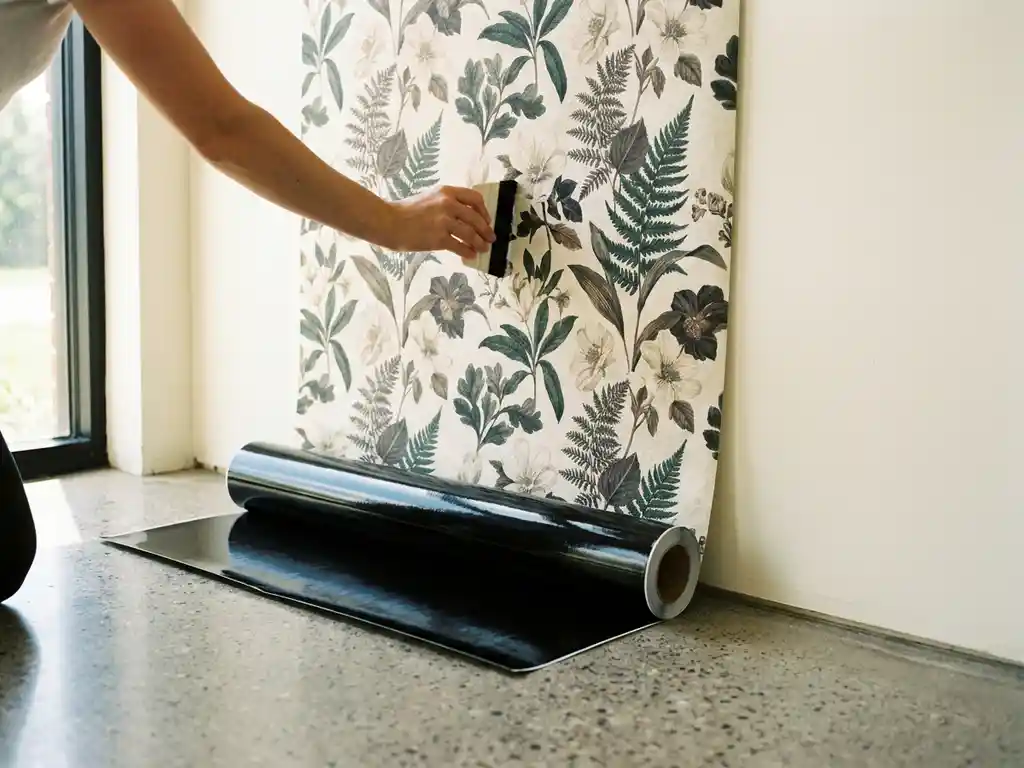
Printable non-woven wallpaper and self-adhesive film are two fundamentally different materials that differ significantly in processing, adhesion, and application area. Non-woven wallpaper is applied to the wall with paste and is particularly suitable for large-scale, permanent wall designs. Self-adhesive film adheres directly to the surface via an adhesive layer and can often be removed again without leaving any residue. The following questions will help you find the right material for your specific situation.
When is which material suitable for which surface?
Non-woven wallpaper is best suited for smooth to slightly textured interior walls that are dry and clean. Self-adhesive film works particularly well on smooth, grease-free, and firm surfaces, such as tiles, glass, painted furniture, or smooth walls. The surface texture is the most important selection criterion.
Non-woven wallpaper forgives structured or slightly uneven walls better because the paste has a certain leveling effect. On heavily textured plaster surfaces, it can still reach its limits. Self-adhesive film, on the other hand, requires a surface that is as smooth as possible so that the adhesive layer bonds across the entire surface and no air bubbles form. On a rough surface, it quickly loses adhesion and can peel off at the edges.
For damp rooms such as the kitchen or bathroom, self-adhesive film is often the better choice because it is water-repellent and can be applied directly to tiles. Non-woven wallpaper does not tolerate a permanently humid environment well and should only be used there with appropriate paste suitable for damp rooms and in well-ventilated areas.
How are non-woven wallpaper and self-adhesive film applied?
Non-woven wallpaper is applied to the wall with paste, with the paste being applied to the wall rather than the wallpaper. The strips are then positioned edge-to-edge and smoothed out. Self-adhesive film is peeled off a protective backing and applied directly to the surface, smoothing out any air bubbles with a squeegee.
The application of non-woven wallpaper requires some practice and preparation: the wall must be primed, the paste applied evenly, and the strips must be aligned precisely. For large-scale wall designs, however, the result is very clean and professional. Non-woven wallpaper is also easy for amateurs to work with if you proceed carefully.
Self-adhesive film is a bit more direct to handle: clean the substrate, position the film, peel it off slowly while avoiding air bubbles. For larger areas, wet application is recommended, where the surface is slightly moistened so that the film can still be repositioned. Smaller areas such as kitchen backsplashes are also easy to work with dry.
Which material can be removed without leaving any residue?
Self-adhesive film with a removable adhesive layer can usually be removed without leaving residue if it is applied to a smooth, solid surface and has not been left on for too long. Non-woven wallpaper can also be removed, but often leaves paste residue and can damage the wall surface if the plaster is delicate.
For rental apartments, residue-free removal is a central issue. High-quality self-adhesive films with a repositionable adhesive layer have been specially developed to peel off cleanly without leaving residues or damaging the surface. It is important to peel off the film slowly and at a shallow angle, ideally at room temperature.
Non-woven wallpaper can be dry-stripped, which is an advantage over classic paper wallpaper, but paste residue on the wall is common. Whether the wall remains free of streaks afterwards depends heavily on the substrate and the primer used. For a guaranteed residue-free solution, removable film is the more reliable choice.
What are the differences in print quality and color reproduction?
Both materials deliver very good results in professional digital printing, but differ in their surface appearance. Non-woven wallpaper has a matte, slightly textured surface that makes colors look soft and natural. Self-adhesive film is available in matte or glossy finishes depending on the version and often reproduces colors with higher contrast and brilliance.
For wall designs intended to create a calm, cozy atmosphere, the matte surface of non-woven wallpaper is often the better choice. It does not reflect light and therefore appears less technical. Glossy films are well suited for accents, kitchen backsplashes, or areas where the surface also needs to be wipeable.
The color reproduction also depends heavily on the printing ink and the printer used. High-quality digital printing media are specially coated to ensure optimal ink absorption. On inferior materials, colors can bleed or appear blurry, regardless of whether it is film or wallpaper. The quality of the substrate is just as important here as the printing technique.
Which solution is cheaper – film or non-woven wallpaper?
In a direct material comparison, self-adhesive film is often somewhat cheaper than printable non-woven wallpaper. However, if you factor in the total effort—meaning material, paste, processing time, and any necessary wall preparation—both options are often closer together than initially expected.
Non-woven wallpaper requires additional materials such as paste and primer as well as a bit more processing time. Self-adhesive film does not need these aids, but instead relies on a well-prepared substrate. If the wall first needs to be filled or painted, the cost advantage of the film is quickly put into perspective.
For smaller surfaces like a kitchen backsplash or a single wall panel, self-adhesive film is usually the more economical choice. For entire room walls or complex interior designs, non-woven wallpaper has the advantage of being easier to work with on large surfaces. The decision should be based less on price and more on the application.
Which option is the better choice for rental apartments?
For rental apartments, self-adhesive film with a removable adhesive layer is the better choice because it can be removed without leaving residue and without damaging the wall surface. Non-woven wallpaper in rental apartments is only practical if the landlord permits structural changes and the wall may be repainted after moving out.
Tenants face the challenge of customizing their apartments without making permanent changes to the building structure. Removable films meet this exact requirement: they can be applied to tiles, smooth walls, or furniture and removed again when moving out. The prerequisite is that the film is suitable for the respective surface and applied correctly.
Non-woven wallpaper can still be an option in rental apartments if it is applied to a drywall or plasterboard wall that needs to be repainted anyway when moving out. In this case, the effort involved is manageable. On standard plastered walls, however, the risk of damage during removal is real and should be taken into consideration.
Print media for wall design by com2C
Whether self-adhesive film for the kitchen backsplash or printable non-woven wallpaper for the living room wall: We support print service providers and sign makers in finding the right material for every requirement. Our Interior design print media are specially developed for digital wide-format printing and designed for precise color reproduction and reliable processing.
- Self-adhesive films with a repositionable adhesive layer for residue-free applications in rented apartments
- Printable non-woven wallpapers with optimized inkjet coating for rich, uniform colors
- Materials compatible with solvent, latex, UV, and water-based printing systems
- Technical advice on substrates, adhesive layers, and application based on over 20 years of practical experience
- Fast availability and customized solutions even for special requirements
If you are unsure which material is best suited for your specific application, we will be happy to help you. Just take Contact and together we will find the right solution.