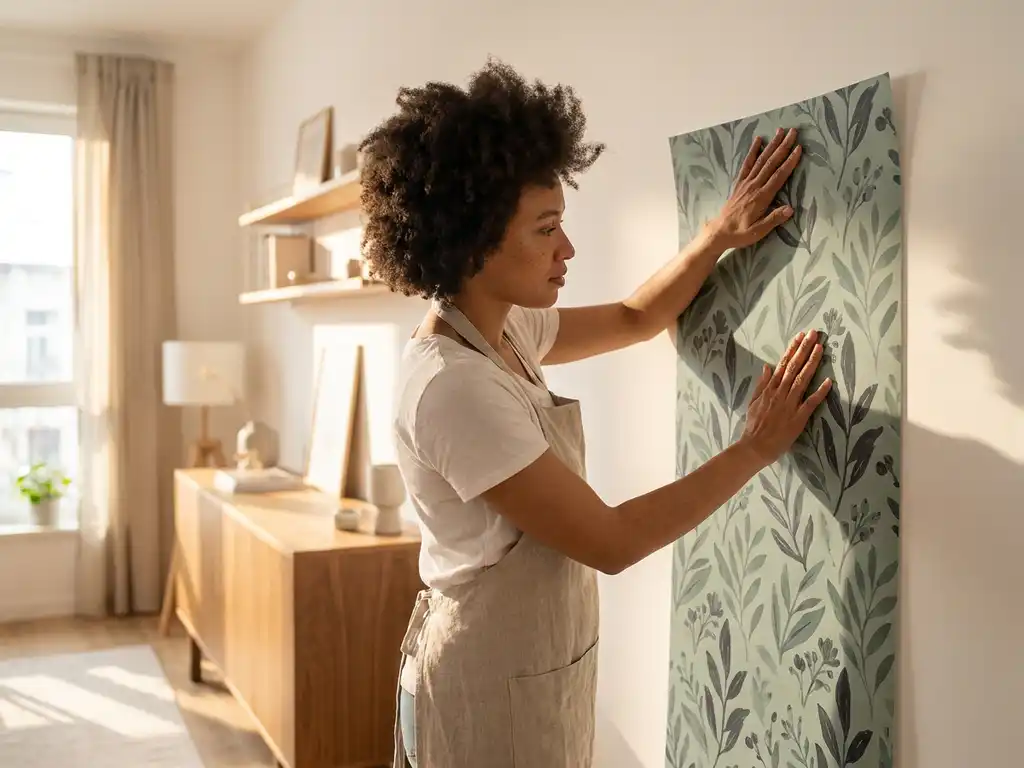
Self-adhesive wall decals work using a pressure-sensitive adhesive on the back that adheres to smooth and clean surfaces without the need for nails, screws, or special tools. The backing material is cut to size, printed with an individual design, and then applied directly to the wall. The following questions will answer all the questions you need to know before using them.
How do self-adhesive films adhere to various wall surfaces?
Self-adhesive wall films adhere most reliably to smooth, grease-free, dry surfaces. These include painted walls with a dispersion paint, glass, tiles, painted wooden surfaces, and smooth plastic panels. The smoother and cleaner the surface, the better the adhesion and the cleaner the subsequent removal.
Rauputz, highly absorbent substrates or freshly painted walls (less than four weeks old) are problematic. On rough plaster, the film cannot form a full-surface bond, which leads to air inclusions and premature peeling. Fresh paint has not yet fully cured and may peel off when the film is removed.
Before applying, it is always advisable to clean the substrate with a mild detergent and then wipe it dry. Fat, dust, or soap residues prevent even adhesion. For tiles, be careful with joints: over wide gaps, the film may form bubbles more easily or peel off over time.
Can self-adhesive wall foils be removed without leaving any residue?
Yes, high-quality self-adhesive wall foils can be removed without leaving any residue if the substrate is stable and the foil is designed for indoor use. The quality of the adhesive used is crucial: foils with a repositionable or weakly adhesive adhesive usually leave no residue on painted walls or tiles.
The best way to remove the film is to pull it slowly and at a slight angle from the wall, not abruptly or vertically. Heat from a hair dryer can help soften the adhesive and make removal easier without damaging the substrate.
Important: On surfaces with an unstable paint finish or on wallpaper, a residue-free film can also cause damage when removed, because the underlying surface itself is not stable enough. Therefore, always test the film on a small, inconspicuous area first before applying it to a whole wall.
Which film types are best suited for the kitchen and bathroom?
Self-adhesive films with a moisture-resistant and wipe-off surface are suitable for the kitchen and bathroom. Damp, splash water, and oil particles form in these areas, which is why the film requires a sealed, non-absorbing surface. Smooth vinyl films or specially coated digital printing films reliably meet these requirements.
kitchen backsplash
Films with a wipe-resistant, easy-to-clean surface are particularly suitable for kitchen back walls. The film must withstand temperature fluctuations and resist short-term moisture exposure. Printed films applied to tiles or painted walls offer a quick and cost-effective alternative to tile renovation.
Bathroom
In the bathroom, permanent moisture resistance is more important than in the kitchen. The films should be fully bonded to ensure no water can get behind the film. The joints between tiles should be checked before gluing. Films are generally not suitable for areas with direct contact with water, such as directly in the shower or bathtub.
How are self-adhesive wall films applied without bubbles?
Self-adhesive wall films are applied without bubbles by starting from one side and applying the film gradually, while using a scraper or a soft card to instantly push any air bubbles to the next open side. The most common cause of bubbles is applying the film over the entire surface at once, before any air can escape.
The so-called Nas technique has proven effective: The substrate is lightly moistened with a water-based detergent mixture before the film is applied. This gives you time to position the film and work out any bubbles before the adhesive completely sets. However, this method only works with films without air channels in the adhesive.
Many modern digital printing films have a structured adhesive layer with micro-channels that allow air to escape automatically during application. These films are significantly easier to process and particularly suitable for large areas, because bubbles can still be removed afterwards.
Are printed wall foils suitable for rental apartments?
Yes, printed wall foils are well suited for rental apartments, provided they can be removed without leaving any residue and the underlying surface remains intact. They allow for individual wall designs without any structural interventions, which is usually permitted in rental agreements. Upon moving out, the foils can be removed without leaving any traces.
It is important that you check whether the paint in the apartment is stable before applying it. On fresh, poorly adhering or highly absorbent paint, removing the film can damage the paint. In this case, a preliminary test or consultation with the landlord is recommended.
Printed films offer renters a clear advantage over wallpaper or wall paint: they are reversible. Whether as a kitchen backsplash, accent wall in the living room, or decorative wall design in the hallway, the film can be removed without renovation effort and replaced with a new design if needed.
How long do self-adhesive films last on the wall?
Self-adhesive wall foils can reliably last several years indoors with proper processing and a suitable substrate. Manufacturer specifications for indoor applications often range between three and seven years, depending on material quality, adhesive system, and the conditions at the point of installation.
Factors that shorten the shelf life include direct sunlight for extended periods, high humidity without adequate ventilation, and mechanical stress on edges and corners. In areas with heavy traffic, such as hallways or staircases, the film should be regularly inspected for detachment at the edges.
The durability also depends on the quality of the print. UV-resistant inks and a protective lamination prolong the color fastness and protect the motif from scratches and moisture. A non-laminated film can fade more quickly in humid rooms or become brittle at the edges.
Wall decoration with digital printing films: com2C as a partner for print service providers
If you, as a printing service provider or advertising technician, supply end customers with individually printed wall foils, the right carrier material is crucial. We at com2C develop and produce digital printing media specifically for large-format printing, which are designed specifically for such applications.
- Self-adhesive films with repositionable and residue-free adhesive systems for interior applications
- Materials with a structured adhesive layer for bubble-free processing even on large surfaces
- Moisture-resistant surfaces for kitchens, bathrooms, and other demanding environments
- Compatibility with solvent, latex, UV and water-based printing systems from HP, Epson, Roland, Mimaki and others
- Consulting by our expert team for specific requirements regarding liability, surface finish, or material thickness
We help you provide your customers with reliable results that work in practice. If you have any questions about suitable materials for your next wall decoration projects, please feel free to Contact.