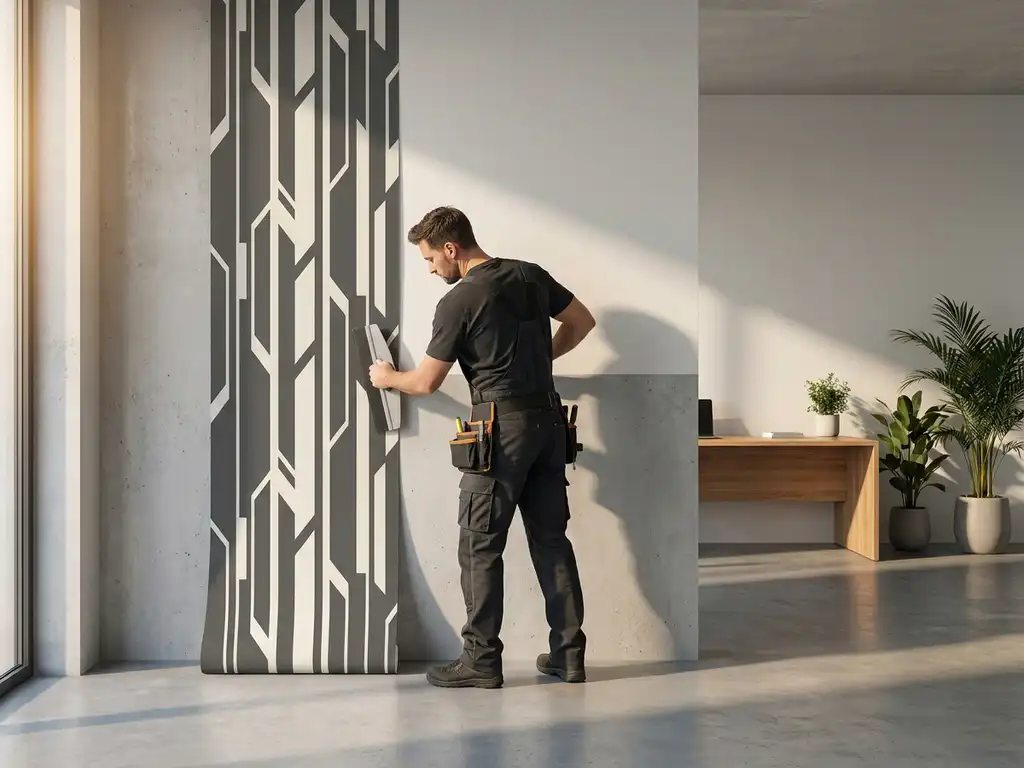
Self-adhesive wallpaper offers an important practical advantage over traditional wallpaper: they can be applied directly to smooth walls without adhesive, are easily removed without leaving residue, and are suitable for professional digital printing with individual motifs. This makes them particularly relevant for temporary installations, rental properties, and high-end interior design. The following questions clarify the most important aspects regarding application, processing, and material selection.
Which surfaces are suitable for self-adhesive wallpaper?
Self-adhesive wallpaper adheres reliably to smooth, clean, and dry surfaces. It works best on painted walls with a dispersion paint, glass, tiles, wooden panels, and painted substrates. Rough plastered or heavily textured walls are less suitable because the adhesive surface is too small and air bubbles can form.
For long-lasting good adhesion, the surface should be free of grease, dust, and completely dry. Freshly painted walls usually require a curing time of at least two to four weeks before self-adhesive wallpaper can be applied. Otherwise, the paint may be removed with the wallpaper.
Self-adhesive wallpaper has proven particularly useful in the interior:
- smooth plastered and painted walls
- Plasterboard panels with dispersion coating
- Glass and Mirrors
- painted wooden surfaces and furniture
- Tiles and other ceramic surfaces
Special outdoor films with stronger adhesive power are required for outdoor applications. Standard wall decals are not designed for outdoor use.
How can self-adhesive wallpaper be removed without leaving any residue?
High-quality self-adhesive wallpaper can be removed without leaving any residue when removed slowly and at a shallow angle from the wall. An angle of about 30 to 45 degrees reduces the tensile force on the substrate and prevents paint or plaster from being damaged. Heat from a hot air gun can facilitate the process with older adhesives.
Whether a wallpaper is truly removable without leaving any residue depends heavily on the quality of the adhesive used. Cheap products with aggressive permanent adhesive often leave adhesive residue or damage the underlying surface. Removable wallpapers with specially formulated repositionable adhesives, on the other hand, are designed so that they can be removed cleanly even after prolonged use.
Important notes for removal:
- Remove wallpaper slowly and evenly, not abruptly
- Maintain flat angles of 30 to 45 degrees
- Use a hot air dryer if necessary to heat the adhesive
- After removal, check the substrate for adhesive residue and, if necessary, clean with isopropanol
- Always test on an inconspicuous spot on freshly painted walls first
How are self-adhesive wallpapers processed in digital printing?
Self-adhesive wallpaper for digital printing is supplied as printable adhesive foil on a roll and printed on large-format printers using solvent-, latex-, UV- or water-based ink systems. The surface of the material has a special inkjet coating that ensures precise ink absorption, sharp print images and good color reproduction.
When processing in digital printing, there are some technical points to consider:
Printer compatibility: Printable wallpaper must match the respective ink system. Latex inks require different coating properties than solvent or UV inks. Always use the ICC profile recommended by the material manufacturer or create a custom profile for your printing system.
Roll handling: Self-adhesive wallpaper on rolls can cause problems during installation due to static charging or roll warping. Proper acclimatization of the material before printing and careful roll unwinding help to avoid printing errors.
Cutting and tailoring: After printing, the material is usually assembled on a cutting plotter or roll cutter. The width of the strips and the overlap dimensions should be agreed with the customer before production to ensure a precise fit.
Relocation: When assembling, it is recommended to work from top to bottom using a spatula or an applicator felt to distribute the air bubbles evenly. Air channel films with microperforation make the process easier. bubble-free bonding significantly.
What are the differences between PVC-containing and PVC-free self-adhesive wallpaper?
The most significant difference between PVC-containing and PVC-free self-adhesive wallpaper lies in the backing material and the associated environmental and health properties. PVC films are robust and inexpensive, but contain plasticizers and chlorine-containing compounds that can be problematic during production, use, and disposal. PVC-free alternatives based on polyester or non-woven fabric offer comparable print properties without these drawbacks.
PVC-based self-adhesive wallpaper
PVC films have been established in large-format printing for decades. They are dimensionally stable, moisture-resistant, and available in many surface structures. Their disadvantage lies in their disposal: PVC is considered difficult to recycle and releases pollutants when burned. Furthermore, many PVC products contain plasticizers such as phthalates, which can emit gases indoors.
PVC-free self-adhesive wallpaper
PVC-free wall murals are often based on polyester, fleece, or special composite materials. They are lighter, often more diffusion-resistant, and do not contain chlorine. For applications in schools, hospitals, or living spaces, they are the more recommended choice. The printing properties of modern PVC-free materials are comparable to those of PVC, provided that the inkjet coating is formulated with high-quality ingredients.
For projects with sustainability requirements, environmental certifications, or public tenders, PVC-free material is often a prerequisite today. Many clients are actively asking for proof of material compliance.
When are self-adhesive wallpapers the better choice compared to standard wallpaper?
Self-adhesive wallpaper is the better choice when flexibility, easy installation or temporary use are required. They do not require any glue, can be applied by one person and can be removed without renovation costs. For individually printed motifs in large format printing, they are also significantly more practical than traditional wallpaper.
Standard wallpaper with adhesive has its place in permanent installations on uneven or absorbent surfaces, where self-adhesive materials reach their limits of adhesion. However, for most professional applications in signage, exhibition construction and interior design, the advantages of the self-adhesive variant outweigh them.
Self-adhesive wallpaper is particularly useful for:
- Temporary installations in rental properties or at trade shows
- Individually printed wall designs with frequent changes of motif
- Projects where wet processing is not possible or not desired
- Quick assembly without drying times
- Applications where the subsoil must remain intact after use
For permanent wall designs in heavily-used areas such as stairwells or restaurants, a vinyl wallpaper with adhesive can be the more stable solution. The decision ultimately depends on the lifespan of the use, the substrate and the requirements of the client.
Self-adhesive wallpaper from com2C: materials for your production
We develop and produce self-adhesive wall murals that are specifically designed for professional digital printing. We place particular emphasis on materials that perform reliably, are easy to handle, and allow your customers to remove them cleanly and without residue.
- Our PVC-free self-adhesive wallpaper materials are specifically optimized for solvent, latex, and UV printing systems and deliver precise printing results with high color brilliance
- We rely on removable adhesive systems that can be removed without residue even after prolonged use.
- All materials are PVC-free and therefore suitable for projects with environmental or health requirements
- Our inkjet coatings are developed in our own chemical laboratory and continuously developed.
- We advise you on material selection, ICC profiles, and processing recommendations for your specific printing system
If you have questions about specific applications or are looking for a material for a specific project, we are happy to help you. Simply contact us. Contact and together we will find the right solution.