Anyone who rents commercial space and wants to customize it quickly faces a legal question that many only take seriously when moving out: Does everything have to be taken down again? The demolition obligation in commercial lease law is not a minor issue. It can ultimately cause significant costs at the end of a lease and make projects significantly more expensive than planned afterwards. This article explains what is legally required, what design measures pose a risk, and how you can still professionally and effectively design your commercial space without getting into legal pitfalls.
The topic concerns hotels, concept stores, offices, and all other companies that want to associate leased space with their brand identity. If you understand how the demolition obligation works and what alternatives there are, you can make the right decisions from the very beginning.
What does the demolition obligation mean in commercial lease law?
The demolition obligation requires a tenant to remove all structural modifications they have made during the rental period upon leaving the property and restore the original condition of the rental space. In commercial lease law, this obligation generally applies more strictly than in residential lease law, because commercial leases are usually negotiated individually and landlords can impose more extensive conditions there.
It is important to understand: the demolition obligation does not automatically arise from any change. It depends on whether a measure qualifies as a structural change in the legal sense, whether the rental agreement contains a corresponding clause, and whether the landlord has agreed to the measure or not. The interplay of these three factors determines whether you can be asked to pay the deposit when you move out.
A concrete example: An office that closes a partition to create a meeting room has made a structural change. If the landlord does not provide written consent or there is no clear provision in the lease agreement, the landlord can require the demolition at the tenant’s expense upon leaving. This also applies even if the wall has objectively increased the value of the space.
Which design measures trigger a demolition obligation
Not every change to a commercial space automatically triggers a demolition obligation. It becomes relevant only when you intervene in the substance of the space or make permanent changes that cannot be undone easily.
Typical actions that can trigger a demolition obligation:
- Moving in or removing walls and partitions
- Installation of floor coverings that are firmly attached to the substrate
- Installation of lighting systems that are integrated into the ceiling or wall
- Installing wall cladding with permanent mounting
- Painting or staining walls in brand-specific colors
- Installation of fixtures such as counters, shelving systems or built-in cabinets
- Changes to electrical, water or ventilation installations
The crucial question is always: Does the measure leave any traces that the landlord would have to remove after you leave? If so, the risk of a demolition order is real. Interior design in commercial premises that uses aggressive adhesive or permanent paint falls into this category, even if the artistic intent was purely decorative.
Design options that allow for retrofitting of commercial spaces
Removable wall design doesn’t mean you have to forgo professional-looking finishes. It means choosing materials and methods that leave no permanent marks and can be completely removed during removal without leaving any residue.
Self-adhesive films for walls and glass
High-quality self-adhesive films can be applied to walls, glass surfaces, doors, and floors without permanently altering the surface. The quality of the film and the type of adhesive are crucial: repositionable or residue-free films leave no adhesive residue when removed and do not damage the underlying surface. They are suitable for shop window signage, glass decorations in offices, wall motifs in hotel rooms, and floor coverings in concept stores.
Textile wall decoration and suspension frames
Printed textiles that are mounted in tension frame systems are another option that is easy to remove. The support system is attached to the wall, but leaves only small holes that can be easily sealed. The textiles themselves can be replaced or taken away. For hotels and offices that are looking for large-scale wall designs with high image quality, this is a proven solution.
Vinyl wallpaper without permanent adhesive
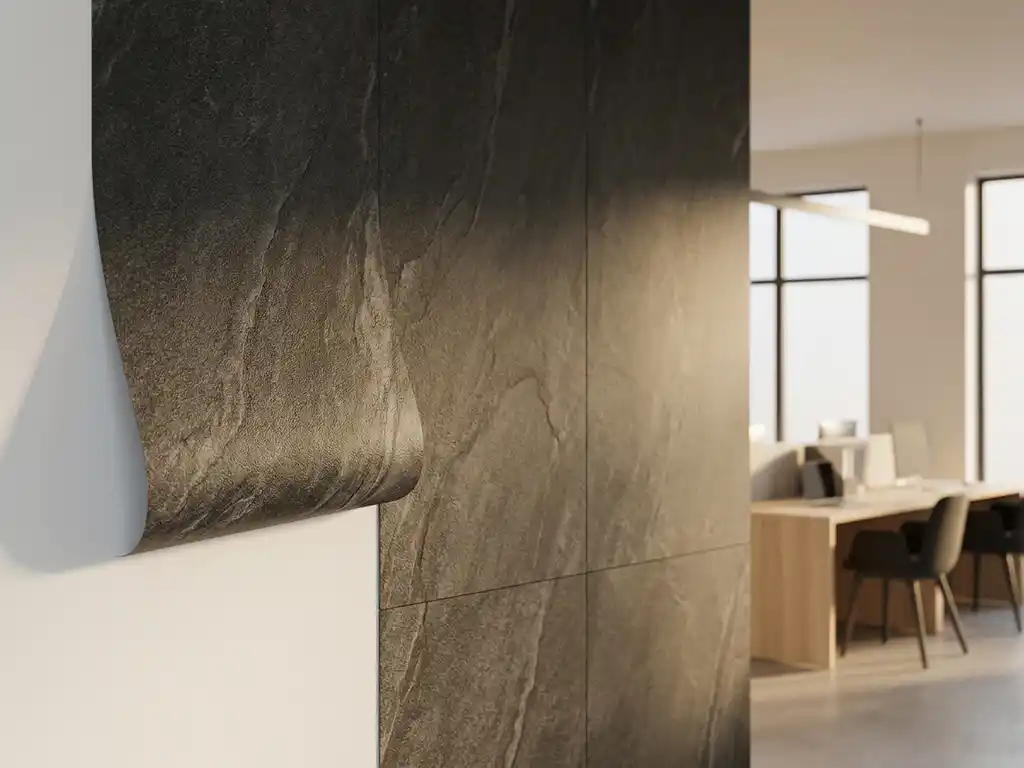
Modern vinyl wallpaper can be applied with removable adhesives and removed without damaging the underlying surface after the rental period has ended. Compared to conventional wallpaper, which often damages the plaster, specially developed vinyl wallpaper is designed for temporary applications. It offers complete creative freedom while reducing the risk of damage during removal.
Floor films as an alternative to floor coverings
Instead of installing new flooring, you can use printable floor foils that are applied to the existing substrate. A suitable substrate and a foil with a non-slip surface and residue-free adhesive are required. When removing the foil, the original floor remains unchanged.
What to consider when drafting the rental agreement
Before you start designing a rented commercial space, you should examine the rental agreement for specific clauses regarding the obligation to demolish the property. Many tenants overlook that standard wording such as „the tenant must return the area in its original condition“ can have far-reaching consequences.
Be sure to pay attention to the following points in the commercial lease agreement:
- Reservation of consent: Check whether any structural changes require the written consent of the landlord. Obtain this before any action is taken and document it in writing.
- Explicitly exclude demolition obligation: Negotiate that certain measures are explicitly exempt from the demolition obligation. This is possible and is often accepted by experienced landlords when making meaningful improvements.
- Transfer protocol: Keep a photographic and written record of the condition of the area upon moving in. This will prevent disputes about what you have changed and what was already there before.
- Replacement of the building instead of demolition: In some contracts, it can be agreed that the tenant will pay a replacement value instead of the renovation or that the improvements will be handed over to the landlord. This can be more economically advantageous than an expensive renovation.
- Duration and investment protection: For longer lease periods, it is worth entering into amortization agreements. When an investment is depreciated over the lease term, the landlord’s interest in demolition often also disappears.
A common mistake: Tenants assume verbal agreements with the landlord are sufficient. In the event of a dispute, only what was agreed in writing counts. Obtain any exceptions in writing before starting the design process.
Ensure design and freedom from rework in the long term
Building on what you have learned about lease contract clauses and retrofits-free materials, the final step is to develop a strategy that permanently combines design freedom and legal certainty.
The most important principle: Plan the design of your commercial space from the very beginning so that you can distinguish between temporary and permanent measures. Temporary measures, that is, those that can be removed without leaving any trace, are generally legally safe for retrofitting purposes. Permanent interventions in the building structure always require contractual protection.
For the practice, this means:
- When designing walls in commercial premises, opt for films, textiles and wallpaper with proven peelability rather than paint or permanently attached materials.
- Document every step of the design process, from the landlord’s approval to the product selection and processing method.
- Test new materials on a small area before working on a large scale. This way, you can detect early on if a material damages the substrate.
- Choose suppliers that provide technical data sheets and certificates regarding the residue-free nature of their products. These documents can be useful in the event of a dispute with the landlord.
- Plan design measures in coordination with the lease term. Short-term lease arrangements require different material decisions than long-term locations.
Anyone who consistently applies these principles can also professionally and brand-appropriate design rented commercial spaces without encountering unpleasant surprises when moving out. The combination of legal clarity in the lease agreement and the targeted selection of non-reparable materials protects you on both sides.
Retro-free wall design with com2C
Many of our customers in the hotel industry, retail and office environments face exactly this challenge: they want to effectively design their leased spaces without exposing themselves to legal risks. We understand this requirement and have specifically tailored our range to it.
Our Interior Film Collection by com2C Includes self-adhesive films, vinyl wallpaper and printable textiles, which are specifically designed for use in rented commercial spaces. All relevant products are designed for residue-free removal and are supplied with technical data sheets that you can provide to your landlord if necessary.
- Self-adhesive wall foils with residue-free adhesive for walls, glass and floors
- Vinyl wallpaper for temporary applications that do not damage the substrate
- printable textiles for tension frame systems with full creative freedom
- Technical advice on material selection and processing, tailored to your substrate and rental conditions
- Quick availability and flexible quantities, even for short-term projects
If you are planning a specific project and would like to know which materials are best suited for your area and your rental agreement, we are happy to help you. Simply contact us. Contact and describe your situation to us. We will help you make the right decision.