When renting a retail space, people usually want to customize it. Window decals, wall stickers, floor designs, or illuminated displays are meant to make the brand visible and attract customers. But what is legally permitted for renting, what requires a permit, and what do you have to undo when moving out? These questions are regularly asked by tenants of retail spaces, and the answers are not always clear.
This article explains step by step what legal requirements apply when designing a retail space, what measures are possible without a permit, and how you can safely exercise your freedom of design. The goal: You will understand the rules of the game and be able to customize your space confidently and without unpleasant surprises.
What can a tenant change in a retail space?
Basically, German rental law states that the tenant may use the rented space, but may not permanently alter it without the landlord’s consent. This rule may sound strict, but in practice it is more nuanced than it first appears.
The distinction between structural changes and decorative measures. Structural interventions such as the repositioning of walls, the installation of new wiring or the installation of fixed fixtures are considered substantial changes to the rental property. Decorative measures, on the other hand, which do not permanently affect the building structure, are assessed differently under rental law.
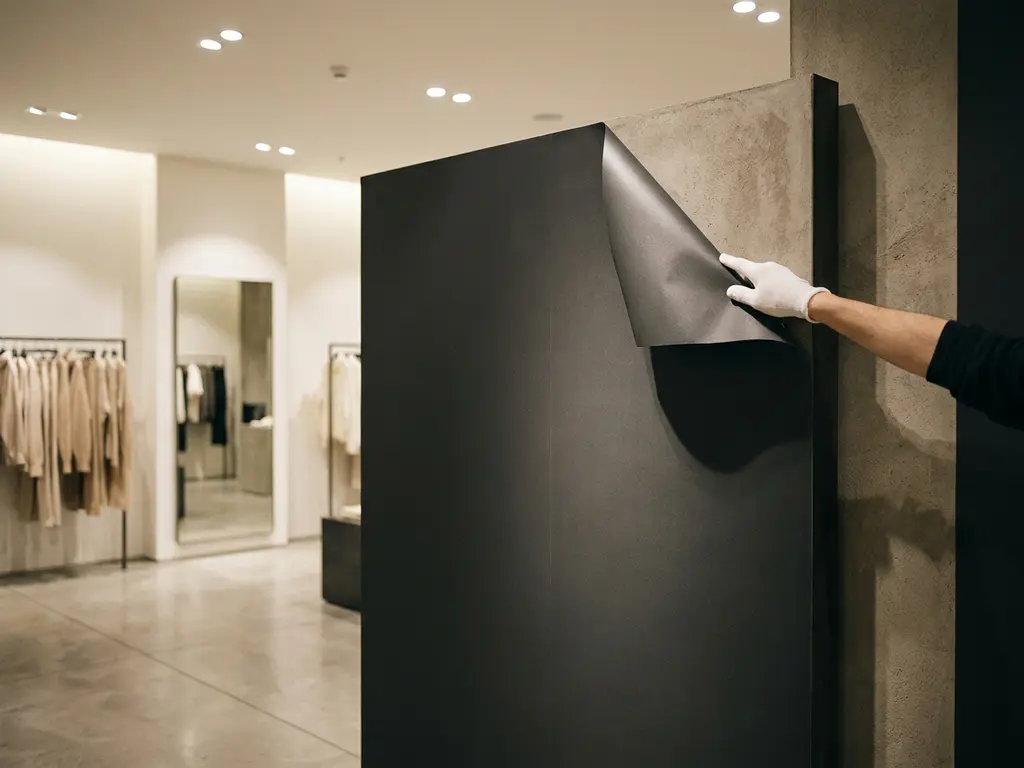
For example: Self-adhesive shop window film that can be removed without leaving any residue does not interfere with the building structure. However, fixed-mounted illuminated advertising signs certainly do. The boundary runs where a measure is reversible and harmless to the material structure or not.
How lease agreements and landlord consent determine the design
The lease agreement is the most important document when it comes to determining what you are allowed to do with your retail space. Many commercial lease agreements contain specific clauses regarding the use, design, and return of the space. These clauses supersede general lease law provided they are legally valid.
Typical provisions in the commercial lease agreement include:
- Permit or prohibition of certain types of use (e.g., gastronomic use, storage of certain materials)
- Requirements for shop design and outdoor advertising
- Obligation to obtain written approval before carrying out construction work
- Regulations for returning the area to its original state
If an explicit regulation is missing in the contract, the general commercial lease law applies. There, it states that the landlord must agree to changes that go beyond the contractual use. Consent should always be given in writing They are obtained in order to have clarity in the event of a dispute. Oral agreements are difficult to prove and offer no reliable protection in the event of a conflict.
What design measures are possible without approval
Not every design measure requires a permit. Measures that can be removed without leaving any trace or damaging the building structure are usually exempt from permits. This is an important basis for many modern print media and films.
The following measures are typically considered to be exempt from approval:
- Removable films on glass surfaces: Window film, privacy film or decorative film that can be removed without leaving any residue does not interfere with the substance.
- Temporary floor coverings: Special floor films for sales areas that are designed for use on floors and can be removed without leaving any residue are generally considered decorative.
- Suspended or framed wall designs: Pictures, posters, or textile prints that are mounted without drilling or gluing do not permanently alter the wall.
- Free-standing displays and stands: Unattached POS materials can be removed at any time, making them hassle-free.
Important: Even if a measure is technically not subject to approval, the rental agreement may stipulate a requirement to post a notice. Please read the contract terms carefully and, if in doubt, check with the landlord beforehand.
Properly assessing the demolition obligation and liability
Building on the understanding of which measures are subject to approval, the next practical question arises: What happens during the move-out? Demolition obligation is a central concept in commercial lease law and concerns all changes made by the tenant.
In principle, this applies: Whoever makes changes must also restore the original state of the property. This means that all installations, modifications and changes that go beyond the original condition of the property must be removed at the end of the lease at the expense of the tenant, unless the landlord explicitly waives the removal.
The following principle applies to liability:
- Damage caused by demolition: If damage is caused to the building structure during the removal of fixtures, the tenant is liable for it.
- Non-removable fixtures: If fixtures remain in place without the landlord's consent, the landlord may demand compensation for the damage or charge the costs of removal.
- Protecting written agreements: If the landlord wants to undertake certain renovations, this should be recorded in writing to avoid any later disputes.
A practical example: Wall decoration with self-adhesive film that peels off the wall can lead to claims for damages. Therefore, use materials that are suitable for the respective substrate and can be removed without leaving any residue.
Maximizing design freedom – legally secure and flexible
The goal is clear: you want to customize and effectively design your retail space without incurring legal risks. This is possible if you take a systematic approach and choose the right materials and methods.
The following strategy helps you combine freedom of design with legal certainty:
- Check the rental agreement before starting: Read all the terms of use, design, and return carefully. Mark any points that are unclear and clarify them in writing with the landlord.
- Obtain permits in writing: For all measures that go beyond decorative films and removable elements, obtain written consent.
- Prefer reversible materials: Opt for films, textiles and displays that can be removed without leaving any residue or damaging the substrate. This protects you during return.
- Create documentation: Take photographs of the condition of the area before the design work begins. This documentation is valuable in disputes over the original condition.
- Reconstruction agreements to be reached: If the landlord wants to undertake renovations or refuses to demolish the property, be sure to document this in writing.
Especially in the area of shop window design and wall decoration, modern printing media offer a wide range of possibilities today. High-quality removable foils, printable textiles and temporary floor coverings enable professional, brand-specific designs that can be easily removed upon removal or when campaigns change. This significantly reduces the risk of damage during removal and gives you the flexibility that a modern store concept requires.
How com2C helps you design your store space
We know that the design of a retail space in rental law often depends on one point: the right materials. Reversible, residue-free printing media are not only legally advantageous; they must also look attractive and function reliably technically. That is exactly what we develop and deliver our products for.
Our Interior Film Collection by com2C Includes materials specifically designed for indoor use. Whether window film, glass decor film, wall film or floor decals: We offer printing media that look professional and can be easily removed for removal or campaign changes.
- Self-adhesive films with residue-free peelability for glass, walls and floors
- printable textiles and vinyl wallpaper for temporary and permanent wall designs
- Materials compatible with all common large format printers (HP, Epson, Roland, Mimaki and others)
- Technical advice on substrate suitability and processing recommendations
- Fast delivery and flexible quantities for seasonal campaigns and individual projects
If you have specific requirements for your store space or are unsure which material is suitable for your subfloor and its lifespan, please contact us. Consultation helps you make the right decision before ordering.