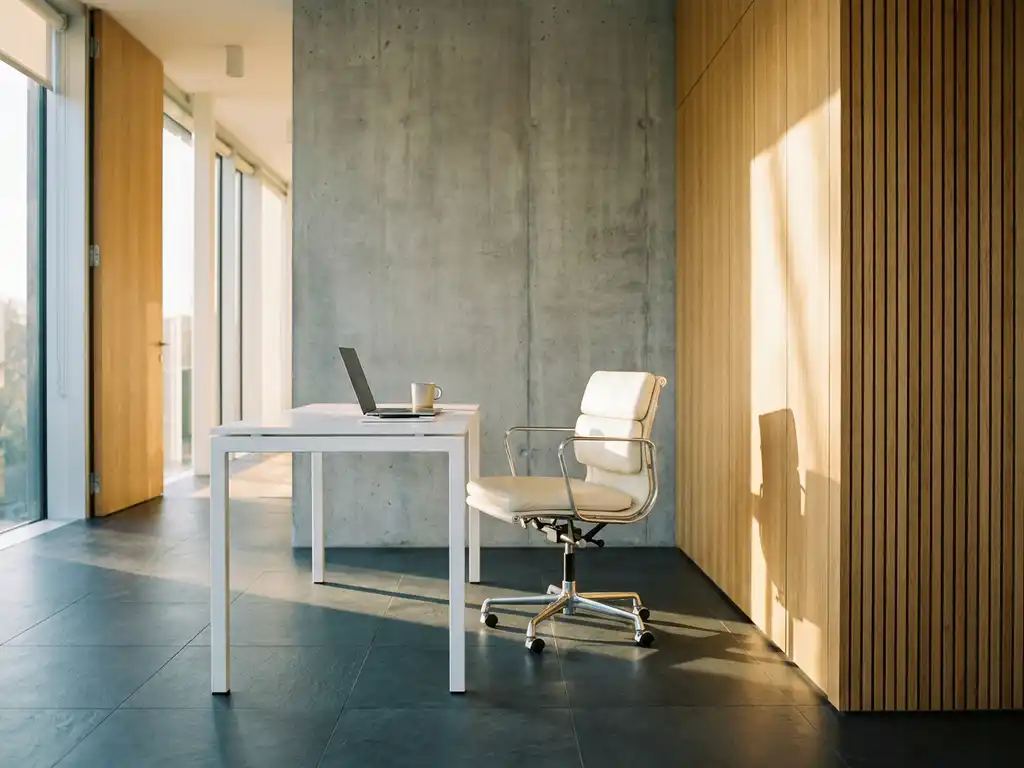
Attractive and modern offices are important because they directly influence how employees work, how customers perceive the company, and how strongly employees identify with their employer brand. Thoughtful office design is not a luxury, but a functional investment in productivity, well-being, and external impact. The following sections answer the most important questions about modern office design and wall art in the office.
What makes an office an attractive workplace?
An attractive workplace combines three factors: functional space planning, a pleasant atmosphere, and a consistent visual appearance. Employees feel comfortable in offices that offer brightness, order, and a clear spatial structure. At the same time, the quality of design plays an important role, as rooms that are aesthetically pleasing strengthen the sense of belonging and identification with the company.
Specifically, this means sufficient daylight, ergonomic furniture, good acoustics, and a well-thought-out color scheme. In addition, there is the visual design of the walls and glass surfaces. Empty walls appear impersonal and cold. Walls that are designed with brand messages, orientation elements, or high-quality print motifs give the room character and structure. Office atmosphere is not created by chance, but through conscious decisions in the room design.
How does office design affect employee productivity?
Office design influences productivity because it determines how well employees can concentrate, orient themselves, and feel comfortable. Well-designed workspaces reduce distractions, promote communication in team areas, and signal to employees that their work environment is taken seriously. This directly impacts motivation and willingness to perform.
Studies in work psychology consistently show that the quality of the environment and well-being at work are closely linked. Specific factors include:
- Zoning: Clearly defined areas for concentration, collaboration, and relaxation help employees mentally switch between different work modes.
- Visual stimuli: Too much visual disturbance disrupts concentration; too little design creates monotony. A balanced wall design in the office creates the right balance here.
- Orientation: Clear guidance systems and signage reduce friction losses in everyday work, especially in larger office buildings.
- Identification: When employees experience their workplace as high-quality and well-thought-out, the emotional bond with the company increases.
What role does corporate design play in office design?
The corporate design gives office design a visual language and makes the brand presence in the space tangible. Colors, typography, image worlds, and design elements from the corporate design should be consistently applied throughout all areas of the office, from the entrance hall to meeting rooms and communal spaces. This creates a cohesive overall image that looks professional both to employees and visitors alike.
Corporate design in the office is more than decoration. It communicates values, positioning, and corporate culture. A technology company that wants to emphasize innovation will set different visual accents than a law firm that emphasizes seriousness and trust. Both are correct as long as the design is implemented consistently and authentically.
In practical terms, this means wall panels with brand motifs, printed glass decor panels for conference rooms, individually designed reception areas, and typographic elements on wall surfaces. These measures can be implemented precisely and reproducibly using modern printing media.
Which materials are suitable for wall decoration in the office?
For office wall decoration, vinyl wallpaper, self-adhesive wall foils and glass decorative foils are particularly suitable. The choice of material depends on the substrate, the desired appearance and the intended duration of use. For temporary designs, residue-free foils are recommended; for permanent solutions, high-quality vinyl wallpaper or permanently adhesive printing media are ideal.
Vinyl wallpaper for office spaces
Vinyl wallpaper can be printed in large format and offers a high-quality, seamless look. They are particularly suitable for reception areas, meeting rooms and hallways where a representative impression is important. Vinyl wallpaper is easy to handle, dimensionally stable and can be removed again if necessary.
Glass decorative films for offices
Glass decorative films are one of the most flexible solutions for modern office design. They can be applied to glass partitions, doors, and windows and simultaneously fulfill several functions: visual protection, room design, and brand communication. With individually printed glass decorative films, conference rooms or entrance areas can be designed specifically without having to forgo natural daylight.
When is an individual printing solution worth considering instead of standard material?
An individual printing solution is worthwhile when standard materials do not meet the specific technical or design requirements. This is often the case with unusual substrates, special formats, specific color specifications from the corporate design, or when environmental compatibility plays a role. Using standard materials risks compromising quality, precision, or durability.
Concrete situations in which individual solutions are useful:
- The substrate is uneven, structured, or difficult to access, and standard films do not adhere reliably.
- The corporate design requires precise color reproduction, which is not achievable with catalog products.
- The project requires PVC-free or particularly environmentally friendly materials.
- Special formats or unusual dimensions make pre-made products impractical.
- The application places particular demands on light transmission, scratch resistance and resistance to cleaning.
In these cases, collaboration with a specialized manufacturer is beneficial, as they can tailor materials to meet specific requirements.
How do you plan a professional office design step by step?
Professional office design begins with an inventory of the spaces and a clear definition of the goals. Those who approach this process in a structured manner avoid costly corrections and achieve a harmonious result. The planning process can be divided into five steps:
- Defining requirements: Which areas are to be designed? What function does each room have? What message is the design intended to convey?
- Incorporate corporate design: Use colors, fonts, image worlds, and design guidelines from the brand manual as a basis.
- Choosing the right material: Check the substrate, consider its lifespan and maintenance requirements, and select suitable printing media.
- Preparing print data: Create motifs in the correct resolution and with the correct color profile, plan for dimensional tolerances.
- Coordinate processing: Ensure assembly by experienced installers or room planners, and coordinate scheduling with the ongoing office operations.
The third step is particularly important. The choice of material determines to a large extent whether the result is durable and visually appealing. By relying on expert advice from a specialist supplier, you save time and avoid errors that become apparent only during assembly.
Office design with com2C: Materials that really work
From our daily work with our clients, we know that attractive offices are not hindered by good ideas, but by materials that do not meet the requirements. This is where we step in.
Our Interior Film Collection by com2C This includes glass decorative films, vinyl wallpaper, self-adhesive wall foils and other printing media that have been specially developed for demanding interior design projects. We manufacture our own products, test each material in our own laboratory and can tailor products to your specific requirements if standard products do not meet your needs.
- Glass decorative films for offices with precise color reproduction and reliable adhesion on smooth surfaces
- Large-format vinyl wallpaper for reception areas, meeting rooms and hallways
- PVC-free alternatives from our GoGreener line for projects with sustainability requirements
- Compatibility with all common large-format printers, including HP, Epson, Roland, and Mimaki
- Quick availability and direct advice from our expert team
If you are planning an office project and are unsure which material is best suited for your specific application, we are happy to help you. Simply contact us. Contact, we will find the right solution together.