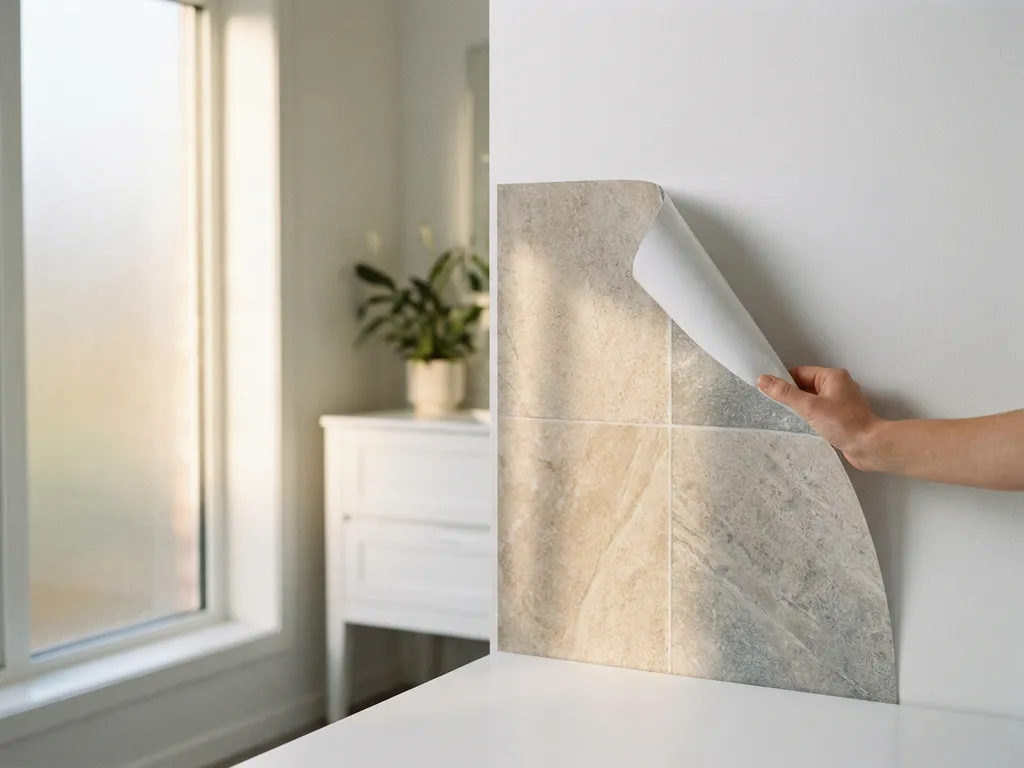
Self-adhesive films made from high-quality polyvinyl chloride or PVC-free alternatives can be removed without leaving any residue from the shower wall, provided the surface is smooth, clean, and non-porous. The quality of the adhesive layer is crucial: repositionable adhesive technology developed specifically for humid environments dissolves cleanly when removed and leaves no adhesive residue. The following sections answer the most important questions about shower wall films, suitable substrates, and the correct removal method.
Which materials can be removed without leaving any residue from the shower wall?
Self-adhesive films with a specially formulated, moisture-resistant adhesive layer can be removed without leaving any residue from the shower wall. The prerequisite is that the material has been designed for the wet area and uses a so-called repositionable or residue-free adhesive technology. Cheap films with aggressive permanent adhesive are, however, often not easily removed without leaving any residue.
Basically, two material categories are suitable for shower walls:
- Self-adhesive vinyl films with moisture-resistant adhesive: These films are designed specifically for use on walls. The adhesive layer adheres reliably to smooth tiles, glass, or acrylic, but can be removed cleanly and without residue after heating with a hot air gun.
- PVC-free films with water-based adhesive: PVC-free alternatives that offer similar load-bearing properties. They are particularly suitable for tenants who want to avoid PVC while at the same time not risking damage to the building structure.
Important: Not every film marketed as „self-adhesive“ is suitable for use in humid environments. When purchasing, be sure to look for the specific mention of „humid room“ or „wet area“ in the product description.
How long does a self-adhesive shower wall film last in a humid environment?
A high-quality self-adhesive shower wall film lasts between three and seven years in a humid environment when properly applied. The actual durability depends on the quality of the material, the preparation of the substrate, and the intensity of daily moisture exposure.
The following factors significantly affect the lifespan:
- Substrate preparation: Fat-free, clean, and completely dry surfaces are the foundation for maximum adhesion. Calcareous or soap residues under the foil significantly shorten the shelf life.
- Edge sealing: Open edges are the most common weakness. If you seal the edges with a transparent, waterproof silicone or a edge sealant, the shelf life is significantly extended.
- Ventilation behavior: Showers without adequate ventilation produce persistent moisture and condensation. Regular ventilation after showering protects both the foil and the substrate.
- Material quality: Films with a UV-stable and moisture-resistant coating last longer and do not fade due to steam or cleaning agents.
As a rough guideline, it is worth noting that if you use the film as a temporary solution for a rental apartment, with good quality and careful workmanship, you can enjoy it for several years without any problems.
What is the difference between printed film and shower wall panels?
Printed films are thin, flexible self-adhesive media that are applied directly to the existing substrate. Shower wall panels are rigid elements made of acrylic, aluminum composite or glass that are fixed or bonded in place. The main difference lies in their assembly, reversibility and their impact on the building structure.
Printed films: flexible and residue-free to remove
The films can be applied to existing tiles, glass or smooth wall surfaces without permanently altering the surface. They are ideal for rental properties, as they can be removed without leaving a trace when moved out. Assembly does not require any tools or craftsmen. Individually printed variants allow for any motif in any size, from natural stone look to personal photos or graphic patterns.
Shower wall panels: durable and time-consuming
Plates offer a more robust surface and are more durable in highly intensive use. However, they usually require permanent bonding or screwing, which involves interfering with the building structure. Removal is time-consuming and often leaves traces. For tenants or anyone who wants to remain flexible, plates are therefore the inferior choice.
Which surfaces are suitable for residue-free removable shower wall foils?
Removable shower wall films reliably adhere to smooth, non-porous surfaces. Glazed ceramic tiles, glass, acrylic, painted walls, and smooth plastic coverings are particularly suitable. Harsh, porous, or uneven surfaces are unsuitable, as the adhesive layer cannot form a uniform bond there.
An overview of suitable and unsuitable substrates:
- Suitable for: Glazed tiles (smooth and without joints), glass, acrylic glass, painted walls (gloss paint), aluminum composite panels, smooth plastic surfaces
- Suitable for: Struktur tiles with a slight texture (depending on the depth of the texture), silk matte paint (check the warranty)
- Not suitable: Rough natural stone surfaces, unpainted walls, highly textured tiles, wallpaper, fresh plaster, surfaces with lime or silicone residues
Tip: Test the film before fully processing it on a small, inconspicuous area. This way you can see if the adhesive is sufficient and whether the film peels off cleanly when removed.
How to remove a shower wall film without leaving any residue?
Shower wall film is removed without leaving any residue by slowly and uniformly removing it under heat. A hot air iron or heat gun softens the adhesive layer, allowing the film to be removed cleanly and without any adhesive residue. Rapid or cold removal, on the other hand, often leads to cracks and leaves adhesive residues.
The step-by-step procedure:
- Clean surface: Remove lime, soap, and dirt from the foil surface before starting. This makes heating up even more efficient.
- Solve the corner: Gently lift a corner of the foil with a fingernail or a soft plastic spatula. Do not use metal to avoid damaging the substrate.
- Apply heat: Keep the hair dryer on medium heat at a distance of about ten to fifteen centimeters. Heat the foil evenly while you are peeling it off slowly and at a slight angle (below 30 degrees).
- Draw evenly and slowly: Do not pull the film abruptly, but in a continuous, smooth motion. Pulling it off too quickly increases the risk of tearing.
- Remove adhesive residue: If any small adhesive residues remain, remove them with a mild isopropyl alcohol cleaner or conventional adhesive remover without damaging the underlying surface.
Which print media are suitable for individually printed shower wall films?
Self-adhesive digital printing films with a moisture-resistant coating and water-resistant ink compatibility are suitable for individually printed shower wall films. The material must be UV-stable, dimensionally stable, and provided with a protective lamination to withstand steam, cleaning agents, and direct contact with water for a long time.
When choosing the printing media for shower wall applications, the following characteristics are important:
- Water resistance: The carrier material and the coating must withstand prolonged moisture without warping, swelling or fading.
- Protective lamination: A matte or glossy protective film over the print protects the ink from steam, cleaning agents, and mechanical stress.
- Compatibility with latex or UV inks: These tinting systems are particularly moisture-resistant and are therefore better suited for wet area applications than water-based pigment tints without lamination.
- Repositionable adhesive layer: For wet applications requiring the removal of residues, the adhesive layer should be explicitly indicated for use in wet rooms.
- PVC-free alternatives: Nowadays, there are moisture-resistant films without PVC that offer similar technical properties.
If you would like to commission an individually printed shower curtain film, specifically ask the printing service provider of your choice to meet these requirements. An experienced digital printer will select the appropriate substrate and the correct lamination for your specific application.
Individual shower wall panels with com2C as the material base
At com2C, we develop and deliver the print media on which print service providers and advertising technicians produce individual shower wall foils for end customers. If you are looking for a custom-made, printed solution for your shower, our materials are the technical foundation for this.
- Self-adhesive films with moisture-resistant adhesive coating, designed for wet area applications
- Materials compatible with leading manufacturers’ latex, UV and solvent printing systems
- PVC-free options from our GoGreener line
- Precise color reproduction through proprietary inkjet coatings from our chemical laboratory
- Consulting on material selection and processing by our expert team
Our Films for kitchen backsplashes and wet rooms Showcase the quality and variety available for individually printed self-adhesive solutions. If you have any questions about suitable materials for your specific application, we are happy to assist you. contact us and we will help you further.