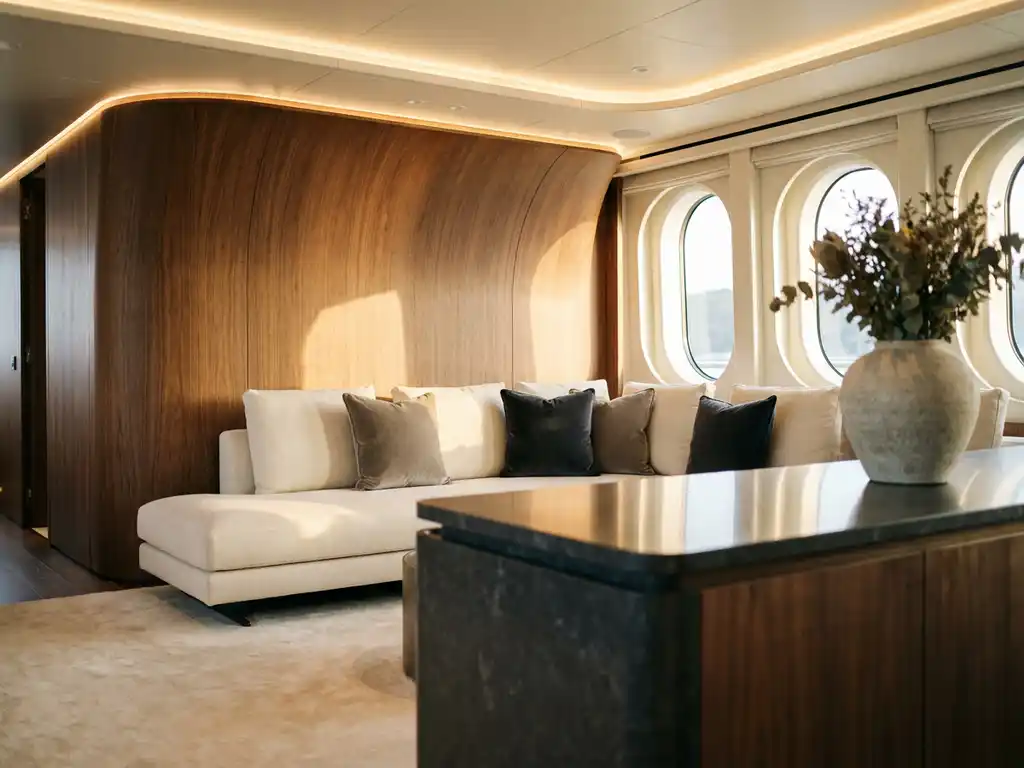
High-quality materials for the yacht interior combine aesthetic quality with technical durability. Printed textiles, wall foils, glass decorative foils, and individual surface designs noticeably enhance the sense of space on board and make the difference between a functional ship and a truly impressive interior. This article answers the question of which materials are suitable, what requirements they must meet, and how individual designs can be implemented.
Which materials are most commonly used in high-quality yachts?
In high-quality yachts, printed textiles, self-adhesive wall foils, glass decorative foils and vinyl wallpaper are used primarily. These materials enable individual room design that is both aesthetically pleasing and functional. They are complemented by floor foils and backlit foils for illuminated design elements in cabins and lounges.
The range of printing media used is wider than many people might think. Self-adhesive films are suitable for wall surfaces, furniture surfaces and glass fronts. Printed textiles bring softness and acoustic insulation to cabins and lounges. Vinyl wallpaper allows for large-format motifs without visible seams. Backlit films add a striking effect of light in passageways or behind cladding. Floor foils provide visual orientation and design accents on decks or in interior spaces.
What these materials have in common is that they are produced in large-format printing, which enables seamless, precise surfaces tailored to the specific dimensions of a yacht.
How do printed textiles and wall panels affect the sense of space on a yacht?
Printed textiles and wall panels fundamentally change the spatial feel of a yacht. They bring depth, warmth, and visual texture to spaces that would otherwise appear bare and technical without design. Large-scale motifs make cramped cabins appear even more spacious, while smooth textures make lounge areas more inviting.
Textiles have a special advantage here: they absorb sound, which makes a significant difference in a ship’s hull made of metal or fiber-reinforced materials. Conversations sound more natural, engine noises are muffled. At the same time, printed fabrics bring a tactile quality that foils alone cannot achieve.
Wall films, on the other hand, excel in precision and ease of installation. They can be precisely cut to fit any wall surface, niche, or cladding, do not absorb moisture, and are easy to clean. For areas such as bathrooms, hallways, or kitchen areas, they are the more practical choice. Both materials can be combined to create different zones on board and to separate them from each other.
What requirements must materials on a yacht meet?
Materials for the yacht interior must meet requirements for moisture resistance, salt air resistance, dimensional stability, and fire protection. At the same time, they must not emit gases, as the air in enclosed cabins is directly inhaled. This significantly restricts the choice and makes material selection a technical decision, not just a design one.
Moisture and salt air resistance
Yachts are permanently exposed to a combination of moisture, salt air, and temperature fluctuations. Materials that work well on land can deteriorate, peel off, or fade when used on board. Films and textiles for the yachting industry therefore require coatings or carrier materials that can withstand these conditions over time.
Fire protection and gas emission behavior
International shipping regulations set clear requirements regarding the fire behavior of interior building materials. Many certifications require proof of flame retardancy and smoke development. Equally important is the gas emission behavior: materials that emit volatile organic compounds (VOC) significantly burden the air in enclosed cabins. PVC-free and emission-free materials offer a clear advantage in this regard.
What distinguishes PVC-free printing media from conventional foils for yacht interiors?
PVC-free printing media do not release any plasticizers or chlorine compounds, making them significantly more suitable for use in enclosed spaces such as yacht cabins. Conventional PVC films can emit gases under heat and UV exposure and, in the long term, compromise the air quality in the room. PVC-free alternatives offer comparable print quality without these drawbacks.
This is particularly relevant for the yacht interior, as cabins are often poorly ventilated and temperatures rise sharply in summer. Conventional PVC films can develop unpleasant odors under these conditions and permanently damage surfaces. PVC-free materials remain stable and odor-neutral even at higher temperatures.
Furthermore, PVC-free printing media are easier to dispose of and increasingly meet sustainability requirements, which are gaining importance also in the yachting industry. Those who value durability and environmental compatibility choose PVC-free films and textiles for interior decoration specifically.
How can individual designs and brand identity be implemented on a yacht?
Individual designs and brand identity can be implemented on a yacht through custom-made printed media that are precisely tailored to the dimensions and design concept. Wall panels, textiles, and glass decorative foils can be printed with logos, color palettes, patterns, or photo motifs that create a cohesive overall look.
Large-format printing enables seamless wall surfaces of any size, allowing irregular floor plans and curved surfaces to be designed precisely. For charter companies or companies with their own fleet, this is a direct way to extend corporate design consistently throughout the interior.
The combination of different materials is particularly effective: a wall panel with a calm background pattern, complemented by printed textiles in matching colors and a glass decorative panel with a discreet logo print, creates a cohesive interior that looks professional without being intrusive. It is crucial that all materials come from a coordinated production process, so that colors and surfaces actually match.
Press media for yachts from com2C
We know that the yachting sector places special demands on materials; standard materials often do not meet these requirements. Moisture resistance, gas emission behavior, dimensional accuracy, and design quality must all be in perfect harmony. That is exactly why we develop and produce printing media that function reliably in demanding environments.
- PVC-free films and textiles from our GoGreener line for emission-free, space-friendly applications in cabins and lounge areas
- Custom-made wall panels and vinyl wallpaper for seamless surface designs that are precisely tailored to the dimensions of your yacht
- Textiles that can be printed with acoustic properties for areas where sound absorption and aesthetics are equally important
- Glass decorative films for separating elements, eyelets and interior glazing with individual motifs or logo prints
- Technical consultation through our expert team, which knows the specific requirements of yacht interiors and recommends suitable materials
Our Interior Film Collection by com2C offers a curated selection of films and textiles specially designed for high-quality interior projects. If you are planning a specific project or have questions about the material selection, we are happy to assist you. Consultation available.