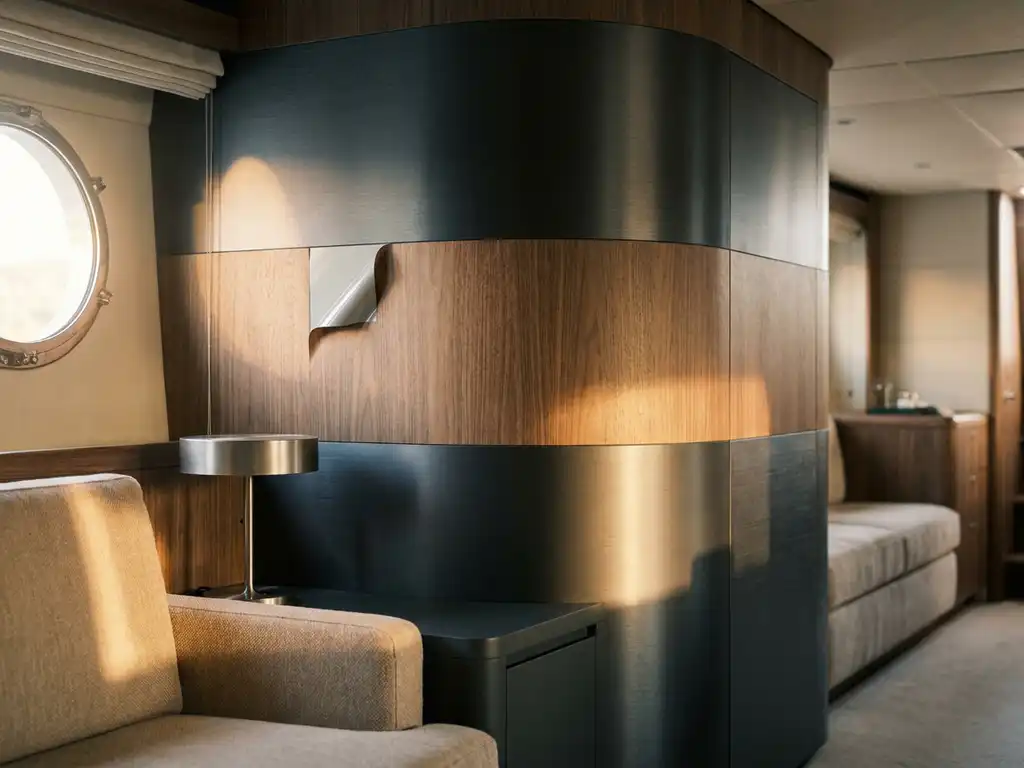
Yes, you can modernize the yacht’s interior in many areas without having to bring the yacht to a shipyard. Self-adhesive foils, printed wall designs, and textile printing media can be processed directly on board and achieve a result that is visually and technically convincing. The following questions clarify the specific options available and what you should pay attention to when implementing them.
What can be changed in the yacht interior without a shipyard visit?
Without a shipyard stay, wall surfaces, ceilings, cabinet doors, glass surfaces, floors, and furniture surfaces can be redesigned using self-adhesive films or printed media. Guide systems, cabin numbering, and decorative elements can also be renewed without disassembly or remodeling. The only prerequisite is that the surfaces are clean, smooth, and free of grease.
Specifically, this means that cabin walls can be covered with vinyl wallpaper or self-adhesive decorative films, glass partitions can be fitted with new privacy or decorative films, and floor coverings in corridors or areas for rest can be upgraded with anti-slip floor films. Even backlit displays in the reception area or in the lounge can be replaced without interfering with the building structure. The effort remains manageable, and the visual effect is significant.
Which materials are suitable for use on yachts?
Self-adhesive films with moisture-resistant coatings, UV-resistant printing media, and vinyl wallpaper with water-repellent coating are particularly suitable for use on yachts. The maritime environment places special demands: salt fog, temperature changes, and increased humidity stress materials more severely than in normal indoor environments.
The following material types have proven themselves in practice:
- Self-adhesive vinyl films with an air channel-based adhesive layer for bubble-free processing on smooth surfaces
- UV-resistant printing media for areas with direct light or window contact
- Moisture-resistant vinyl wallpaper for cabin walls and living areas
- Glass decorative films for partition walls, bullauge frames and privacy protection applications
- Anti-slip floor films for corridors and outdoor areas with access
- PVC-free materials for applications where environmental compatibility and odor neutrality are important
What is important is that the materials not only look good but are also technically suitable for the environment. A material that lasts for years in an office can fail within a few months on a yacht under salt air and condensation water.
How are self-adhesive films applied to yacht surfaces?
Self-adhesive films are applied to yacht surfaces by thorough cleaning, degreasing, and subsequent rubbing with a felt roller. Air bubbles are systematically worked out from the center outwards. For profiled or curved surfaces, a film with air channels in the adhesive layer is recommended, as this significantly facilitates the processing.
The processing steps in a nutshell:
- Prepare the surface: Degrease the surface with isopropanol or a suitable cleaner and allow it to dry completely
- Position the foil: Align the film with the masking paper on the surface before the adhesive layer is exposed.
- Choose the wet or dry method: For large areas, wet bonding with mounting fluid is recommended; for smaller areas, the dry method is sufficient.
- Getting excited: Film with uniform pressure from the center outwards, preventing air inclusions
- Edges secure: Firmly press the edges with the curling iron or heat them slightly with a hot air iron if necessary to improve adhesion
On yachts, it is particularly important to ensure that surfaces made of teak, laminate or composite materials have different adhesion properties. A preliminary adhesive test should be carried out on porous or textured substrates.
How long do printed foils and wall designs last on a yacht?
Printed films and wall designs last between three and seven years on yachts when properly processed and using suitable materials. The actual lifespan depends on UV exposure, humidity, the quality of the substrate and care. Indoor spaces without direct sunlight usually achieve longer lifetimes.
Areas such as cabins, corridors and lounges that are protected from direct sunlight approach the upper end of this range. Outdoor areas or areas near the eyes with strong UV exposure shorten their lifespan. UV-laminated or UV-resistant media should be used here, which significantly prolongs color retention.
Regular maintenance extends the lifespan: Films should be cleaned with mild, non-abrasive cleaning agents. Aggressive solvents or high-pressure cleaners damage the surface and the adhesive layer. If edges begin to peel off, they can often be fixed again with a hair dryer and light pressure, without having to replace the entire film.
How much does an interior modernization with print media cost compared to the shipyard?
Interior modernization with print media costs a fraction of a comparable shipyard stay. While a shipyard stay for interior renovations quickly reaches five-figure sums and puts the yacht out of commission for weeks, with foils and print media, entire cabins can be redesigned for a few hundred to a few thousand euros.
The cost advantages arise on several levels:
- No extra bed charges: The yacht stays in the water and does not lose any operating time
- Shorter processing time: Refinishing work takes hours to days, not weeks
- Less material consumption: Print media do not require disassembly, priming, or the reconstruction of surfaces
- Reversibility: The films can be removed without leaving any residue, which saves time and money when selling or redesigning the space.
A fair comparison, however, also takes into account limitations: structural damage, moisture damage to the building structure, or the replacement of interior fittings still require a shipyard. Print media are a useful solution for artistic renovation, not for technical repairs.
Which areas of a yacht benefit most from pressure solutions?
Cabin, corridor, lounge and saloon areas, as well as glass partitions, benefit the most from pressure solutions. These areas have large, easily accessible surfaces, are highly visible and directly influence the overall impression of the interior. At the same time, they are usually easy to glue because the surfaces are flat and smooth.
In detail, the following areas are available:
- Cabin walls: Individual motifs, wood effects or monochrome colors with vinyl wallpaper or decorative film
- Corridors and passages: Control systems, cabin numbering, decorative strips
- Salon and lounge: Large-format wall designs that convey atmosphere and brand identity
- Glass surfaces and partitions: Privacy screens, milk glass lenses or printed motifs
- Floors in hallways: Anti-slip floor films with routing or design elements
- Backlit displays: Illuminated signs in the reception area or in the lounge for a professional look
Areas with high moisture loads, such as bathrooms or kitchens, are also possible, but require particularly moisture-resistant materials and careful edge sealing. In this case, a material consultation is worthwhile before implementation.
Modernizing yacht interiors with com2C: Materials that work in a maritime environment
We know the requirements that the maritime environment places on print media from experience. Moisture resistance, UV resistance and secure adhesion on various surfaces are not optional features, but essential prerequisites for an application that lasts.
- We supply self-adhesive films, vinyl wallpaper and glass decorative films that have been developed for demanding indoor conditions
- Our materials are compatible with all common large-format printers and ink systems, so your printing service provider can get started right away.
- We offer PVC-free alternatives from our GoGreener line for applications where environmental compatibility and odor neutrality are important
- Our technical team can advise you specifically on material selection, processing, and durability for your specific application.
- We also develop individual solutions upon request if standard materials do not meet the technical requirements.
If you would like to know which materials from our Interior Film Collection If you are looking for the best solution for your yacht, please contact us directly. Consultation This often suffices to make the right material choice and avoid costly mistakes.