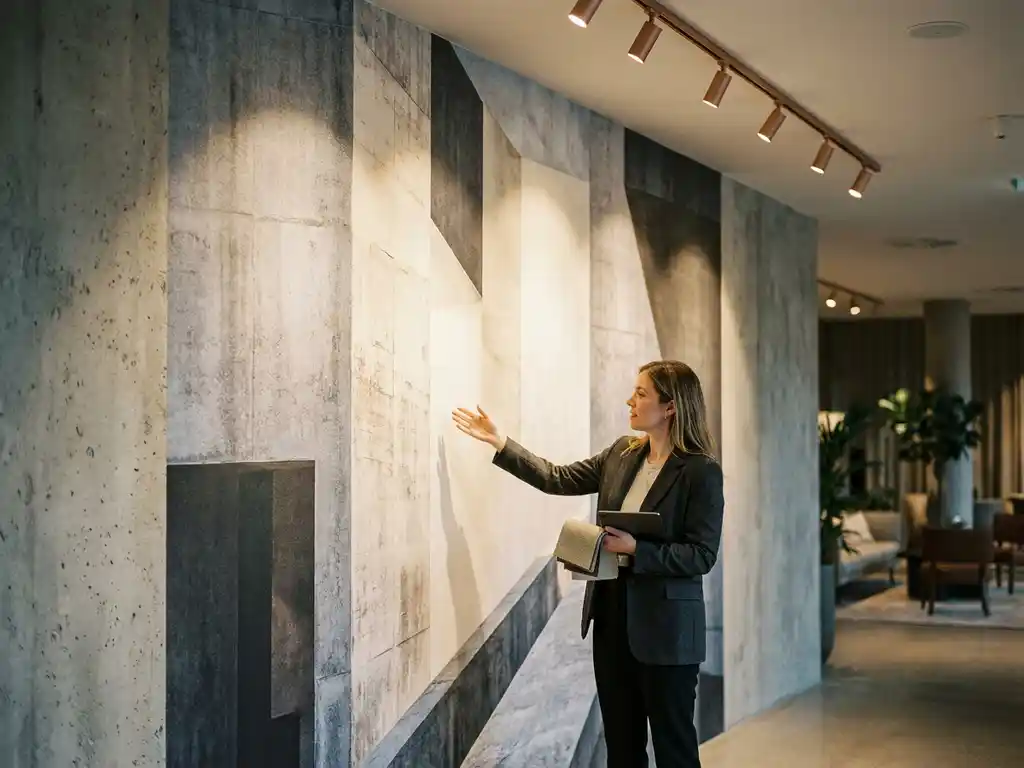
When hanging non-woven wallpaper, there are a few important points to keep in mind: the surface must be clean, dry, and flat, the paste is applied to the wall (not the wallpaper), and the strips are butt-joined rather than overlapped. Anyone who knows these basic rules will avoid the most common mistakes during installation. The following sections answer the most important questions about non-woven wallpaper in detail.
How do you properly hang non-woven wallpaper?
With non-woven wallpaper, the paste is applied directly to the wall, not to the wallpaper strip. That is the most important difference to traditional paper wallpaper. The strip is applied dry to the freshly pasted wall and butt-jointed, meaning edge to edge without overlapping. This creates a clean, uniform look.
For processing, an adhesive specifically designated for non-woven wallpaper is recommended. Universal adhesive or starch paste are often not suitable for heavy non-woven wallpapers because they do not provide enough adhesion. Apply the paste evenly to the wall with a roller and start at a straight reference line, for example at a plumb line.
The strips are applied from top to bottom and smoothed from the center outwards using a smoothing trowel or a soft brush. Air bubbles and wrinkles can thus be reliably avoided. Excess paste at the joints should be wiped off immediately with a damp sponge before it dries.
What surfaces are suitable for non-woven wallpaper?
Non-woven wallpapers adhere reliably to most smooth, absorbent surfaces. Painted walls, plasterboard, plaster, and prepared concrete surfaces are suitable. The surface must be dry, clean, and free of grease. Highly absorbent surfaces such as raw plaster should be treated with a deep primer beforehand.
Substrates with loose layers, damp spots, or heavily textured surfaces are not suitable. Non-woven wallpaper generally does not adhere sufficiently to tiles or smooth plastic surfaces. Existing old wallpapers should be completely removed, as they impair adhesion and can detach under the weight of the new wallpaper.
Special care is required with plasterboard: without primer, the material absorbs the paste too quickly, which shortens the working time and impairs adhesion. A primer balances out the absorbency and ensures an even result.
What are the advantages of non-woven wallpaper compared to paper wallpaper?
Non-woven wallpapers are more dimensionally stable than paper wallpapers because they do not swell up when soaked with paste. This makes hanging them significantly easier and more forgiving of mistakes. In addition, non-woven wallpapers can generally be removed from the wall dry and without leaving any residue, which saves a considerable amount of time when redecorating.
Further benefits at a glance:
- No soaking required: The strip is processed dry, the paste goes on the wall.
- Higher tear resistance: Nonwovens tear significantly less often during application than paper wallpapers.
- Better breathability: Nonwoven fabric regulates moisture better and is therefore also suitable for living spaces with a changing climate.
- Simple removal: Non-woven wallpapers can usually be peeled off dry in one piece.
- Overprintable: Printable non-woven wallpapers for large-format printing are specially designed for high-quality digital printing applications.
Which printing inks and systems are compatible with printable non-woven wallpapers?
Printable non-woven wallpapers for digital printing are generally compatible with water-based ink systems, meaning latex and aqueous inks. These ink systems are particularly suitable for interior applications because they are low-odor and do not contain problematic solvents. Many non-woven materials are also approved for UV-curable inks.
Solvent inks are less commonly used for non-woven wallpapers because the strong solvents can attack the non-woven substrate. If solvent printing is desired, the print media should be explicitly designated as solvent-compatible.
For use on large-format printers from manufacturers such as HP, Epson, Roland, Mimaki, or Durst, the non-woven material should include the corresponding ICC profiles and print parameters, or at least have them available upon request. Print resolution, ink volume, and drying settings significantly influence image quality and ink adhesion on the non-woven material.
How to remove non-woven wallpaper without leaving any residue?
Non-woven wallpapers can in most cases be removed dry and without leaving any residue. To do this, loosen the wallpaper slightly at a corner or seam and pull the strip slowly and evenly off the wall, at as shallow an angle as possible. If the substrate was well prepared and a suitable paste was used, the wall will remain clean in the process.
If wallpaper paste residue remains on the wall, it can be easily wiped off with warm water and a sponge. It is important that the surface dries completely after removal before applying new wallpaper or paint.
With older non-woven wallpaper or when using the wrong type of paste, it can happen that the top layer separates from the backing and the backing remains on the wall. In this case, water or a commercially available wallpaper remover helps to loosen the remaining backing.
When should non-woven wallpaper be chosen instead of other wall coverings?
Non-woven wallpapers are the right choice if you want to implement large-format wall designs with high image quality that are at the same time easy to hang and remove again. They are particularly suitable for interiors where solvent odors are to be avoided, as they are printed with low-odor latex or aqueous inks.
Compared to self-adhesive films, non-woven wallpapers offer better results on uneven or slightly textured walls because they bridge small irregularities more effectively. Compared to textile tension frames or acrylic panels, they are significantly lighter and more cost-effective to produce, making them attractive for temporary installations, trade fairs, or changing interior concepts.
Non-woven wallpapers are less suitable for permanently damp rooms such as bathrooms or kitchens, as moisture can impair adhesion in the long term. In such cases, coated films or other moisture-resistant wall coverings are the better choice.
Digital print non-woven wallpapers: How com2C supports you
We work daily with print service providers, sign makers, and exhibition builders who need printable non-woven wallpapers for demanding projects. In doing so, we know what matters in practice: reliable printing results, clean processing, and materials that are tailored to the respective printer and ink system.
Our printable non-woven wallpapers from com2C are PVC-free and specially developed for digital printing with latex, aqueous, and UV inks. This means for you:
- Compatibility with leading large-format printers from HP, Epson, Roland, Mimaki, and other manufacturers
- PVC-free materials without compromising on quality
- Availability of matching ICC profiles and technical printing parameters upon request
- Personal consultation on material selection for your specific printing system
- Fast delivery and reliable availability for ongoing productions
If you have any questions about the right non-woven wallpaper for your printer or if you would like to test a sample, please feel free to contact us. Get in touch and together we will find the right solution for your project.