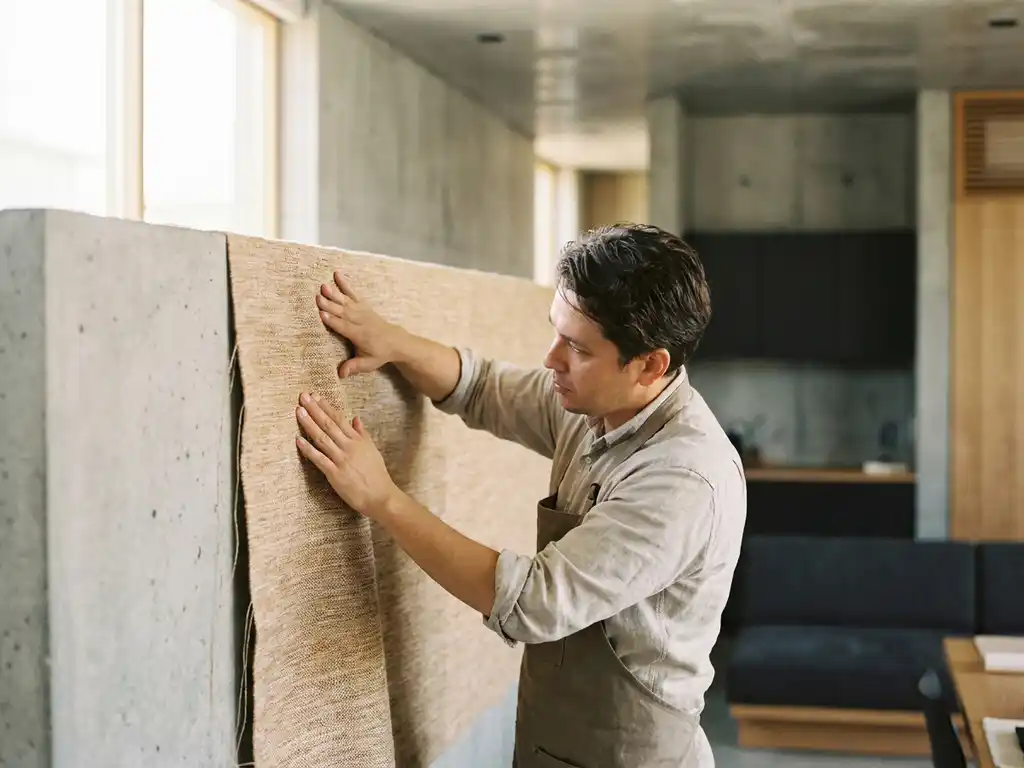
A textile wall covering is a printable or non-printable fabric applied directly to walls to visually design, structure, or acoustically improve rooms. The material can consist of polyester, polyamide, or blended fabrics and is suitable for large-format digital printing. The following sections answer the most important questions regarding materials, processing, and application areas.
What materials are used for textile wall coverings?
For textile wall coverings, polyester fabrics, polyester blends, and coated textiles are predominantly used. These materials combine durability with good printability and are available in various grammages depending on the requirements for opacity, haptics, and processability.
Polyester is the most commonly used base material because it is dimensionally stable, lightweight, and colorfast. Coated textiles are used for more demanding applications, where a special inkjet coating is applied to improve ink absorption and achieve sharp printing results. Some materials are self-adhesive, while others are stretched, glued, or clamped into profile systems.
PVC-free textile materials are becoming increasingly important, especially in indoor areas where emissions and sustainability play a role. These alternatives offer comparable printing properties without resorting to plasticizers or halogen-containing compounds.
How is a textile wall covering printed?
Textile wall coverings are printed using digital large-format printing, typically with latex, sublimation, or UV inks. The process depends on the backing material: directly printable textiles absorb the ink into the coating, while sublimation textiles are colored through heat transfer.
In direct printing on coated textiles, the inkjet coating ensures that the ink is absorbed in a controlled manner and does not bleed. The result is high-contrast, color-brilliant prints with high detail sharpness. Latex printing has proven particularly effective here because it is low-odor, dries quickly, and uses inks suitable for indoor use.
In sublimation printing, transfer paper is first printed and then transferred to the polyester fabric using heat and pressure. This process produces particularly soft transitions and is suitable for uncoated textiles. It is important that the respective textile material is compatible with the chosen printing method, as not every fabric is suitable for every ink type.
Where are textile wall coverings used?
Textile wall coverings are primarily used indoors: in retail spaces, trade fair construction, offices, hotels, showrooms, and public buildings. They serve for interior design, brand presentation, and in some cases also for acoustic improvement.
In retail and showrooms, printed textile walls enable flexible, quickly changeable surface designs. Brands can integrate large-format imagery or campaign motifs directly into the interior architecture. In exhibition stand construction, tensioned textile systems have been standard for years because they are easily transportable and reusable.
Architects and interior designers deliberately use textile wall coverings as a design element to structure spaces, set accents, or conceal existing surfaces. In office environments, sound-absorbing textile panels combine function and aesthetic appeal. Wall decoration with textiles is also gaining popularity in living areas, especially as an alternative to classic wallpaper.
What is the difference between textile wallpaper and non-woven wallpaper?
The essential difference lies in the material and processing: A non-woven wallpaper consists of a cellulose- or polyester-based non-woven fabric and is attached to the wall with paste. A textile wall covering consists of a woven fabric and is either glued, stretched, or hung in profile systems.
Non-woven wallpapers are generally easier to handle because the paste is applied directly to the wall and the material adheres well. They are well-suited for even surfaces and are available in many grammages. Their print result is matte and textured.
Fabric wall coverings, on the other hand, offer a significantly higher-quality feel and a different visual appearance. Stretched textiles look particularly elegant and can be replaced without damaging the wall. They are more durable against mechanical stress and are better suited for applications where the material needs to be changed regularly or reused. The processing effort is higher, but the result is correspondingly more sophisticated.
What advantages do PVC-free textile materials offer for wall design?
PVC-free textile materials for wall decoration avoid the use of plasticizers and halogen-containing compounds that can emit gases in indoor environments. They are lighter and, depending on the product, are certified for use in sensitive environments.
From a design perspective, PVC-free textiles present no limitations: color brilliance, image detail, and haptics are comparable to conventional materials. The difference lies in the composition and emission levels. For architects and planners aiming for sustainability certifications such as LEED or DGNB, such materials are often a prerequisite.
In practical terms, this also means: PVC-free textiles are often lighter, which makes transport and installation easier. In many cases, they are easier to dispose of or recycle. For projects with clear environmental requirements or for clients who value sustainable materials, they are the logical choice.
What should be considered when processing textile wall coverings?
When processing textile wall coverings, three factors are particularly important: the preparation of the substrate, the choice of the correct fastening system, and the management of material tension. Errors in these areas lead to wrinkles, uneven tension, or poor adhesion.
The substrate must be clean, dry, and flat. Unevenness shows through stretched textiles much more than through wallpaper because the material does not conceal texture. In the case of self-adhesive textiles, the surface must also be free of grease and have sufficient load-bearing capacity.
The choice between adhesive mounting and clamping systems depends on the intended application. Clamping systems allow for a quick change of the graphic without wall damage, but require careful installation of the profiles. When using adhesive, the curing time of the glue must be considered so that the material can be correctly aligned before it bonds.
Textiles react to temperature and humidity: they can warp if stored improperly or when rolled up. Therefore, the material should be acclimatized before processing, meaning stored at room temperature at the processing location for a few hours. During printing itself, the color consistency must be checked across the entire width, as textiles can react differently to inks depending on their weave structure.
Textile Wallcoverings with com2C: Materials That Work in Practice
We work daily with printers, sign makers, and planners who use textile wall coverings in demanding projects. In doing so, we know: it is not just about the print result, but about the entire interplay of material, ink, processing, and application site.
- We offer self-adhesive PVC-free textile materials that are specially designed for digital wide-format printing and are compatible with latex, UV- and solvent-based inks.
- Our materials are tested and optimized for inkjet compatibility in our own chemical laboratory, not just purchased and resold.
- We provide concrete advice on material selection, printing processes, and processing instructions to ensure you don't experience any nasty surprises on the construction site.
- Our claim: Our GoGreener line includes PVC-free alternatives with demonstrably reduced emission values for interior projects.
- We respond quickly and develop customized solutions if standard materials do not fit.
If you are planning a specific project or have questions about material selection, we are happy to help. Just take Contact, we will find the right solution together.