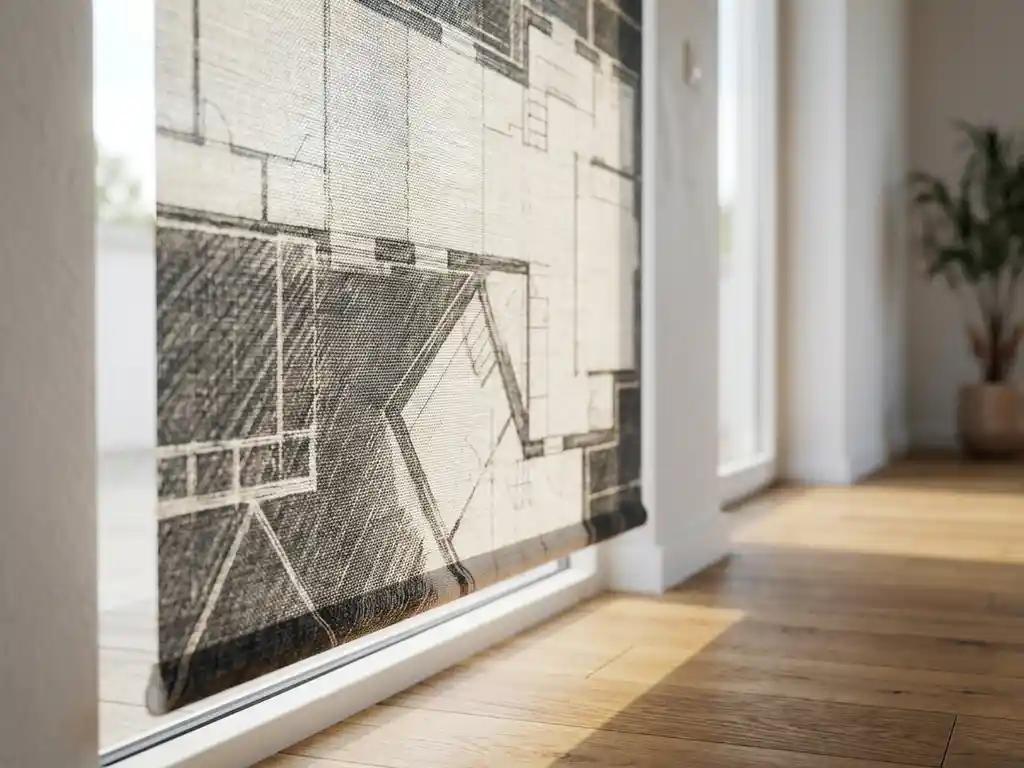
A self-adhesive roll backer is a flexible, printed film that is applied directly to existing wall surfaces or tile surfaces, creating a new visual design without requiring any structural modifications. It is particularly suitable for kitchens, bathrooms and living rooms where tiles or walls need to be quickly and cost-effectively upgraded. The following sections answer the most important questions about selection, installation and materials.
How does a roll-back wall differ from other kitchen back walls?
A self-adhesive roll back wall differs from other kitchen back walls primarily in its installation method and flexibility. While glass, tiles, or composite panels are permanently installed and mean a permanent change to the building structure, the roll back wall is simply applied and can be removed without leaving any residue if necessary. This makes it the only solution that can be done without the help of a craftsman.
Classic kitchen backsplashes made of glass or natural stone are durable but expensive to purchase and time-consuming to install. Tile backsplashes require tile work during removal and installation. Roll backsplashes, on the other hand, are printed to size, delivered as a roll, and applied directly to the existing substrate. For tenants who are not allowed to make structural changes, this is a crucial practical advantage. Even when moving, the film can be easily removed, and the original surface remains unchanged.
Which surfaces is a self-adhesive roll back panel suitable for?
Self-adhesive roll backings adhere reliably to smooth, clean, and grease-free surfaces. They are suitable for smooth tiles, painted walls, glass, wooden panels, and many plastic surfaces. Harsh, porous, or highly textured substrates such as unplastered concrete or rough wallpaper are less suitable, as adhesion is not uniform there.
Before installation, the substrate should be thoroughly cleaned and degreased. Particularly in the kitchen, fat and silicone residues accumulate, which affect adhesion. Smooth tile surfaces are ideal because they provide a uniform adhesive surface. For slightly textured tiles, the film can also work, as long as the texture is not too deep. In case of doubt, a test run with adhesive is recommended in an inconspicuous area before the entire surface is covered.
How is a self-adhesive roll backer properly installed?
Installing a self-adhesive rear film is a simple process: clean the surface, align the film, press it in gradually, and remove any air bubbles with a scraper. With the right tools and a little patience, even inexperienced users can complete the installation.
To achieve a clean result, do the following:
- Clean the surface thoroughly with detergent and water, then degrease with isopropanol and allow it to dry completely.
- Align the film at the desired position and temporarily fix it with masking tape to check the position.
- Step by step, peel off the protective film from the top down, and simultaneously press the film down with a scraper or credit card to ensure no bubbles.
- Press the edges and corners carefully to ensure no air is trapped.
- Poke any small air bubbles with a fine needle and squeeze the air out.
For larger areas, it is advisable to work in pairs. One person holds the film taut, while the other applies pressure and smooths it down. This way, you avoid wrinkles and shifting during assembly.
Can a roll back wall be removed without leaving any residue?
Yes, high-quality self-adhesive rear-facing film can usually be removed without leaving any residue, provided the film is designed for this purpose and the substrate is in good condition. It is important to peel the film slowly and at a flat angle to avoid any residue or damage to the substrate.
The quality of the adhesive plays a central role in this. Films with a so-called repositionable or residue-free adhesive have been specifically developed for applications where the substrate is intended to remain unchanged. On the other hand, cheaper products with aggressive adhesive can leave behind residues or cause paint to peel off the wall when removed. For those who want to be sure, they should specifically ask about films that are explicitly marked as being removable without residue when purchasing. This is an important selection criterion for rental properties.
Can a roll back wall be individually printed?
Yes, self-adhesive roll backdrops can be fully individually printed. Digital printers and advertising technicians can print any motif, any color and any format onto the film, from stone patterns to wood decor to custom photo motifs or patterns. This enables a design that is precisely tailored to the specific space.
The basis for an individually printed roll back wall is a printable self-adhesive film suitable for digital printing. The print file is created in the desired size and printed by a large-format printer from a printing service provider. Resolution and color profile are important to achieve a sharp and colorful result. Good printing media support precise color reproduction and are compatible with the common ink systems such as latex, solvent, or UV. The result is a custom-made back wall that stands out significantly from standard products.
What materials are used for self-adhesive roll back panels?
Self-adhesive roll backings usually consist of a printable polymer film or PVC film with an adhesive layer on the back. For kitchens and wet rooms, water-repellent, wipe-resistant materials are often used that withstand cleaning agents. Increasingly, PVC-free alternatives are also available.
Polymer films and PVC films
Classic self-adhesive films for kitchen walls are based on polyvinyl chloride (PVC) or polymer films. PVC films are robust, moisture-resistant, and easy to print on. They are suitable for heavily used areas such as the area behind the stove or the sink. Polymer films usually offer a more uniform printing surface and higher dimensional stability, which is important for precise designs and sharp lines.
PVC-free alternatives
Those who want to do without PVC can now find it printable self-adhesive films without PVC backing material Based on polyolefins or other PVC-free carrier materials. These materials are also suitable for use in the kitchen and bathroom. For applications where PVC-free is a selection criterion, it is worth taking a targeted look at the material composition when purchasing.
Regardless of the carrier material, the film should have a protective lamination or a scratch-resistant surface to ensure that the printed design remains intact for a long time and is easy to clean. A wipe-down surface is especially important in the kitchen, as it easily absorbs grease and splashes.
Rollback walls at com2C: print media for individual results
Anyone who wants to create a self-adhesive roll back wall in a customized design needs a printing medium that works reliably and delivers a high-quality print result. That is exactly our approach.
We develop and produce printable self-adhesive films that serve as a basis for custom-made print services and signage solutions for print service providers and advertising agencies. Kitchen backsplashes Our materials are tailored to the requirements of digital large-format printing and deliver precise colors, a wipe-resistant surface, and reliable adhesion on smooth surfaces.
- printable self-adhesive films for solvent, latex and UV printers
- Water-repellent, wipe-resistant surfaces for kitchens and wet rooms
- PVC-free materials from our GoGreener line
- Repositionable adhesive systems for residue-free removal
- Precise color reproduction for photorealistic scenes and clear designs
- Technical advice by our expert team for specific requirements
If you have questions about the right materials for your application, we are happy to help. contact us and we help you find the appropriate printing medium for your project.