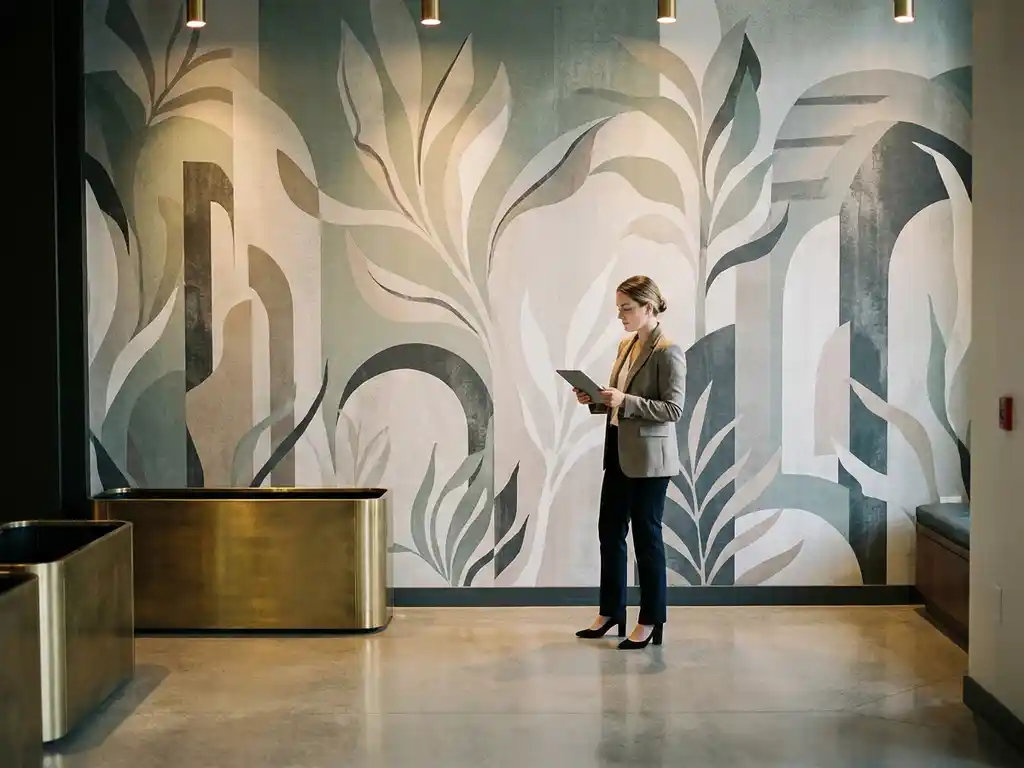
A non-woven wallpaper is a printable wall medium made from a composite material based on polyester or cellulose fibers, which contains no plasticizers and is suitable for both interior construction and professional printing applications. Unlike conventional paper wallpaper, non-woven wallpaper is dimensionally stable, tear-resistant, and can be applied dry. The following sections answer the most important questions regarding material, processing, and possible applications.
What is non-woven wallpaper made of and how is it produced?
A non-woven wallpaper consists of a backing fleece made from polyester fibers, cellulose fibers, or a combination of both raw materials. The fibers are not woven, but are bonded together through thermal or chemical processes. The material is then given an inkjet coating, which ensures ink absorption and color brilliance during printing.
The manufacturing process begins with non-woven formation: the fibers are evenly deposited on a conveyor belt and then calendered, meaning they are compressed into a homogeneous web under pressure and heat. For printable non-woven wallpapers, the most important step follows: the application of a coating that is tailored to the respective ink system. This coating largely determines how sharply lines are reproduced, how well colors adhere, and how moisture-resistant the end product is.
The result is a material that feels soft to the touch, but is significantly more stable than paper wallpaper. It can be applied without tearing and adapts to slight unevenness in the substrate.
What applications is a printable non-woven wallpaper suitable for?
Printable non-woven wallpapers are suitable anywhere large-scale wall design with high image quality is required. Typical application areas include office spaces, hotels, retail, trade fair booths, and exhibitions. The material is also well suited for temporary installations and event decorations, as it can be removed without leaving any residue.
In professional large-format printing, non-woven wallpaper is particularly frequently used for the following purposes:
- Wall design in public buildings and commercial spaces
- Photo walls and mural wallpapers in the gastronomy and hotel industry
- Exhibition stand construction and temporary interior design
- Privacy solutions in offices and conference rooms
- Decorative wall paneling in retail
A practical advantage: Non-woven wallpapers can be applied strip by strip without the strips having to be soaked beforehand. This saves time during installation and reduces the risk of dimensional deviations caused by stretching.
Which printing technologies are compatible with non-woven wallpaper?
Non-woven wallpapers are compatible with common inkjet large-format printing technologies, including latex, water-based, and UV printing systems. Solvent inks are used less frequently because on some non-woven materials they can cause odors that are unsuitable for indoor spaces.
Compatibility depends heavily on the coating of the non-woven medium. A well-adjusted coating ensures that the ink is absorbed in a controlled manner without bleeding or damaging the surface. Latex printers from HP or Epson as well as water-based systems from Roland, Mimaki, and Durst deliver very good results with high color density and sharp contours on suitable non-woven wallpapers.
UV printing on non-woven fabric is technically possible, but requires flexible UV inks, as rigid ink films can crack when the material is rolled or folded. Anyone using UV systems should check material compatibility in advance.
What is the difference between non-woven wallpaper and other wallcoverings?
The most important difference between non-woven wallpaper and other wall coverings lies in the material base and the application method. Paper wallpapers are more sensitive to moisture and expand when soaking. PVC film is self-adhesive, but less breathable and more difficult to remove. Non-woven wallpaper combines stability with easy application and is particularly suitable for indoor spaces.
Non-woven wallpaper vs. paper wallpaper
Paper wallpapers must be soaked before installation, which can lead to stretching and dimensional deviations. Non-woven wallpapers are applied dry: the paste is applied directly to the wall, not to the material. This makes the installation faster and more precise, especially with large formats.
Non-woven wallpaper vs. self-adhesive PVC film
Self-adhesive PVC films adhere without paste and can be repositioned, but are more difficult to apply without bubbles on large areas. Non-woven wallpapers look warmer and more natural, are generally more breathable, and can be removed from the wall without residue after use. For interiors with specific requirements for indoor climate and aesthetics, non-woven wallpaper is often the better choice.
How are non-woven wallpapers correctly processed and installed?
Non-woven wallpapers are installed using the so-called dry-hanging method: the paste is applied to the wall, not to the wallpaper material. The strips are then applied directly to the wall, aligned, and smoothed out. This process is less prone to errors than the traditional wet-hanging method.
An overview of the most important assembly steps:
- Prepare the substrate: The wall must be clean, dry and flat. Remove loose paint or residue beforehand.
- Apply paste: Apply a suitable non-woven wallpaper paste evenly to the wall, not to the wallpaper.
- Create path: Align the first strip vertically, press it down lightly, and smooth it out from the center outwards using a squeegee or wallpaper brush.
- Track collisions Subsequent panels must butt directly against the previous one without overlapping. Align the pattern precisely in the process.
- Cut off excess: Cut cleanly at the ceiling and floor using a sharp utility knife and a guide rail.
- Let dry: Avoid drafts and direct sunlight during the drying period.
A common mistake during application is using too much paste, which oozes out between the lengths and damages the printed surface. It is better to apply it sparingly and touch it up if necessary.
Are there PVC-free alternatives to conventional non-woven wallpapers?
Yes, PVC-free vinyl wallpaper is available and well suited for many professional applications. It is made from polyester or cellulose fibers without any plasticizers and does not contain chlorine-containing plastics.
PVC-free non-woven wallpapers are particularly suitable for interiors where indoor air quality plays a role, for example in schools, hospitals, or living spaces. They do not emit volatile organic compounds (VOCs) from plasticizers and are in many cases recyclable or compostable.
For printing service providers who want to offer PVC-free materials without compromising on print quality or processing capability, PVC-free vinyl wallpaper is a compelling option. The print results on high-quality PVC-free media are comparable to those on conventional materials, provided the coating is matched to the ink system used.
Non-woven wallpapers by com2C: PVC-free, print-ready and tried and tested in practice
We develop and produce vinyl wallpaper that works in the everyday life of professional large-format printing. Our focus is on materials that are easy to handle reliably and deliver clean printing results.
Our PVC-free non-woven wallpaper from com2C are part of the GoGreener line and offer concrete benefits for your daily production:
- Compatible with latex, water-based, and UV inks on standard large-format printers from HP, Epson, Roland, Mimaki, and Durst
- Optimized inkjet coating from our own chemical laboratory for sharp contours and high color density
- PVC-free and without plasticizers
- Simple dry application for fast and clean installation, even with large formats
- Clean removability for temporary installations and trade show applications
- Personal technical advice on material selection and printing parameters
If you have any questions regarding material selection or would like to implement a specific project, we are happy to assist you. Just take Contact and together we will see which solution best fits your application.