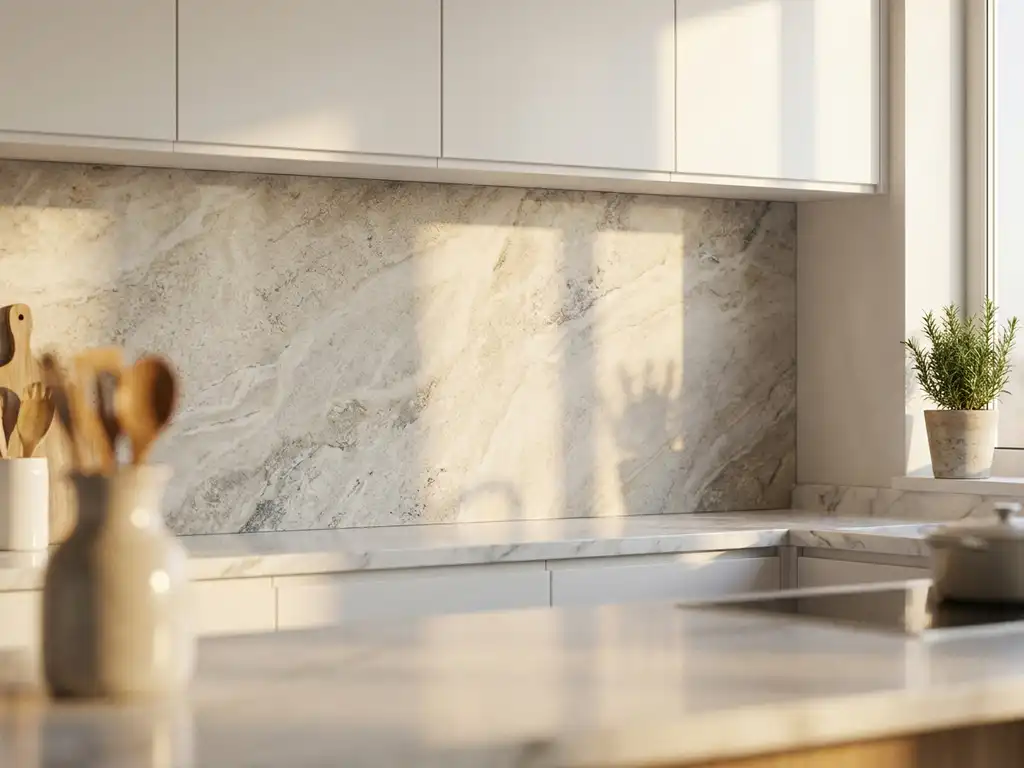
As an alternative to the classic tile backsplash in the kitchen, self-adhesive films, composite panels, glass, acrylic, and wooden panels are particularly suitable. Which option best suits your needs depends on usage, budget, and living situation. For rental properties in particular, residue-free solutions such as self-adhesive roll back panels are a real alternative today. The following questions will help you make the right choice for your kitchen.
Which materials are suitable as a kitchen backsplash without tiles?
As kitchen back walls without tiles, self-adhesive films, glass, acrylic panels, composite panels (e.g. Dibond), wooden panels, and stainless steel are suitable. Each material has specific strengths: glass and acrylic are easy to clean, composite panels are robust and can be cut to size, and self-adhesive films are flexible and cost-effective to install.
In detail, the most common alternatives offer the following characteristics:
- Self-adhesive film: Easy to install, completely removable without leaving residue, individually printable, ideal for rental properties.
- Acrylic glass: Smooth, easy-to-clean surface, available in transparent or colored colors, but sensitive to scratches.
- True glass: Very hygienic and heat-resistant, but more expensive to purchase and install.
- Composite panels (Dibond, aluminum composite panels): Stable, lightweight, easy to print, suitable for permanent installations.
- Wood panels: Visually warm, but less moisture resistant and not recommended directly behind the stove.
- Stainless steel: Professional optics, very robust, but elaborate in their design and expensive to manufacture.
For many households, the self-adhesive roll back panel is the most convenient solution because it can be installed without a professional and can be completely removed if necessary.
What is the difference between kitchen backsplash film and other alternatives?
The main difference lies in assembly, reversibility, and individuality. A self-adhesive kitchen backsplash film is applied directly to the existing substrate without drilling or adhesive, and can be removed without leaving any residue. Other alternatives such as glass or composite panels require a permanent installation and are more durable, but also less flexible.
Specifically, the options differ in these points:
- Assembly: Films are glued directly to the wall, while panels are screwed or attached with special adhesive.
- Removable: High-quality films can be removed without leaving any residue, leaving holes or adhesive residues behind.
- Creative freedom Films can be printed with any desired motif; plates are usually available in monochrome or in limited decorative designs.
- Cost: Films are usually cheaper than glass or composite panels, especially when the assembly costs are taken into account.
- Longevity: High-quality films last for many years with proper handling, but are not as robust as hard materials.
Those who value maximum design freedom and easy assembly are often better served with a printed film than with a rigid plate.
How heat-resistant must a kitchen backsplash be behind the stove?
A kitchen backsplash directly behind the stove should be able to withstand temperatures of at least 60 to 80 degrees Celsius on a consistent basis, as cooking heat, steam, and occasional splashes can stress the surface. Materials like real glass or stainless steel are clearly the best choice here. Self-adhesive films should only be used in this area with sufficient distance from the stove.
It is important to distinguish between the direct area of the oven and the rest of the rear wall:
- Right behind the cooking plates: Glass, stainless steel or ceramic tiles are recommended here, as the temperatures can be significantly higher in the short term.
- On the sides and above the herd: Self-adhesive films are readily suitable for use in these areas, provided that they are suitable for kitchen applications.
- Behind the work surface: Here, heat resistance hardly plays a role, so all materials are suitable.
If you plan to use a self-adhesive back panel, make sure that the area immediately behind the flames or heaters is either cut out or supplemented with heat-resistant material. Many kitchens solve this problem by using a small strip of glass directly behind the stove and a film for the rest of the back panel.
Which kitchen backsplash alternative is best suited for rental apartments?
For rental properties, the self-adhesive film is the best alternative to the tile back wall, because it can be applied without permanent changes to the building structure and removed without leaving any residue upon removal. A clean, smooth surface and a film with a suitable adhesive system are required.
Self-adhesive roll backings meet exactly the requirements that tenants typically have:
- No drilling holes, no special adhesive, no need for any tradesmen.
- Complete removal without leaving any residue when removing the tiles or wall covering.
- Individual designs and sizes are possible, so that the film is precisely tailored to the available area.
- Quick assembly, which can also be done by non-experts without any experience.
Plastics panels or glass are usually excluded for rental apartments because they require a fixed installation and can cause damage when removed. For those who want to be on the safe side, choose a high-quality self-adhesive solution.
How much does a kitchen backsplash without tiles cost compared to?
The cost of a kitchen backsplash without tiles varies greatly depending on the material and design. Self-adhesive films are usually the cheapest option, while real glass and stainless steel are at the upper end of the price range. Composite panels and acrylic are in the middle price segment.
A rough guide by material type:
- Self-adhesive film: Cheapest option, especially if you carry out the assembly yourself. The price depends on size and print quality.
- Acrylic glass: Moderate price, installation is easier than with glass, but more expensive than film.
- Composite panels: Similar price level as acrylic, robust and durable.
- True glass: Significantly more expensive; there are also assembly costs due to a professional service.
- Stainless steel: Comparable to glass; high material and processing costs.
In the case of hard materials, there are almost always mounting costs involved, which are not present with self-adhesive films. Therefore, anyone who keeps the overall budget in mind should not only calculate the material price but also the cost of installation.
Is it possible to install a kitchen backsplash yourself?
Yes, a self-adhesive kitchen backsplash can be easily installed by yourself if the substrate is clean, dry, and smooth. However, for hard materials such as glass or composite panels, a professional installation is recommended, as precision measurement and installation are more demanding.
The following procedure applies to the self-assembly of a film:
- Prepare the substrate: Clean the tiles or wall thoroughly to remove any dirt so that the film adheres permanently.
- Take measurements: Accurately measure the area, taking socket outlets and cutouts into account.
- Cut the film: Cut to size or use pre-made film.
- Avoid air bubbles: Apply the film from one side and press it evenly with a spatula to prevent air inclusions.
- Refine the sections: Cut the power outlets and switches cleanly off.
With a little care and the right tools, the result is convincing even without any previous handcrafting experience. The important thing is to take your time and not tape the film down while it is still wet, as it can otherwise tear off over time.
Kitchen backsplashes from com2C: custom-made solutions for your kitchen
If you are looking for a kitchen backsplash that is visually appealing, easy to install, and can be removed without leaving any residue if needed, we can help you with the right materials and the necessary expertise. Our Kitchen backsplashes by com2C are produced by specialized printing services on high-quality digital printing media that we develop and produce ourselves.
What this means in practice:
- Pressure-resistant media suitable for kitchen applications: moisture-resistant, easy to clean and durable.
- Self-adhesive materials with a suitable adhesive system for smooth surfaces such as tiles or painted walls.
- Precise color reproduction for individual motifs, photos, or design patterns in your desired format.
- PVC-free options from our PVC-free self-adhesive wallpaper line For everyone who values PVC-free materials.
- Customized formats so that the back panel fits exactly to your kitchen without unnecessary excess.
Do you have questions about materials, application possibilities, or the right solution for your situation? Feel free to Contact, we will help you further.