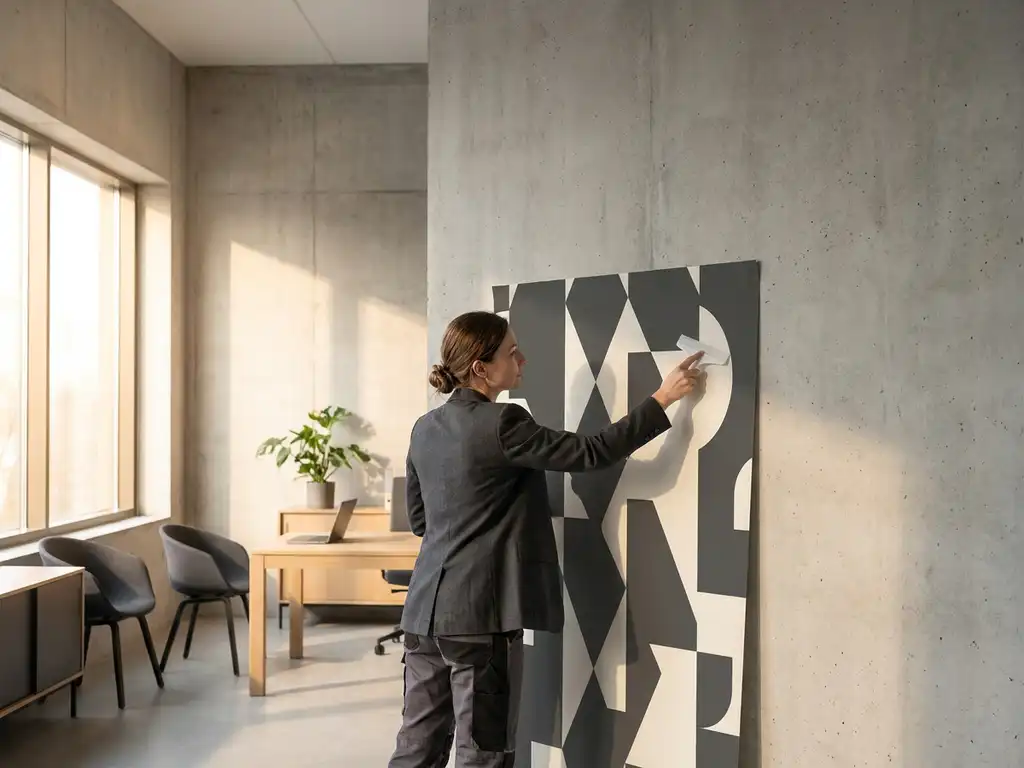
Self-adhesive wallpaper is wall covering with a printable surface and an adhesive layer applied on the reverse side, which enables easy installation without additional adhesive. It combines the visual appeal of a classic wallpaper with the practical handling of a film. For professional digital printing, it is a versatile medium that is used in interior spaces, at trade shows, and in interior design. This article answers the most important questions about the material, application, and assembly.
How do self-adhesive wallpapers differ from conventional wallpaper?
Self-adhesive wallpaper differs from conventional wallpaper primarily in its installation technique and its compatibility with printing. While classic wallpaper is applied to the substrate using glue, self-adhesive variants adhere via an integrated adhesive layer on the back. They are specially formulated for digital printing and can usually be removed without leaving any residue after installation.
Another important difference lies in the flexibility of the application. Conventional wallpaper is designed for permanent installations and requires a complex preparation of the substrate. Self-adhesive wallpaper, on the other hand, is also suitable for temporary installations, rental spaces, or changing decorations, as they can be removed without damaging the wall. For print service providers, this means shorter assembly times, less effort on the construction site, and happier end customers.
Technically speaking, self-adhesive wallpaper is also tailored to the requirements of modern inkjet printers. The surface is coated in such a way that it absorbs inks based on water, latex, solvent or UV, while producing a sharp, colour-rich print image.
On which surfaces do self-adhesive wallpapers reliably adhere?
Self-adhesive wallpaper adheres reliably to smooth, clean, and dry surfaces. These include painted walls, plasterboard panels, glass, tiles, wood panels, and many plastic surfaces. Rough, porous, or highly textured surfaces reduce the adhesive surface area and can impair the adhesive strength.
For long-lasting adhesion, the substrate should be free of grease and dust. Freshly painted walls usually require several weeks of drying time before self-adhesive wallpaper can be applied, as cured paint provides a better adhesive base. Room temperature also plays a role: at too low temperatures, the adhesive layer may lose its effectiveness.
Many self-adhesive wallpapers feature an air-channel-structured adhesive layer that facilitates bubble-free installation and allows for corrections during application. This feature is particularly relevant for large-scale installations, where precise alignment without air inclusions would otherwise be difficult.
What are self-adhesive wallpapers used for in professional printing?
In professional large-format printing, self-adhesive wallpaper is primarily used for wall designs in interior spaces, shop decorations, exhibition stands, and temporary space installations. They enable large-scale, high-quality print motifs that can be quickly mounted and removed without leaving any residue if necessary.
Typical applications include:
- Wall decoration in offices, hotels, restaurants and retail stores
- Seasonal and temporary decorations in shop windows and sales areas
- Trade fair stands and event decoration with alternating motifs
- Photo backgrounds and backdrops for studios and events
- Space branding and corporate design in corporate buildings
- Children's room and living room design with individual motifs
Printing service providers particularly appreciate self-adhesive wallpaper because it can be processed efficiently in production and enables end customers to install it quickly and cleanly without the need for skilled labor. The combination of high print quality and ease of handling makes it a sought-after product in the B2B segment.
What materials are used for self-adhesive wallpaper?
Self-adhesive wallpaper is manufactured from various substrate materials. The most commonly used are PVC film, non-woven fabric, and PVC-free composite materials based on polyester or paper. The choice of material affects printability, feel, environmental compatibility, and application area.
PVC-based materials
PVC films are widely used because they are robust, moisture-resistant, and cost-effective. They are suitable for intensive use and are easy to clean. However, they contain plasticizers and are difficult to recycle at the end of their lifespan, which makes them less suitable for sustainability-oriented projects.
PVC-free and fleece-based materials
Vinyl wallpaper on a non-woven base is tear-resistant, dimensionally stable, and can be processed without blistering. PVC-free composite materials based on polyester or paper offer a PVC-free alternative that is suitable for projects where sustainability certifications or emission limits play a role. These materials are often compatible with environmental certifications such as GREENGUARD or similar standards.
How are self-adhesive wallpapers for digital printing packaged?
For digital printing, self-adhesive wallpaper is provided with a special inkjet coating that optimizes ink absorption. The assembly process also includes selecting the appropriate adhesive layer, applying a backing paper or film, and cutting to the desired roll widths and lengths.
The inkjet coating is the most technically demanding part of the finishing process. It determines how well the ink is fixed to the surface, how sharp the contours appear in the print, and how lightfast the finished design is. Depending on the ink system—whether latex, solvent, UV, or water-based—different coating formulations are required.
Roller widths are based on the common printer formats. Typical widths range between 137 cm and 160 cm, to ensure compatibility with large-format printers from manufacturers such as HP, Epson, Roland, Mimaki or Durst. The length of the roller affects production efficiency: longer rollers reduce setup times, but require a stable winding quality without pressure marks or deformations.
When should you choose PVC-free self-adhesive wallpaper?
PVC-free self-adhesive wallpaper is the right choice when projects in indoor environments are subject to strict emission requirements, when clients require sustainability certificates, or when the material is to be disposed of in an environmentally responsible manner at the end of its useful life. It is particularly relevant for public buildings, schools, hospitals, and certified office buildings.
Furthermore, PVC-free materials are recommended wherever users may be sensitive to emissions. Conventional PVC films can release plasticizers that affect air quality in enclosed spaces. PVC-free alternatives avoid this problem without compromising print quality or processing capabilities.
For printing service providers who want to offer sustainable products in their portfolio, PVC-free self-adhesive wallpapers also offer a clear communication advantage over end customers who specifically seek PVC-free products. The demand for such materials is growing, and companies that can meet this requirement early on gain a relevant competitive advantage.
Self-adhesive wallpaper from com2C: materials for demanding projects
We develop and produce self-adhesive wallpaper that performs reliably in daily printing production. Our focus is on materials that are technically sophisticated and can be processed efficiently.
What we specifically offer:
- Self-adhesive wall media in PVC-free version from our GoGreener line, Developed for professional large-format printing
- Our own inkjet coatings from our chemical laboratory, tailored to latex-, solvent-, UV- and water-based ink systems
- Compatibility with leading printer manufacturers such as HP, Epson, Roland, Mimaki and Durst
- PVC-free materials for interior spaces
- Quick availability and individual customization according to your requirements
- Technical advice that goes beyond the purchase of a product
If you have specific requirements regarding the substrate, tinting system or certification, we can help you find the right material. Simply contact us. Contact, We will look at your application case together.