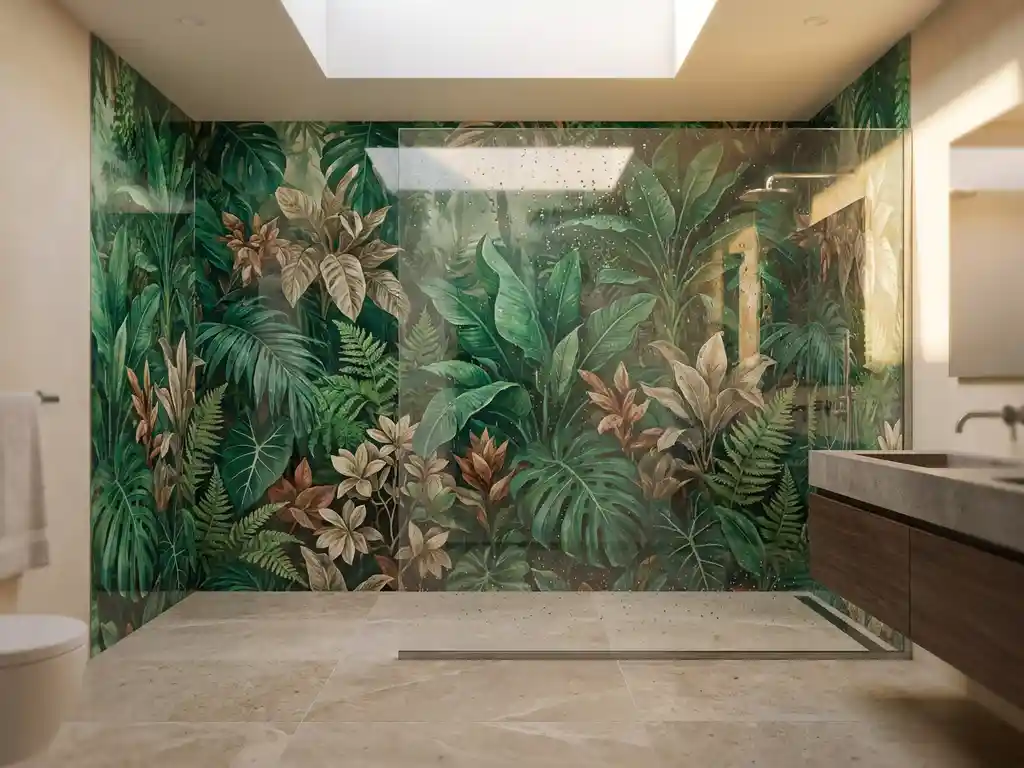
Shower walls made of printable film are self-adhesive foils that are applied directly to existing tiles or smooth wall surfaces in the shower, completely replacing their visual appearance. They work through a specially developed, water-resistant adhesive layer combined with a moisture-resistant backing film that permanently withstands the wet area. The following sections answer the most important questions regarding material, installation, printing, and costs.
How does a printable film adhere permanently in the shower?
A printable shower film adheres through a specially formulated acrylic adhesive that holds permanently on smooth, grease-free surfaces while being resistant to moisture, steam, and cleaning agents. The deciding factor is not just the adhesive itself, but the combination of a clean surface, proper application, and a material designed for wet areas.
Tiles, glass and painted wall surfaces are ideal substrates because they offer a uniform, non-porous surface. Rough plaster, untreated walls or heavily textured tiles, on the other hand, are problematic because the adhesive cannot form a continuous bond. Before application, the substrate must be thoroughly cleaned and completely dry, as even small amounts of residual moisture will permanently impair adhesion.
Many high-quality shower films use a so-called air channel technology in the adhesive layer. These small channels make it possible to push out air bubbles during application, which significantly simplifies the installation process while ensuring an even, bubble-free bonding surface.
What materials are suitable for printable shower curtains?
For printable shower films, PVC films and PVC-free polyolefin-based alternatives that are specially coated for wet areas are particularly suitable. The material must be water-repellent, dimensionally stable against temperature fluctuations, and resistant to cleaning agents.
PVC films are widespread in wet areas because they are naturally water-repellent and easy to process. They are available in various surface textures, from high-gloss to matte, which allows for visually diverse effects.
PVC-free materials based on polyolefin offer a PVC-free alternative without compromising water resistance. These materials do not contain chlorinated compounds.
Printability depends heavily on the film's coating. A special inkjet coating ensures that the ink is absorbed evenly, does not bleed, and adheres permanently after drying. Without this coating, even high-quality print would quickly fade or peel off in wet environments. It is also important that the printed image is sealed with a suitable laminate after printing to protect it from moisture and mechanical stress.
How is a shower curtain printed individually?
A shower curtain film is printed using the digital printing process, typically with latex or UV inks that are particularly water-resistant and lightfast. The print service provider receives an individual design, prints it to exact dimensions on the prepared film, and then laminates the result for protection.
The process begins with data preparation. The desired motif, whether a tile pattern, natural stone look, individual photo, or abstract design, is supplied as a high-resolution print file or created by the print service provider. The resolution should be at least 100 dpi in the final format, and around 150 dpi or more for close-range applications such as a shower.
Subsequently, the film is printed on a large-format printer. Latex inks are particularly suitable here because, after drying, they form a flexible, water-resistant ink layer and do not leave any solvent-based emissions. UV inks also offer high durability and dry immediately through UV light.
Lamination follows printing. A transparent protective laminate is applied to the printed image, sealing it against water, steam, and cleaning agents. For showers, a matte or satin-matte laminate is recommended, as it makes fingerprints less visible while also providing a non-slip effect.
Can a shower foil be removed without leaving any residue?
Yes, a shower film can be removed without leaving any residue in most cases, provided the material is designed for it and the surface was smooth and intact. A prerequisite is a film material with an adhesive designed for residue-free removal, known as repositionable or residue-free adhesives.
The removal works best when the film is pulled slowly and at a shallow angle from the wall. Heat, for example from a hairdryer, softens the adhesive and makes removal much easier. On tiles and glass, most high-quality shower films leave no adhesive residue after removal.
It gets critical with older tiles that have hairline cracks, surfaces that are already peeling, or substrates that are not completely smooth. Here, the film can take parts of the substrate with it when removed. If you want to be on the safe side, test the film first in an inconspicuous place and check after a few weeks whether it can be peeled off without any problems.
For tenants, residue-free removability is particularly relevant. It makes it possible to customize the shower without having to worry about damage when moving out. When purchasing or commissioning a print service provider, make sure that the material used is explicitly designated as residue-free removable.
How is a shower foil correctly installed?
A shower film is applied correctly by thoroughly cleaning and degreasing the surface, cutting the film to fit precisely, and applying it from one corner without bubbles. Using a squeegee or a soft cloth, the film is pressed down evenly and air bubbles are smoothed out toward the edges.
Surface preparation is the most important step. Tiles are cleaned with a degreaser or isopropyl alcohol and must be completely dry before applying the film. Grout lines should be flush and not patched, as unevenness may become visible later.
When applying, the wet method is recommended for larger areas: spraying a little water with a drop of dish soap onto the surface provides time to position the film before the adhesive finally bonds. For smaller areas and films with air-release technology, the dry method is simpler and more precise.
Tile joints can easily be covered with the film as long as they are clean and even. At corners and edges, the film is applied with a slight overlap and cleanly cut using a utility knife. Finally, all edges and corners are sealed with a silicone adhesive or waterproof sealing tape to prevent water from getting behind the film.
How much does a custom-printed shower curtain cost?
An individually printed shower curtain foil costs between 30 and 150 euros per square meter, depending on the size, material, and print service provider, with very small print runs and custom formats tending to be more expensive than larger quantities. In addition, there may be costs for data preparation and installation.
The material costs make up part of the price, but the larger share is accounted for by the printing process, lamination, and custom finishing. A custom-made motif for an average shower enclosure with about two to three square meters of wall space is therefore in a range comparable to the price of high-quality tile backsplashes, but without the labor costs for installation.
Compared to a bathroom renovation, the shower foil is significantly cheaper. New tiles including installation quickly cost several thousand euros, while a printed foil achieves the same visual effect at a fraction of the cost and can be installed without a craftsman.
Anyone wanting to design multiple walls or a complete shower often benefits from volume discounts from the print service provider. It is worth ordering all surfaces in a single order, as setup costs and material waste are then spread over a larger area.
Shower foils and kitchen backsplashes: How com2C supports print service providers
We provide the material basis on which print service providers and sign makers create high-quality shower films and comparable applications in wet areas. Our films are specially developed for use in humid environments and are compatible with standard large-format printing systems.
- Materials for wet areas: We supply self-adhesive films with a water-resistant coating and suitable adhesive systems for tiles, glass, and painted surfaces.
- PVC-free alternatives: Our GoGreener line offers PVC-free materials without loss of quality in terms of water resistance and print quality.
- Compatibility with leading printing systems: Our media is compatible with latex, UV, and water-based ink systems from HP, Epson, Roland, Mimaki, and other manufacturers.
- Technical consulting: We support you in material selection for specific applications, from the shower to the kitchen backsplash.
- Rapid availability: Short delivery routes and direct decision-making processes mean that you can react quickly when an order requires it.
If you have specific requirements for a wet area project or are unsure which material is best suited for your printing systems and the respective substrate, we are happy to help. contact us and find the right solution together.