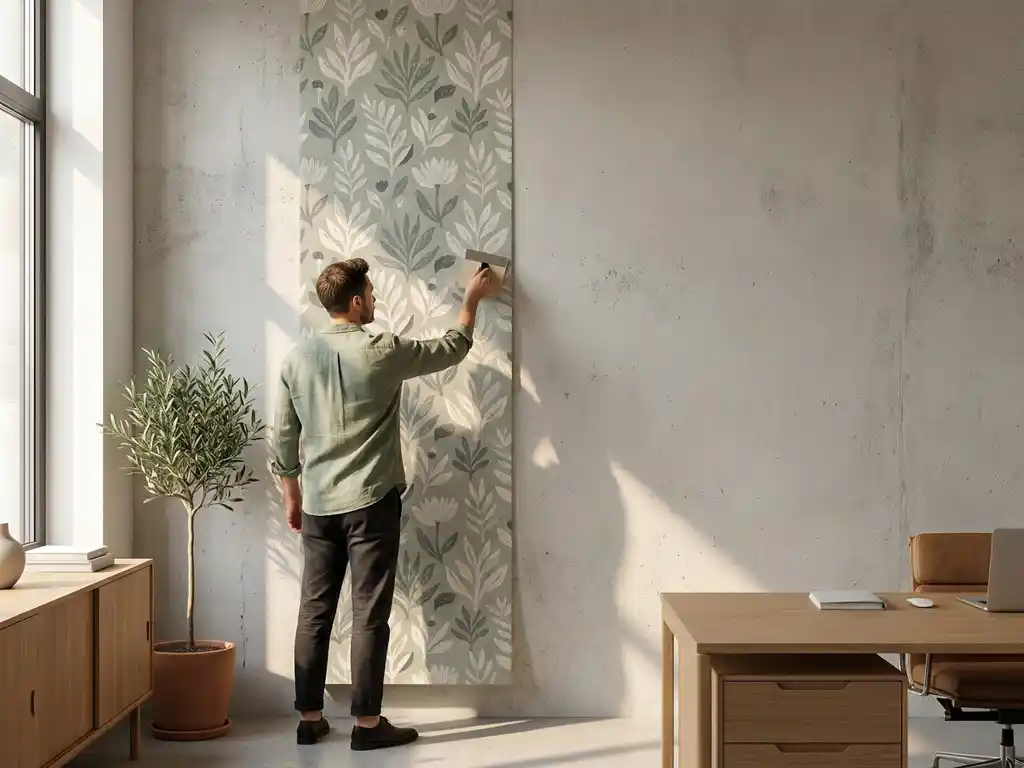
Self-adhesive wallpapers can be a sustainable choice for wall decoration if you pay attention to the right materials. Whether a product is truly eco-friendly depends primarily on the backing material used, the coating, and its recyclability. The following questions help you clearly distinguish sustainable options from less sustainable ones.
What are self-adhesive wallpapers made of and what materials are available?
Self-adhesive wallpapers consist of a backing material, a print layer, and an adhesive layer on the back. PVC film, non-woven fabric, polyester fabric, or paper-based materials are mainly used as the backing material. The adhesive layer is designed to be either permanent or repositionable, depending on the intended application.
The following main categories are available on the market today:
- PVC-based films: Widespread, inexpensive to produce, but problematic from an ecological perspective, as PVC is difficult to recycle and releases pollutants when burned.
- Non-woven wallpapers with self-adhesive layer: Made of polyester or cellulose fibers, are more breathable than PVC, and in many cases can be processed without solvents.
- Textile-based media Woven or knitted carrier materials with an adhesive coating, often used for high-end interior design.
- PVC-free polyester-based films: An increasingly common alternative that offers similar technical properties to PVC, but without chlorine-containing compounds.
The choice of material affects not only the print quality and durability, but also the ecological footprint of the entire project.
How eco-friendly are self-adhesive wallpapers compared to standard wallpapers?
Self-adhesive wallpapers are not automatically more environmentally friendly than standard wallpapers. The decisive difference lies in the material: conventional wallpapers often consist of paper or non-woven fabric without plastic content, while many self-adhesive variants are based on PVC. Products containing PVC perform significantly worse in terms of life cycle assessment.
In a direct comparison, several factors play a role:
- Resource extraction Wallpaper made of paper uses renewable resources, while PVC films are based on petroleum.
- Processing: Self-adhesive wallpapers do not require additional wallpaper paste, which saves solvents and processing chemicals.
- Disposal: PVC is difficult to recycle and burdens incineration. PVC-free alternatives or non-woven materials are much easier to dispose of.
- Lifespan: A durable, self-adhesive wallpaper that can be repositioned multiple times reduces material consumption over time.
Self-adhesive wallpapers made from PVC-free materials can certainly be ecologically on par with or even superior to standard wallpapers when production, use, and disposal are considered together.
What makes a self-adhesive wallpaper truly sustainable?
A self-adhesive wallpaper is truly sustainable when it is made from low-emission materials, allows for a long service life, and can be disposed of or recycled at the end of its life cycle without major environmental impact. Sustainability is not a single feature, but the result of multiple factors combined.
Specifically, you should pay attention to the following properties:
- PVC-free backing material: Polyester-, fleece- or paper-based backings avoid chlorine-containing compounds.
- Solvent-free adhesives: Water-based or pressure-sensitive adhesives without volatile organic compounds (VOC) improve indoor air quality.
- Certifications: Certifications such as OEKO-TEX, Greenguard, or FSC provide indications of tested freedom from harmful substances and responsible raw material sources.
- Repositionability Wallpapers that can be removed without leaving residue and reused extend the service life and reduce waste.
- Recyclability Materials that can be separated by type and recycled close the material loop.
A product that meets only one of these criteria is not yet a sustainable product. Only the combination of low-pollutant manufacturing, long usability, and clean disposal results in a credible ecological balance.
Are PVC-free self-adhesive wallpapers a better choice for interiors?
Yes, PVC-free self-adhesive wallpapers are generally the better choice for indoor spaces. Materials containing PVC can release plasticizers (phthalates) and other volatile compounds that negatively impact indoor air quality. PVC-free alternatives made of non-woven fabric or polyester avoid these emissions, making them particularly suitable for continuously used indoor spaces such as offices, living areas, or children's rooms.
Furthermore, they offer PVC-free materials further practical benefits:
- They are often more breathable, which reduces mold growth behind the wallpaper.
- Many PVC-free products are lighter and easier to process.
- In many cases, they can be printed with water-based inks, which makes the entire printing process lower in emissions.
- Disposal is simpler, as no chlorine-containing compounds are released.
For professional applications in large-format printing, this means: PVC-free wall murals allow you to offer your customers a product that is technically superior and free of PVC and PVC-type plasticizers.
How long do self-adhesive wallpapers last and can they be removed without leaving residue?
Self-adhesive wallpapers generally last for several years with proper application and a suitable substrate. For indoor applications without direct sunlight, lifespans of three to five years are realistic. Removability depends heavily on the adhesive used and the substrate: repositionable adhesives generally leave no residue on smooth, clean surfaces.
For residue-free removal, the following points are important:
- Substrate preparation: The substrate should be clean, dry, and free of grease. Porous or unpainted walls can affect the adhesive's adhesion and make removal more difficult.
- Type of adhesive: Pressure-sensitive, repositionable adhesives are specially designed for easy removal. Permanent adhesives are intended for long-term use and often leave residues when removed.
- Distance technology: Slow, even pulling out at a flat angle protects the floor surface and the wallpaper.
- Storage and processing: Wallpaper that has been stored for too long or processed at incorrect temperatures may adhere more strongly than intended.
For temporary installations, trade shows or showrooms, repositionable variants are particularly recommended, as they can be used repeatedly, thereby reducing material consumption.
Which self-adhesive wallpapers are suitable for sustainable large-format printing?
Self-adhesive wallpapers made from PVC-free materials are suitable for sustainable large-format printing. These wallpapers can be printed with water-based or latex inks. This combination of low-toxicity substrate material and environmentally friendly ink system is free of PVC and solvent-based inks. Non-woven-based and polyester-based media without plasticizers are the most commonly used options.
When using professional large-format printing, you should pay attention to the following characteristics:
- Ink compatibility: The medium must harmonize with the ink system used, whether latex, UV, or water-based. A suitable inkjet coating ensures sharp printing results and good color reproduction.
- Dimensional stability: For large-format wall installations, a slight stretch in the material is important to ensure that the seams and patterns fit neatly.
- Pollutant-free: Materials without VOC emissions are important for interior applications, especially when the wallpaper is used in public buildings or offices.
- Processing width: The roll widths and core diameters relevant for large-format printers should be matched to the printing systems used.
Companies that focus on sustainability benefit from being able to offer their customers documented advantages: materials with low levels of harmful substances, residue-free removal, and a PVC-free alternative to PVC-based products.
PVC-free self-adhesive wallpaper by com2C
We develop and produce self-adhesive wallpaper that functions technically while offering a PVC-free alternative to PVC standard materials. Our self-adhesive wallpaper PVC-free It is specifically designed for professional large-format printing and is tailored to the requirements of digital printers, advertising companies, and exhibition organizers.
What we specifically offer you:
- PVC-free carrier materials without plasticizers, suitable for indoor applications with high requirements on the indoor air quality
- Compatibility with water-based and latex ink systems from leading printer manufacturers such as HP, Epson, Roland, and Mimaki
- Repositionable adhesive options for temporary installations, exhibitions, and showrooms
- Our own inkjet coatings from our chemical laboratory for precise printing results and good color reproduction
- Technical advice that goes beyond pure product sales: We help you find the right material for your specific application
If you want to use PVC-free printing media without compromising on quality or usability, please feel free to contact us. We can help you choose the right material and stand behind our commitment to quality. Consultation available.