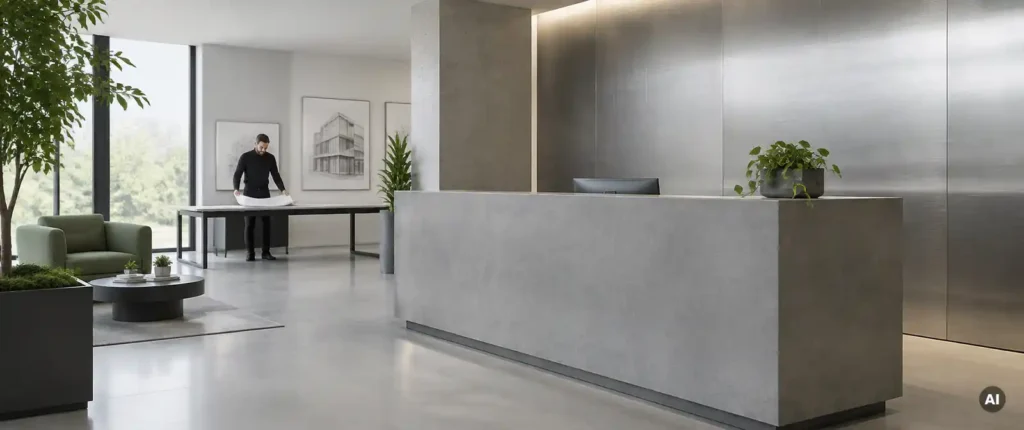
An office is more than just a place where work is done. The design of the space influences how people feel, how they collaborate, and how visitors perceive the company. Anyone who wants to redesign the office often faces the question: Where to start? The following five approaches show how, through targeted measures, you can create a modern workplace that combines corporate design, functionality, and atmosphere.
How space design shapes the work culture
There are many office design ideas, but not all of them hit the core of what truly transforms a workplace. Spaces communicate values before a single word is spoken. An entrance area that consistently implements the corporate design signals professionalism. A meeting room with thoughtful wall design invites concentration. Open spaces with clear visual structure help with orientation.
Anyone who wants to modernize their office should not view interior design as a decorative task, but as a strategic tool. Materials, colors, and visual elements influence mood, productivity, and brand perception. The following points show concrete ways to achieve this.
1: Use wall design as a brand message
The wall is the largest surface area in the room and at the same time the one that is most often underestimated. Wall design in the office goes far beyond a fresh coat of paint. Individually printed vinyl wallpaper allows you to bring brand worlds, corporate values or visual leitmotifs directly into the room.
A vinyl wallpaper in the office can be precisely coordinated with the corporate design: Logos, color palettes, typography, and image backgrounds become part of the architecture. This works just as well in the reception area as in meeting rooms or hallways. Compared to painted walls, printed material offers significantly more creative freedom; the effort involved in preparing the substrate and processing is slightly higher than when painting.
This solution is particularly suitable for companies that understand their location as a brand experience. Visitors immediately perceive the visual language of the space, even before the conversation begins. For employees, consistent room design creates identification and orientation.
2: Enhance glass surfaces with decorative films
Glass surfaces are ubiquitous in modern offices: partitions, conference rooms, entrance areas. They create openness, but can also reveal views where discretion is required. Glass decorative panels solve this conflict without sacrificing brightness.
Office glass decor film can be used in various configurations: matte for privacy with light permeability, printed with patterns or corporate logos, or a combination of both functions. The result is a surface that fulfills both function and aesthetics. Films with removable adhesive can usually be removed without leaving any residue, which is relevant when moving or remodeling.
This solution is particularly suitable for meeting rooms, reception areas and partitions in open-space offices. For those who want to redesign the office without carrying out any structural modifications, this offers a flexible and visually high-quality option.
3: Ground design for orientation and impact
The floor is often considered last in workplace design, yet it offers significant potential. Printed floor foils create visual guidance systems, mark off areas or set out design accents that structure the space.
In large office spaces, floor markings help with orientation: walkways, zoning, entrance areas. In reception areas or showrooms, floor decals with brand motifs or patterns can significantly enhance the spatial effect. The materials are designed for pedestrian traffic and are coated with anti-slip coating.
Especially practical: floor panels can be quickly replaced if room concepts change. This makes them a relevant option for offices that are regularly remodeled or want to add seasonal accents.
4: Improve acoustics and atmosphere with textile prints
Noise is one of the most common problems in open-space offices. Printed textiles offer a way to address acoustics and aesthetics simultaneously. Large-format textile prints on walls or as room dividers absorb sound and at the same time create visual warmth.
Compared to hard surfaces like glass or concrete, textiles appear softer and more inviting. They bring color and texture into the room without being heavy or overwhelming. Printed textiles can be customized and coordinated with the corporate design, making them a functional design element.
This solution is particularly suitable for areas where concentrated work or confidential conversations take place. In lounge areas or break rooms, textile prints can also noticeably improve the atmosphere and contribute to a modern workplace.
5: Use backlit displays as spatial accents
Backlit displays set targeted light accents and highlight specific areas or messages. In the office context, backlit displays are particularly suitable for reception areas, waiting areas, or representative hallways, where visual impact and brand presence come together.
The combination of light and printed media creates a depth that is unattainable with conventional printing. Colors appear brighter and motifs are more prominent. At the same time, the motif can be replaced if needed without replacing the entire display. This makes backlit systems a long-term investment.
For businesses that regularly receive customers or partners, backlit displays are an effective way to control the first impression. They combine office decor with a clear brand presence without being intrusive.
Sustainable materials for future-proof offices
Anyone who wants to modernize their office should also consider the material issue. Many traditional print media contain PVC or other substances that are problematic to dispose of. PVC-free alternatives offer comparable technical properties with significantly better environmental profiles.
For offices that pursue sustainability goals or aim to obtain corresponding certifications, the choice of materials is a relevant factor. This applies not only to wall design but also to all printing media used: films, wallpaper, textiles, and floor coverings. Environmentally friendly materials are now technically advanced and equally reliable in processing as conventional alternatives.
Sustainability in the office is not at odds with high quality or demanding design. With the right materials, both requirements can be met, and the result is both visually appealing and environmentally friendly.
Reimagine the office with com2C: print media for modern work environments
We help companies design office spaces with high-quality print media that are technically functional and visually appealing. Our Interior Film Collection by com2C It includes materials for all relevant application areas, from glass decorative films to vinyl wallpaper, and even printable textiles and floor coverings.
- Glass decorative films for privacy and brand visibility on glass surfaces
- Individually printable vinyl wallpaper for walls and reception areas
- Floor films with anti-slip coating for guidance systems and accents
- Textile prints for acoustics and atmosphere in open-space areas
- Backlit media for backlit displays in reception and representation areas
- PVC-free materials from our GoGreener line for sustainable office projects
We can advise you specifically on material selection, processing instructions and technical requirements. If you are planning an office project and are looking for the right printing media, please feel free to contact us. Contact.