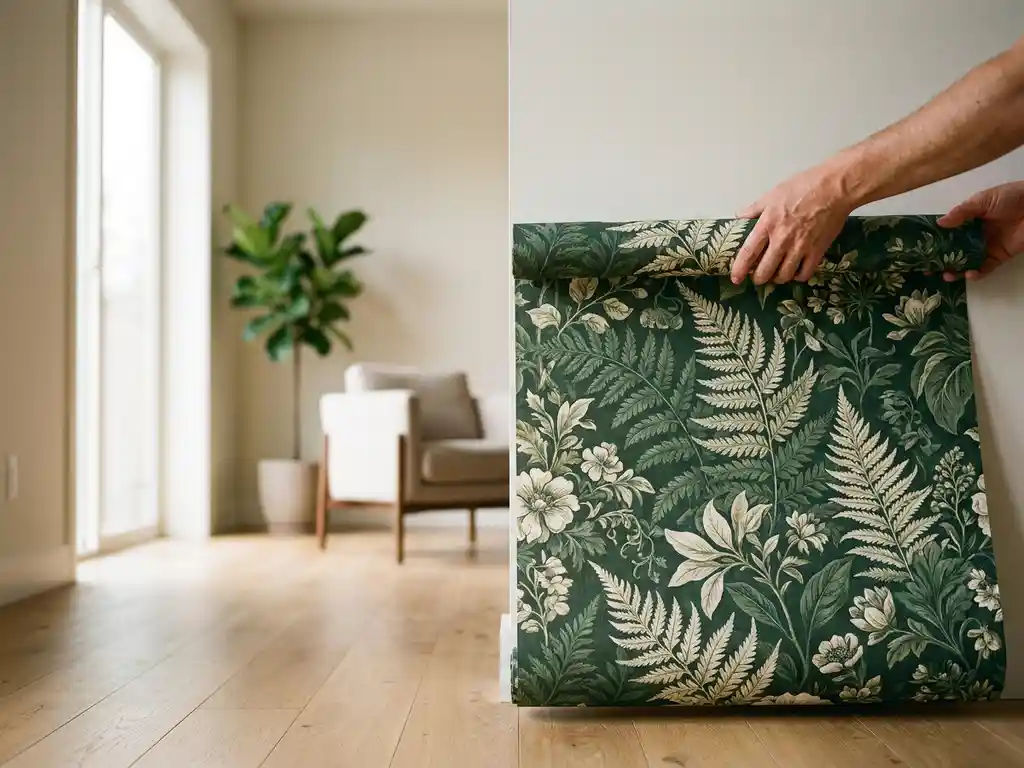
For indoor digital printing, polyester-based or polyester-cellulose-based vinyl wallpaper is particularly suitable, which is specially equipped with an inkjet coating. This coating ensures that ink is evenly absorbed and colors adhere precisely and durably. The following sections answer the most important questions about material selection, ink compatibility, and application in rental apartments.
Which vinyl wallpaper materials are best suited for digital printing?
Polyester-based materials or a polyester-cellulose combination with a special inkjet coating are best suited for printing vinyl wallpaper. This coating is the real difference from uncoated vinyl: it controls ink absorption, prevents bleeding, and ensures sharp contours as well as uniform color reproduction.
Pure cellulose non-woven fabrics are cheaper, but less suitable for high-quality printing results because they absorb ink unevenly. Polyester-based non-woven wallpaper is more dimensionally stable, more resistant to tearing, and less sensitive to moisture, which is a clear advantage when processing and later installing the wallpaper.
The following characteristics are also relevant for interiors:
- Grammar: Typically, 150 to 250 g/m² is used, depending on the application and the desired opacity.
- Surface: Matt or slightly textured for a natural wall look.
- Type of coating: Water-based inkjet coating for water-based and latex inks, or variants formulated specifically for UV inks.
- Fire protection class: Relevant for commercial interiors, e.g. B1 according to DIN 4102.
How is printed vinyl wallpaper different from regular wallpaper?
Printed vinyl wallpaper differs from normal wallpaper primarily in its inkjet coating, which allows for precise ink absorption. Normal wallpapers, whether paper, vinyl or untreated felt, are not designed for the requirements of large-format printers and do not provide reproducible printing results.
Regular decorative wallpaper from the retail market is designed for the manual application of paint or patterns. Printable vinyl wallpaper, on the other hand, must be tailored to the specific properties of inkjet inks: the drying speed, color density, layer thickness, and adhesion all play a role.
Another practical difference lies in the processing: printable vinyl wallpaper is processed as a roll material on large format printers, then cut to size and attached to the wall with wallpaper adhesive. The adhesive layer is applied to the wall, not to the wallpaper itself, which significantly simplifies the process and supports a bubble-free installation.
Which ink types are compatible with printable vinyl wallpaper?
Printed vinyl wallpaper is compatible with water-based inks, latex inks, and UV inks depending on the coating. The most common combination for interior applications is latex ink, as it is odorless, dries quickly, and is safe for the living area.
Water-based inks
Water-based pigment inks, such as those used in many Epson and Canon systems, work well with vinyl wallpaper that has an aqueous inkjet coating. The ink is absorbed by the coating and fixed. It is important to allow sufficient drying time, as too much moisture can cause the material to curl.
Latex inks
Latex inks, such as those used by HP Latex printers, are particularly suitable for vinyl wallpaper for interior use. They dry through heat and leave no volatile organic compounds. The result is odor-neutral, which is a clear advantage for living rooms and offices. Many printable vinyl wallpapers are specifically certified for latex systems.
UV inks
UV-curing inks are less often used for vinyl wallpaper, but are possible if the material is appropriately coated. The advantage lies in the immediate curing and high color brilliance. For living spaces, UV printing on vinyl wallpaper is more of an exception, as the materials must be specifically adapted to UV systems.
Is printed vinyl wallpaper suitable for rental apartments?
Yes, printed vinyl wallpaper is suitable for rental apartments, provided that it is applied with a residue-removable adhesive or a regular wallpaper adhesive that can be easily removed upon departure. Vinyl wallpaper is considered normal wall decoration under the rental law and is permitted in most rental agreements.
The crucial point is the non-residue removal process. High-quality vinyl wallpaper can be removed from the wall dryly without damaging the wall paint or the plaster if it is properly applied. This makes it an attractive alternative to permanent wall designs such as paint stenciling or tiles.
The following points are also recommended for rental apartments:
- Prime the wall before tiling to create a clean separating layer.
- Use high-quality, solvent-based wallpaper adhesive.
- When entering, document the condition of the walls.
- Keep in touch with the landlord if large-scale wall designs are planned.
What print resolution is recommended for vinyl wallpaper for indoor use?
For vinyl wallpaper in interiors, a print resolution of 720 to 1440 dpi is recommended. At a normal viewing distance of one meter or more, 720 dpi is sufficient to achieve a sharp, detailed result. Higher resolutions are advisable for close-up applications or very delicate motifs.
The optimal resolution depends on two factors: the viewing distance and the complexity of the subject. A large-scale wall mural in a living room that is viewed from two meters away does not require 1440 dpi. A subject with fine textures or small fonts, on the other hand, benefits from a higher resolution.
Practical preparation of the file is also important: The original motif should be available in at least 150 dpi in the final size. Scaling up from low resolution images also leads to blurred results even at high print resolution. For interiors, it is important that the quality of the motif and the print resolution match each other.
Where can you obtain printable vinyl wallpaper for large-format printing, and how does com2C support this?
We at com2C We supply printable vinyl wallpaper specifically designed for large-format printing, tailored to the requirements of printing service providers, signage specialists, and anyone who wants to produce individual wall designs for interiors. Our materials are compatible with common printing systems from HP, Epson, Roland, and Mimaki, and are suitable for water-based, latex, and UV inks.
What sets us apart from a pure retailer: We develop and coat our print media ourselves, in our own laboratory in Porta Westfalica. This means that for you, we can answer questions about ink compatibility, the correct print setting, or the material choice for specific applications directly and thoroughly, without going through middlemen such as manufacturers or data sheets.
Specifically, we support you with:
- Vinyl wallpaper printing media in various grammages and surface structures for different interior applications.
- Materials that are easily removed without leaving any residue and are therefore suitable for rental properties.
- Technical advice on the correct ink and printer settings for your specific system.
- Quick availability and flexible quantities, also for smaller orders or sample orders.
- A personal contact person who knows your production situation and collaborates with you.
If you would like to know which vinyl wallpaper material is best suited for your application, please feel free to Contact. We help you make the right choice.