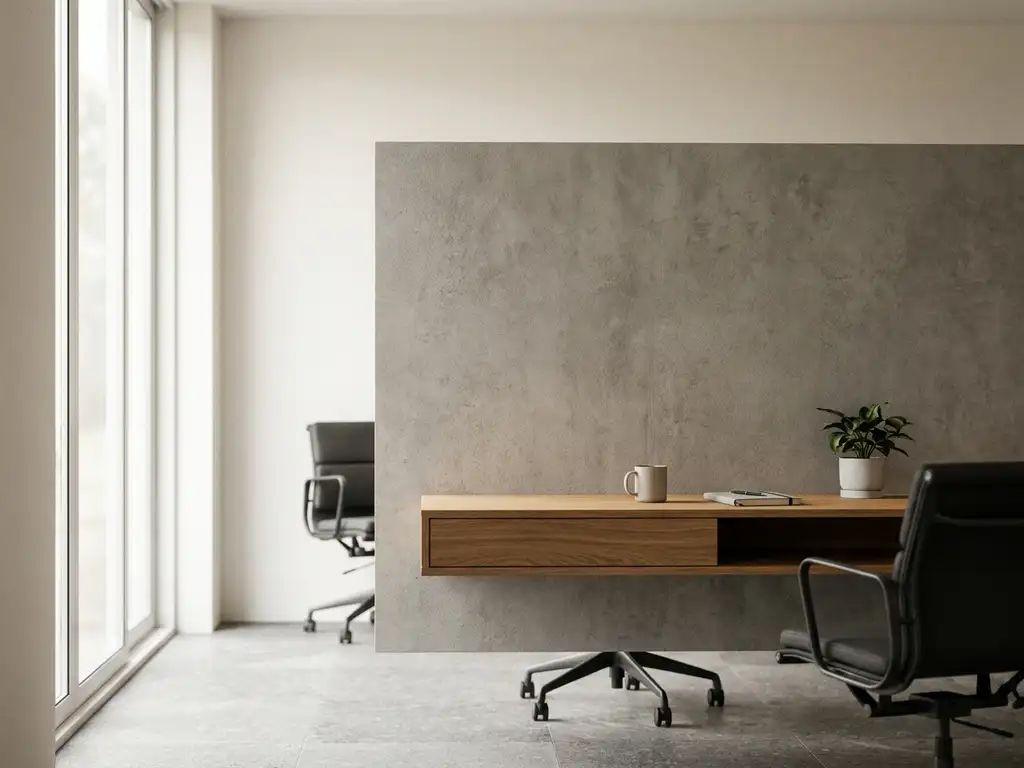
Modernizing an office doesn’t necessarily mean tearing down walls, renovating floors, or undertaking months of construction work. Many companies underestimate how much can be transformed through targeted surface design without hiring a single contractor for structural work. This article shows you the options for choosing the right materials for different areas and how to make your corporate design visible while doing so.
The following sections build upon each other: we begin with the basic principle of building-free modernization, then go on to discuss specific materials and application areas, and conclude with practical tips for planning and implementation.
What does office modernization without structural interventions mean?
Office modernization without structural interventions refers to all measures for space design that do not require structural changes to the building. This means: no core drilling, no new partitions, no traditional floor installation. Instead, you work with surfaces that transform existing areas.
This approach is particularly relevant for companies that use rental space or need to quickly respond to changing requirements. Lease agreements often restrict structural modifications, and even in their own offices, a complete renovation involves significant time and cost. Designing offices without renovation therefore means maximum impact with minimal intervention.
A concrete example: A company moves into new premises and wants to make the glass walls of the meeting rooms vandal-proof and at the same time brand-typical. Instead of building new walls, it applies a glass decorative film. The result is ready in a few hours and can be removed without leaving any residue if needed.
How surfaces determine the effect of a space
Surfaces are what people first perceive in a room. Color, texture, light, and patterns influence how an office looks: inviting or sterile, professional or casual, lively or monotonous. Therefore, office wall design is not a purely aesthetic issue but has direct effects on atmosphere and perception.
There is a simple principle at work here: large surfaces dominate the impression of the room. A neutral white wall looks different than the same area with a high-quality vinyl wallpaper or a textured film covering. Even small accent areas, such as behind a reception desk or in a hallway, can significantly change the overall impression of a room.
In addition, there is the factor of light: matte surfaces absorb light and appear quiet, shiny materials reflect it and create dynamism. Backlit foils that are illuminated from behind set targeted accents and are particularly suitable for reception areas where a strong first impression is important.
Which print media are suitable for which office areas
Not every material is suitable for every application. The choice of the right printing medium depends on the surface, the level of usage, and the desired effect. Here is an overview of the most important application areas:
Reception areas and lobbies
The reception area is the face of a company. Large-format wall decals, vinyl wallpaper with individual motifs or backlit displays are particularly suitable here. These materials enable a high-quality, brand-specific design that immediately makes an impact.
Meeting rooms and glass surfaces
Glass surfaces in meeting rooms present special requirements: they must provide visual protection without darkening the room. Glass decorative films elegantly solve this problem. They can be combined with frosted effects, patterns or logo prints and are easily removed without leaving any residue. Therefore, film for office glass surfaces is one of the most frequently requested materials in office space design.
Open-space areas and corridors
In open workspaces and hallways, the goal is often to create orientation while simultaneously making the corporate culture visible. Wall decals with guidance systems, motif walls, or typographic elements work well here. Floor decals can also mark paths or visually separate areas.
Rest areas and creative areas
In areas intended to encourage relaxation or creative work, softer motifs and textures work particularly well. Printed textiles or textured vinyl wallpaper create a different atmosphere than smooth foils and are suitable for lounges or informal meeting areas.
Making corporate design visible: From the surface to the brand message
Making corporate design visible in the office means more than just pasting a logo on the wall. It’s about translating the colors, typography, imagery, and values of a company consistently into the space. Every designed surface is a way to communicate the brand identity.
The difference between an office designed generically and a space uniquely designed for a brand is immediately noticeable to visitors. When colors, materials, and motifs are coordinated to match the corporate identity, a cohesive overall impression is created. This strengthens customer and partner trust and conveys a sense of belonging to employees.
In practical terms, this means: First, define which areas in the office have the greatest impact. Reception areas, conference rooms, and entrance areas are the obvious candidates. Then consider which brand messages are appropriate on which area. A guiding system can connect brand colors and messages. A motivational wall in the meeting room can visualize corporate values. Print media for the office is the tool that translates these ideas into reality.
Sustainability in office design: What matters when it comes to materials
Sustainability in office design concerns not only the ecological footprint of the materials used, but also their durability and recyclability. Those who regularly redesign offices should choose materials that produce as little waste as possible and are health-safe.
PVC-free materials are playing an increasingly important role in this regard. While classic PVC films are inexpensive and widely available, they are environmentally harmful during production and disposal. Alternatives based on polyester, paper, or biodegradable carrier materials offer comparable print properties with significantly better environmental profiles.
For offices that pursue sustainability goals or aim to obtain corresponding certifications, the choice of materials is a relevant factor. When selecting materials, pay attention to the following points:
- Emissions-friendly materials that do not burden the air quality in the room
- PVC-free alternatives for wall foils and floor coverings
- Materials with a return or recycling option
- Long-lasting surfaces that need to be replaced less frequently
- solvent-free printing inks that do not emit harmful emissions
Sustainability and quality do not exclude each other. On the contrary: High-quality, durable materials are often the more sustainable choice because they last longer and need to be replaced less frequently.
Planning office design: From the idea to the finished implementation
Successful office design without renovation begins with a clear assessment of the existing situation. What areas are available? What surfaces are present, and what materials are reliable enough to support them? These questions determine which printing media are even suitable.
Follow these steps to plan:
- Capture areas: Measure all relevant wall, floor and glass surfaces. Note down the substrate (plasterboard, glass, concrete, tiles) and the condition of the surface.
- Defining goals: What is the design intended to achieve? Privacy, brand presence, orientation, atmosphere? The clearer the goal, the more targeted the choice of materials.
- Selecting materials: Choose print media that suits the background, usage intensity, and design requirements. If in doubt, seek advice.
- Preparing print data: Make sure that your graphics and logos are available in sufficient resolution. For large-format printing, 72 to 150 dpi is usually sufficient for final size.
- Coordinate implementation: Determine whether the installation is carried out by your own staff or by a professional company. Complex film applications, especially on glass or structured substrates, require experience.
A common mistake in planning is to make decisions on the choice of materials too late. Those who decide just before implementation which films or wallpaper to use risk delivery bottlenecks or compromises in quality. Plan the material selection early and clarify technical questions with the supplier before finalizing the print data.
Office design with com2C: Materials that work in practice
We help companies design their offices with printing media that are technically reliable and visually appealing. Whether glass decor film for meeting rooms, vinyl wallpaper for the reception area, or PVC-free wall foils for sustainable projects: We provide materials that have been developed for each specific application and that work in practice.
Our Interior Film Collection covers a wide range of printing media specifically for indoor applications. What sets us apart from standard suppliers:
- Materials developed and manufactured in-house, adapted to real application requirements
- Deep technical expertise in substrates, adhesion and print compatibility
- PVC-free alternatives for projects with sustainability requirements
- Quick availability and short delivery times
- Personal advice when standard materials are not suitable and individual solutions are required
If you are planning an office project and are unsure which materials are best suited for your specific spaces and requirements, please contact us. A brief Consultation It often helps to make the right decisions early in the process.