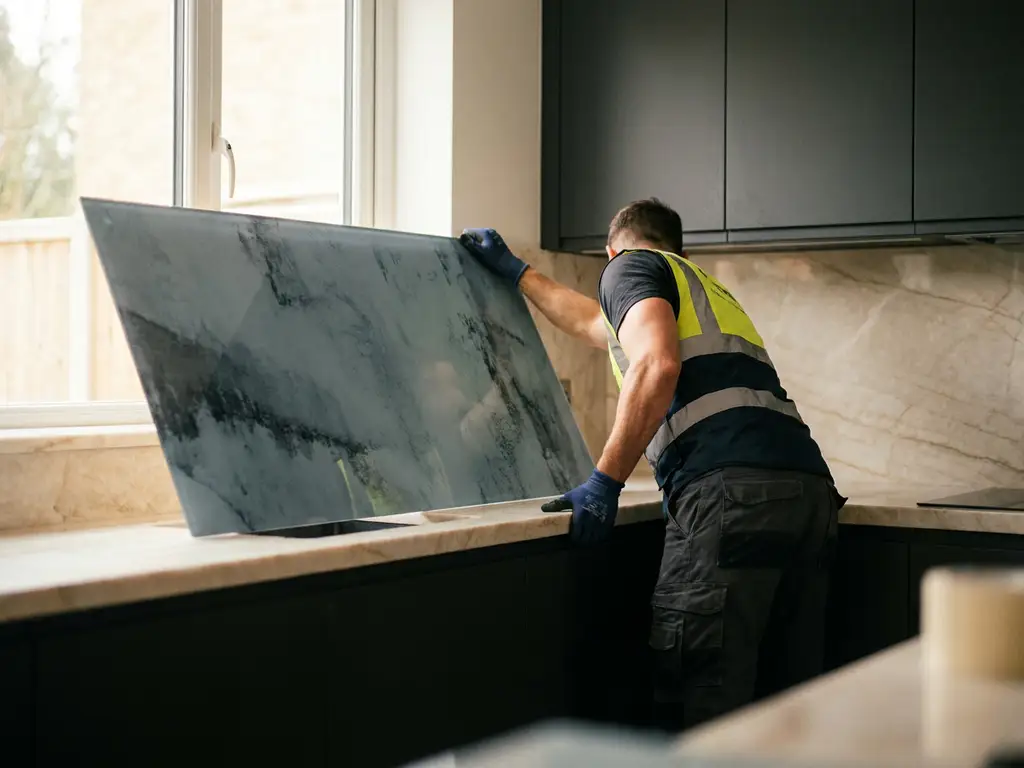
Anyone planning a new kitchen backsplash first thinks about appearance and price. Weight and risk of breakage often only become noticeable once the material has been ordered and the delivery truck is parked outside the door. In fact, these two factors are the biggest practical obstacles for many DIYers and renters when it comes to implementation.
This article explains why classic materials are so heavy and fragile, what that means in everyday life, and how lightweight self-adhesive films offer a real alternative to glass or stone kitchen backsplashes. You will also learn what really matters when it comes to installation and material selection.
Why classic kitchen backsplashes are so hard and scratch-prone
Classic kitchen backsplashes are usually made of glass, natural stone, ceramic tiles, or coated wood materials. These materials were originally designed for installation by professional contractors, not for independent assembly by private individuals.
Glass is the most typical example: A kitchen backsplash made of single-pane safety glass often measures several square meters and weighs between 15 and 30 kilograms depending on the thickness. Natural stone can be even significantly heavier. The weight is due to the material density, which simultaneously ensures stability and heat resistance. These properties are technically sensible, but they make transportation and installation complex.
There is also a risk of breakage because glass and ceramics can break when subjected to impact or bending stress. Even toughened glass can break under improper transport or a collision with a edge. The result: special transport, a technician, special tools, and, in the event of damage, a new order.
What weight and fracture risk really mean in practice
The abstract weight of a glass panel becomes tangible only when it is transported. A 20-kilogram glass panel cannot be carried alone, transported by car, or attached to the wall without the help of tools. In practice, this means that you need at least a second person, a suitable vehicle or a delivery service, and heavy-duty mounting tools.
Another problem arises for tenants. Heavy back walls require deep wall reinforcements that permanently alter the building structure. In rental apartments, this is often not allowed or leads to costs when the tenants move out. The Kitchen backsplash in the rental apartment Therefore, it must not only be visually appealing, but also be easily removed without leaving any residue.
Risk of breakage also means a financial risk. Anyone who orders a custom-made glass back panel pays for the measurement, material, and delivery costs. If the pane breaks during installation, the process has to be started all over again. This risk is particularly relevant for a self-executed project, because no professional liability applies.
How self-adhesive printing films solve the weight problem
Self-adhesive film for the kitchen works according to a different principle than glass or stone. The material consists of a thin carrier film with a sticky backing. The weight varies depending on the product, at only a few hundred grams per square meter, which is a fraction of the weight of conventional materials.
This has direct practical consequences:
- No special transport required: The film is rolled or folded and fits into any mailbox or package shipment.
- No heavy-duty mounting: The film adheres to the substrate without any dowels, screws, or adhesives.
- No risk of breakage: The films do not tear when being hit or bent; they are flexible and robust to handle.
- Removable without residue: High-quality self-adhesive films can be removed without damaging the underlying surface, making them suitable for rental properties.
A Light kitchen backsplash With foil, it is not only easier to transport, but also easier to assemble and replace as needed. This is not a compromise, but a different approach with its own strengths.
What really needs to be taken into account when installing and underfloor heating
The installation of self-adhesive film is reliable when the substrate is properly prepared. This is the point where most errors occur.
Underground preparation
The substrate must be clean, dry, and free of grease. Kitchen walls are particularly prone to deposits of grease from cooking fumes. Even if the wall appears visually clean, invisible residues can significantly reduce the adhesive strength of the film. Clean the surface thoroughly before installation with a grease-dissolving agent and allow it to dry completely.
Suitable substrates
Smooth, non-absorbing surfaces such as tiles, painted walls or glass are well suited for self-adhesive films. Rough plaster, untreated walls or highly porous surfaces are problematic because the adhesive surface is too small. On tiles, the adhesion is usually very good, provided that the joints are not too deep or damaged.
Monday technology
Use a scraper or a spatula to avoid air bubbles when applying the adhesive. Start at one edge and work evenly to the other side. For larger areas, the wet-mount method with some water and a drop of dishwashing liquid is recommended, which allows more time to position the film before it becomes permanently attached.
Choosing the right film for the kitchen backsplash
Not every self-adhesive film is suitable for the kitchen. The area behind the stove is exposed to heat, moisture, and grease fumes. This places specific requirements on the material.
When choosing, pay attention to the following characteristics:
- Heat resistance: The film should be suitable for use near the kitchen. Temperatures can build up directly behind a gas stove or induction cooktop, which can soften or deform the film.
- Moisture resistance: A film for the kitchen must withstand splashes of water and steam. Look for a sealed surface without open pores.
- Cleaning friendliness: The surface should be able to be wiped clean with commercial kitchen cleaners without affecting the printing or coating.
- Print quality: If you want an individually printed Kitchen back wall foil When choosing, color durability is relevant. High-quality digital printing films retain their colors even after regular cleaning.
- Removable without residue: Especially important for rental apartments: Check whether the manufacturer explicitly specifies a residue-free removal process.
The Kitchen back wall glass alternative Film is not a quick fix for tight budgets. It is a standalone solution with benefits that glass simply cannot offer: flexibility, easy assembly, and the ability to change the motif at any time.
Kitchen back panels made of foil: What we offer at com2C
We know that a kitchen backsplash is more than just a decorative surface. It must withstand heat, moisture, and daily cleaning routines while still looking good over time. That’s exactly what we develop our print media for.
About our com2C kitchen back panels we offer self-adhesive films that are specifically designed for use in the kitchen:
- Materials with proven heat and moisture resistance for the kitchen area
- High-quality digital printing quality with precise color reproduction and a durable surface
- Removable adhesive layers that are suitable for rental properties
- Custom-made sizes for every wall size and motif
- PVC-free material options from our self-adhesive wallpaper without PVC GoGreener line for environmentally conscious applications
If you are unsure which material is best suited for your specific subfloor or kitchen conditions, we are happy to help. Simply contact us. Contact and tell us about your situation. We will find the appropriate solution together.