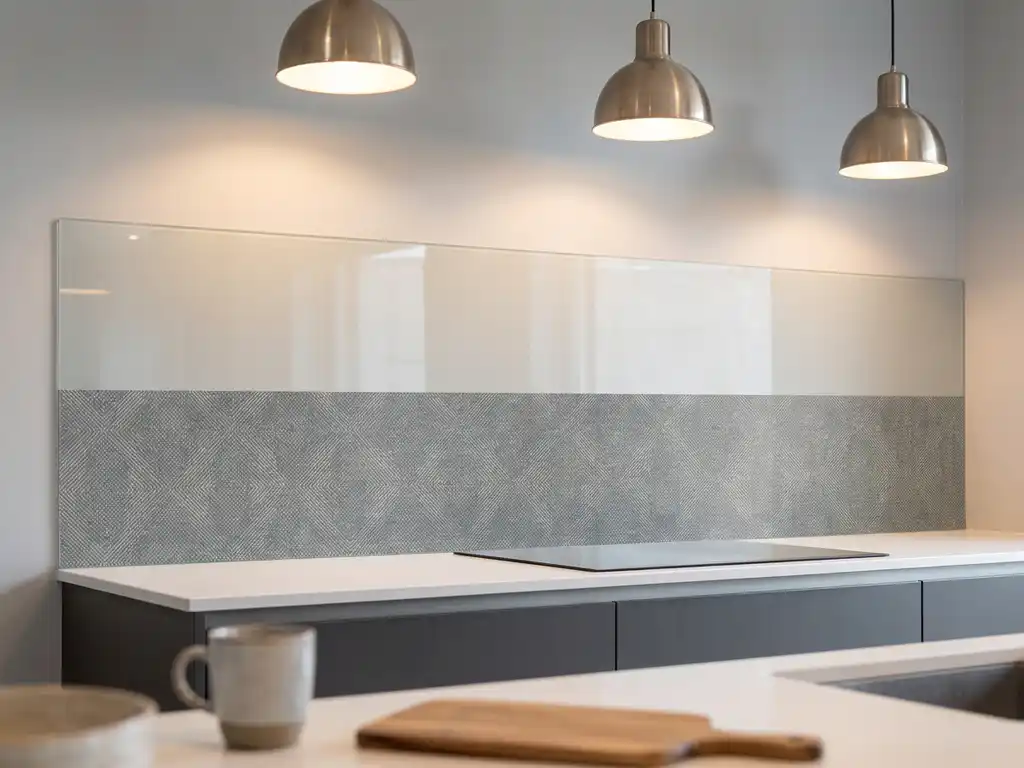
Film and glass are the two most commonly used materials for kitchen backsplashes, and both have their merits. The most important difference lies in assembly, cost, and flexibility: film adheres directly to the existing substrate, while glass is mounted as a separate panel. For those living in rental properties or who want to achieve an immediate visual result, a self-adhesive kitchen backsplash film is generally a better option. The following sections answer the most important questions about material, assembly, cost, and maintenance.
What material differences are there between film and glass?
Kitchen backsplash film is a multi-layer self-adhesive polymer film with a printable surface and a backing adhesive layer on the back. Glass, on the other hand, is a rigid, non-flexible material that is applied as a pre-assembled sheet to the substrate. The fundamental difference: Film adapts to the substrate, whereas glass brings its own structure with it.
High-quality kitchen wall decals are specifically designed for use in wet rooms and kitchens. They have a non-abrasive, easy-to-clean surface and are generally water-repellent. Glass naturally offers a smooth, non-porous surface that repels moisture and grease well, but is heavier, more expensive, and more complex to process.
Another difference concerns the appearance: Film can be supplied in almost any color, pattern, or with individual photo printing. Glass is supplied in the standard transparent or solid-colored finish and offers less design freedom, unless it is also printed, which significantly increases the price.
How easy is it to install a kitchen backsplash film?
A self-adhesive kitchen backsplash film can be installed without any special skills or tools. The substrate must be clean, dry, and free of grease. Then the film is peeled off, positioned, and pressed onto the surface with a spatula or cloth to eliminate air bubbles. The entire project is usually completed in one to two hours.
Glass, on the other hand, requires significantly more effort. The panel must be precisely cut to fit the back wall, which is usually done by a specialist workshop. The installation is done with special adhesive or screws, and the joints must be sealed. This is not a typical do-it-yourself project.
For the film installation, the following applies: The smoother the substrate, the better the result. Tiles, plaster, wood and many other surfaces are suitable as substrates. Unevenness of more than two to three millimeters should be compensated for beforehand, so that the film adheres evenly and no voids form.
Which solution is better for a rental apartment?
For a rental apartment, a self-adhesive kitchen backsplash film is the significantly better choice. It can be removed without leaving any residue, does not leave any drilling holes, and does not interfere with the building structure. Glass, on the other hand, is permanently installed and can damage the underlying structure when removed.
Tenants are usually required to return the apartment in its original condition. Folie meets this requirement as long as it is carefully processed and properly removed upon departure. High-quality films completely dissolve upon careful removal without any adhesive residue, especially if the substrate has been thoroughly prepared beforehand.
Glass panels are structural modifications that require the landlord’s approval in most rental agreements. Even if the landlord agrees, there remains the risk of damage during the demolition process. For tenants who want to customize their kitchen without compromising on moving out, film is the more practical solution.
How much does a film-covered kitchen backsplash cost compared to glass?
A kitchen backsplash made of film is usually significantly cheaper than a glass solution. The cost of a printed film depends on the provider, material, and printing quality; it ranges between 30 and 150 euros per square meter. A glass backsplash, including cutting and installation, often costs between 150 and 400 euros per square meter.
In addition, glass has assembly costs, which vary depending on the complexity and region. With film, this cost is eliminated if you handle the assembly yourself. This makes film cheaper not only when buying it, but also in the overall cost calculation.
What is important here: The price does not say anything about the optical quality. High-quality printed films with precise color reproduction look professional in the end and are hardly distinguishable from other materials by amateurs. The cost advantage thus does not come at the expense of the appearance, as long as you pay attention to quality when printing and using the material.
How easy to clean and heat-resistant is kitchen back wall film?
Kitchen backsplash film is easy to clean and can be wiped clean with a damp cloth and mild cleaning agents. Grease, splashes, and dust do not permanently adhere to the surface. However, there is an important difference in heat resistance compared to glass: Film should not be used directly over an open gas burner or in the immediate vicinity of a stove without a distance between them.
Good kitchen backsplash films are designed for temperatures of about 60 to 80 degrees Celsius. That is enough for normal kitchen use, i.e. for steam, splashes of water and heat radiation from the stove. However, direct flames or prolonged contact with very hot pots and pans should be avoided.
Glass is more robust in this regard and can withstand higher temperatures without restrictions. Anyone who operates a gas stove with an open flame directly on the back wall should carefully check the distance from the foil or place glass or tiles in this area. For electric stoves and induction cooktops, foil is usually suitable without problems.
Can you have a kitchen backsplash film printed individually?
Yes, kitchen backsplash film can be fully individually printed. Designs, colors, photos, patterns, or your own custom designs can be printed to size and delivered as a finished film. This is one of the biggest advantages over glass, which is significantly more expensive and more complex to individually print.
For printing, digital printing methods are used that allow for high color accuracy and sharp details. You can choose your own image, a natural motif, an abstract pattern, or a simple monochrome color. The foil is then precisely cut to your measurements and delivered ready for assembly.
Quality of the printing medium is important for individually printed films. Inferior materials can fade over time, are bad at handling moisture, or tear at the edges. High-quality digital printing films, specifically designed for kitchens and humid environments, maintain their color and adhesion permanently when properly processed.
Kitchen backsplashes by com2C: print media for precise results
We at com2C The printing media on which your individual kitchen backsplash is created. Our foils are specially designed for digital large-format printing and are designed for use in kitchens and wet rooms. Printing service providers and advertising technicians use our materials to produce custom-made kitchen backsplashes of top-quality workmanship.
- Special kitchen films With a non-slip, moisture-resistant surface for long-term use
- Self-adhesive materials, which are completely removable and suitable for rental properties
- Precise color reproduction through optimized inkjet coatings from our own laboratory
- Compatibility with all common large-format printers and ink systems (solvent, latex, UV, water-based)
- PVC-free alternatives from our GoGreener line
If you would like to know which material is best suited for your specific application, we are happy to assist you. Simply contact us. Contact, we will help you further.