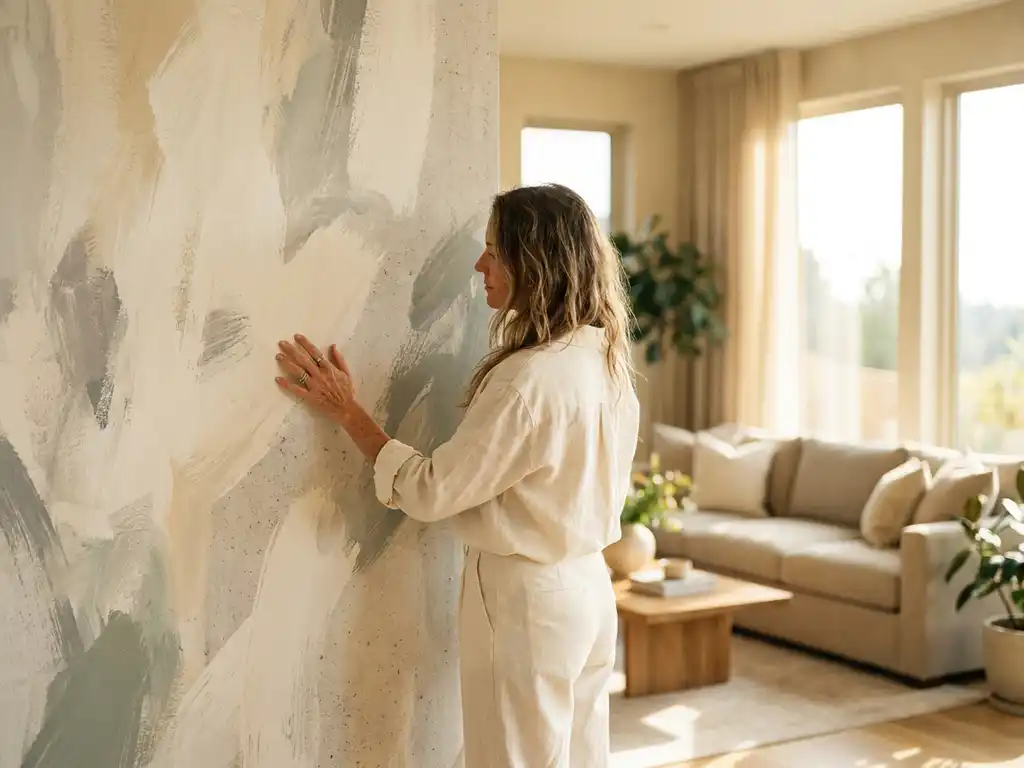
Yes, vinyl wallpaper is generally suitable for rental apartments. It can be applied to prepared surfaces and removed again with care, without permanently damaging the walls. However, suitability depends on several factors: the surface, the quality of the wallpaper, and the correct installation technique. The following questions clarify what you need to pay particular attention to in the rental apartment.
Is it allowed to glue vinyl wallpaper in a rental apartment?
In most rental agreements, it is allowed to wallpaper the walls as long as you restore the walls to their original condition upon leaving. Vinyl wallpaper is considered a normal cosmetic repair under the rental law, not a structural modification. The key is that you can completely remove the wallpaper during the move and without leaving any trace.
Generally speaking, tenancy law distinguishes between permitted cosmetic repairs and unauthorized structural modifications. Tiling falls into the first category. Nevertheless, it is advisable to take a preliminary look at the tenancy agreement and, if in doubt, to speak with the landlord briefly. Many landlords have no objection as long as the walls are properly handed over upon departure.
It is also important: If you make changes beyond the wallpaper, such as drilling holes for skirting or rails, other rules apply. The wallpapering itself is usually not a problem.
Can vinyl wallpaper be removed without leaving any residue?
Yes, vinyl wallpaper can be removed from the wall in most cases in a dry, one-piece operation. This is one of the biggest practical advantages over traditional paper wallpaper. Whether the removal is truly foolproof depends on the substrate, the quality of the adhesive used, and the quality of the finishing process.
Vinyl wallpaper is designed so that the adhesive is applied to the substrate, not to the wallpaper itself. This makes the rail more stable and allows for a dry removal without soaking. The adhesive residues on the wall can then be removed with warm water.
To ensure that the distance works without any problems, you should bear the following points in mind:
- Use a wallpaper adhesive that is indicated for vinyl wallpaper.
- Apply the adhesive evenly and avoid overdosing.
- Let the wallpaper dry completely before removing it again.
- Pull the train slowly and at a slight angle from the wall.
However, in cases of substrates with poor adhesion or old, loose plaster, peeling may still occur. This is not due to the vinyl wallpaper itself, but to the condition of the wall.
Which surfaces are suitable for vinyl wallpaper in rental apartments?
Vinyl wallpaper adheres most reliably to smooth, absorbent and stable surfaces. Smooth non-woven wallpaper, painted walls with a matte finish, plastered and primed plaster are well suited. Less suitable are highly absorbent, cracked or loose surfaces as well as walls with a glossy finish.
In rental apartments, you often encounter stripped-off walls or existing rough plaster. Both usually work well if the surface is smooth and clean. You should lightly sand the walls with a glossy paint before applying the plaster to ensure that the adhesive has a good surface area.
Moist walls, such as in poorly ventilated bathrooms, are generally unsuitable. There is a risk that mold will form under the wallpaper here. Specially coated materials are available for damp rooms, but even these require a dry, stable substrate.
A short checklist before tiling:
- Check the foundation for strength: The plaster must not crumble or flake off.
- Clean the surface: remove grease, dust and dirt.
- Prepare substrates with a strong absorption of water with a deep base coat.
- Smooth surfaces with a glossy finish should be lightly sanded.
- Repair cracks and holes beforehand with filler and sandpaper.
What is the difference between vinyl wallpaper and self-adhesive film for rental apartments?
Vinyl wallpaper is applied to the wall with adhesive and is suitable for large-area wall designs. Self-adhesive film has its own adhesive layer and can be directly applied without adhesive. Both variants are suitable for rental apartments, but they differ significantly in application area, appearance, and handling.
Vinyl wallpaper: Strengths and limitations
Vinyl wallpaper is particularly suitable for entire walls or large areas. It can be printed and provides a high-quality, virtually seamless finish. The installation requires some preparation: mixing the adhesive, checking the substrate, aligning the lines. The result is visually convincing and the wallpaper can be easily removed without leaving any residue.
Self-adhesive film: Strengths and limitations
Self-adhesive film is faster to apply and is well suited for smaller areas, furniture, kitchen mirrors, or bathroom tiles. It can usually be removed without leaving any residue when designed for smooth surfaces. On rough or porous surfaces, the adhesion may decrease. For entire walls, it is more complex to apply film because air bubbles and edges must be carefully smoothed.
In short: If you want to cover an entire wall, vinyl wallpaper is the more practical choice. For tiles, furniture fronts or smaller areas, self-adhesive film offers more flexibility.
Which vinyl wallpaper is best suited for printed wall designs?
For printed wall designs, you need a vinyl wallpaper specially designed for digital printing. It must have a smooth, coated surface that accurately absorbs ink and allows for sharp color reproduction. It is also important for it to have dimensional stability during bonding and a good ability to return to its original shape after removal.
Not all vinyl wallpaper from the DIY store is suitable for digital printing. Standard wallpaper often does not have an inkjet coating and produces blurred edges or uneven colors with printed motifs. For individual photo prints, wall motifs, or design wallpapers, you need a material that is optimized for large-format printers.
When choosing, pay attention to the following characteristics:
- Inkjet coating for precise color reproduction
- Compatibility with the used printing system (latex, solvent, UV or water-based)
- Sufficient grammar for dimensional stability during bonding
- PVC-free materials when PVC is to be avoided
- Proven removability, so that the wallpaper can be easily removed from rental apartments
If you are not printing the wallpaper yourself, you should hire a printing service provider or advertising technician. They will choose the appropriate material for your design and substrate and deliver the fully printed wallpaper for installation.
Printed vinyl wallpaper from com2C: materials for individual wall designs
We develop and produce vinyl wallpaper that is specifically designed for digital large-format printing. Our materials are used by printing service providers and advertising companies to create individual wall designs for end customers, including for rental apartments.
Our PVC-free non-woven wallpaper from com2C offer concrete advantages for printed wall designs in rental apartments:
- Inkjet-optimized coating for sharp color reproduction and precise image representation
- PVC-free materials from our GoGreener line
- Compatible with latex, solvent, UV and water-based printing systems from leading manufacturers
- Proven dimensional stability for clean processing without warping
- Retractable for dry cleaning, so tenants won't leave any damage when moving out
- Developed and produced with our own chemical laboratory for inkjet coatings
If you have any questions about the material selection or would like to know which product best suits your specific substrate and printer, we are happy to help. contact us, and we will be happy to help you.