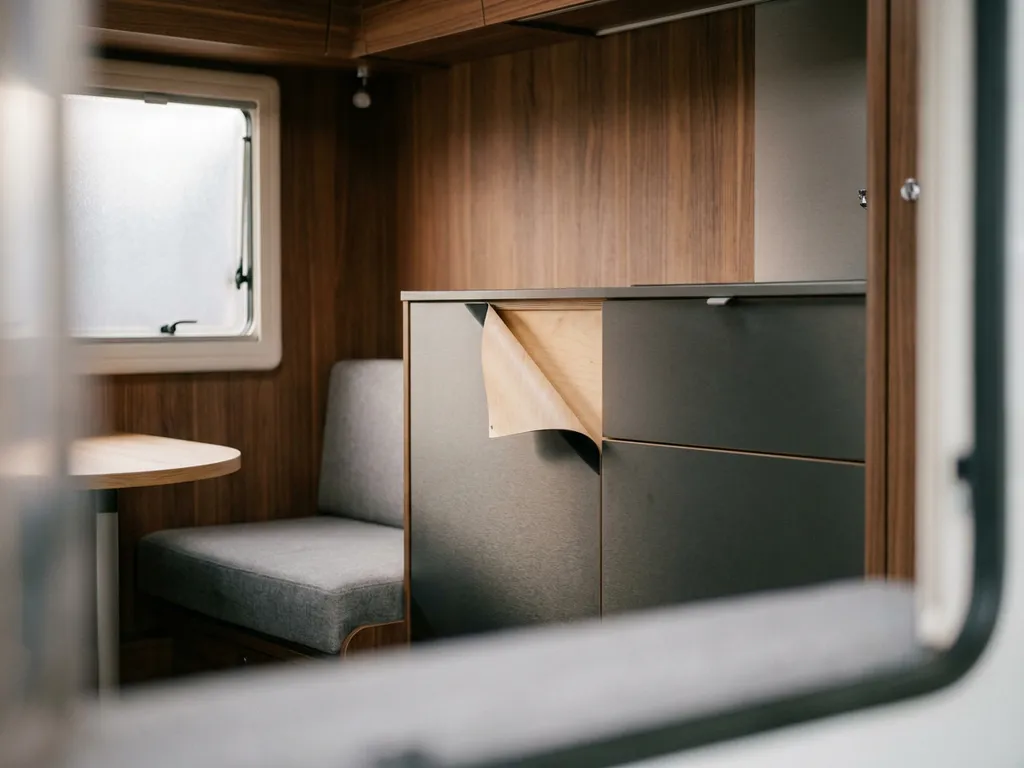
Yes, you can modify the interior of a camper van. Whether it’s wall decoration, floor covering, or structural modifications: Many measures are possible without a permit, as long as they do not compromise vehicle safety or the permissible total weight. Those who take a targeted approach can significantly enhance the visual and functional appeal of a camper van with relatively little effort. The following sections answer the most important questions about interior modifications, material selection, and wall decoration for camper vans.
What can be changed inside the caravan?
In the interior of a camper van, you are generally allowed to carry out any measures that do not endanger vehicle safety or exceed the permissible total weight. These include wall cladding, floor coverings, furniture modifications and decorative paintwork. However, any modifications to gas systems, electrical systems or load-bearing structures require specialist knowledge and, where applicable, a permit.
As a general rule, when retrofitting a caravan, the following applies: Anything that is purely aesthetic and does not add any weight is usually fine. Films, wallpaper and floor coverings fall clearly into this category. Anyone who is replacing furniture or planning new installations should keep the weight in mind. Heavy materials add up quickly and can exceed the permissible load limit.
For modifications that affect the vehicle structure, such as removing walls or installing new wiring, it is advisable to consult the TÜV or a vehicle inspection center. In many cases, registration in the vehicle registration certificate is required.
Which materials are suitable for wall decoration in a caravan?
Lightweight, moisture-resistant materials such as self-adhesive films, printable vinyl wallpaper and thin decorative panels are ideal for decorating the interior of a caravan. These materials are easy to handle, carry little weight and can be removed or replaced if necessary.
The walls in caravans are usually made of plastic, coated wood panels or composite materials. Not every surface is equally suitable for adhesive applications. Smooth, clean and grease-free surfaces are essential for a permanently adhesive film or wallpaper.
- Self-adhesive decorative films: Lightweight, flexible and available in many finishes. They are suitable for smaller areas, accents and furniture surfaces.
- Non-woven wallpapers: They are printable and breathable. They can also be applied to slightly uneven surfaces and feel more homely than plain films.
- Structural films and wood decorative films: Imitates wood, concrete or stone without the corresponding weight. Particularly popular for modern caravan wall design.
- Lightweight panels made of PVC or aluminum composite: Suitable for structural cladding when a little more stability is required.
When buying a caravan, pay attention to the weight per square meter and its suitability for changing temperatures. Caravans heat up strongly in summer, which can cause inferior materials to peel off.
How do you permanently stick film to the interior walls of a caravan?
To ensure that the film adheres permanently to the caravan’s interior walls, you must thoroughly clean the surface, degrease it and allow it to dry. Next, apply the film without bubbles, working from the center outwards and firmly pressing down on the edges and corners. With proper preparation, a high-quality film will also reliably hold its shape even with temperature fluctuations.
Preparation is the most important step in renovating a caravan with foil. Dust, grease or residues from old adhesives prevent a clean adhesion. Clean the surface with isopropanol or a suitable cleaner and let it dry completely.
The following steps are recommended for processing:
- Measure the area and cut the film with some excess.
- Clean the substrate with isopropanol and allow to dry.
- Apply the film starting from one side and press it down with a brush without bubbles.
- Firmly press the edges and corners with a spatula or a soft cloth.
- Cut the protruding foil cleanly with a sharp knife.
On curved or textured surfaces, lightly heating the film with a hair dryer helps. This makes the film more flexible and better conforms to the shape. However, avoid using too much heat as this can damage the adhesive layer.
Can you design campervan walls with printed motifs?
Yes, caravan walls can be decorated with individually printed motifs. For this purpose, printed self-adhesive films or printable vinyl wallpaper are suitable, which are custom-made by digital printing service providers. This creates personal wall murals, panoramas or patterns that transform and customize the interior of the caravan.
The process is simpler than many people think: you provide a motif in sufficient resolution, a printing service provider produces the foil or wallpaper to exact specifications, and you print the material yourself. For caravans, a resolution of at least 100 dpi is recommended for the final output size, so that the print image looks sharp even from a close distance.
Printed vinyl wallpaper has the advantage of being easier to handle than large-format films. They can be divided into strips, which significantly simplifies assembly in cramped caravans. Films, on the other hand, offer greater moisture resistance and are particularly suitable for areas near the kitchen or bathroom.
How can caravan floors be easily renewed?
Caravan floors are easiest to renew with self-adhesive floor films or click vinyl panels. Both options are lightweight, easy to install, and generally require no adhesive. They are particularly suitable for interior renovation on caravans because they withstand temperature fluctuations and can be removed again if necessary.
Before installing new flooring, check the existing subfloor. Any unevenness, moisture, or damaged areas should be repaired beforehand. A damp subfloor under new flooring leads to mold and peeling over the long term.
Self-adhesive floor film
Self-adhesive floor foils are the fastest solution. They cut the foil to size, stick it to the clean surface and that’s it. Be sure to choose a foil that is specifically designed for floor loading and has anti-slip properties. Some products mimic wood, tiles or stone and appear deceptively realistic.
Click vinyl as an alternative
Click vinyl panels are placed loosely on the substrate and are connected using a click system. They do not require any adhesive, can be easily removed again and are available in many decors. The disadvantage: They are slightly heavier than foils and minimally increase the build height. This can be relevant in caravans where doors or fittings are of a compact design.
Which modifications increase the resale value of a motorhome?
Renovation projects that increase the resale value of a home include those that are reversible, professionally executed, and in keeping with the general style. These include new flooring, fresh wall design with neutral colors or decor, and functional and well-maintained technology. Involuntary renovations that are difficult to reverse, on the other hand, can reduce the value.
When renovating a caravan, buyers primarily evaluate the overall visual appearance and the technical condition. A fresh, clean interior with high-quality materials signals care and value retention. Repainting and installing new flooring can be relatively inexpensive and has a significant visual effect.
The following measures usually pay off when reselling:
- Neutral floor covering: Light, timeless designs appeal more to buyers than flashy patterns.
- Fresh wall decoration: Clean, bright walls or discreet decorative foils make the interior larger and more inviting.
- Well-maintained surfaces: Refreshing furniture fronts with decorative film is inexpensive and makes them look like new.
- Reversible modifications: Anything that can be easily rebuilt is less intimidating for buyers.
- Technical functionality: The heating, water system and electricity should work flawlessly. That has more influence on the price than any decoration.
Avoid modifications that affect the vehicle registration certificate or require a new registration. This discourages many buyers and can significantly complicate the sales process.
Interior design of a caravan with com2C: materials that really work
Anyone who wants to decorate the interior of a camper with film, wallpaper or floor coverings needs materials that can withstand temperature fluctuations, are lightweight and easy to clean. That is exactly our field of expertise.
We develop and produce digital printing media for demanding applications, including self-adhesive films, printable vinyl wallpaper and floor films that are also reliable to adhere and remain durable in difficult environments. Our Interior Film Collection by com2C offers you a wide selection of materials that have been specifically developed for indoor applications and are equally suitable for caravan wall design as well as for professional interior design projects.
What we have prepared specifically for you:
- Self-adhesive decorative films in various surfaces and finishes, lightweight and temperature-stable
- printable vinyl wallpaper for individual motifs and panoramas, easy to process
- Floor films with non-slip properties and high load-bearing capacity
- Technical consultation for material selection, substrate preparation and processing
- Quick availability and short delivery times from our own production in Porta Westfalica
If you are unsure which material is best suited for your specific application, we are happy to help you. Simply contact us. Contact, and we will be happy to help you.