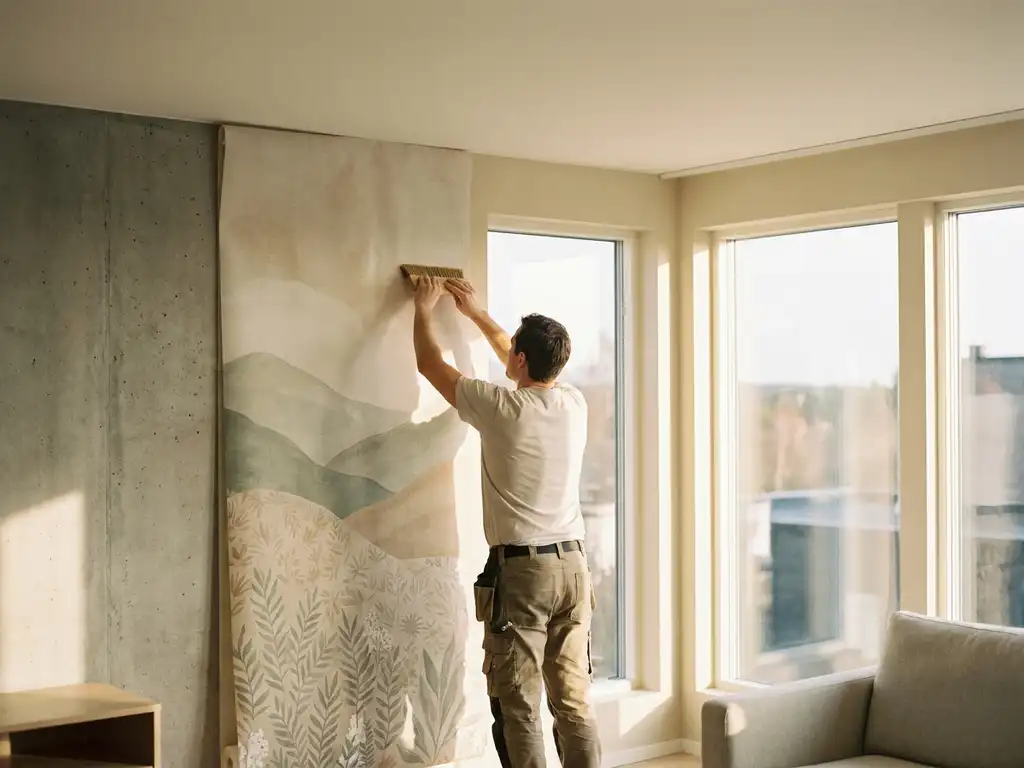
A Non-woven wallpaper gives every room a new look – and with little effort. Compared to traditional paper wallpaper, hanging non-woven wallpaper is much more relaxed: the paste goes on the wall, not the wallpaper, the strips are easy to align, and the result impresses with an even, robust surface. This step-by-step guide shows you how to properly hang non-woven wallpaper – from preparation to the finished wall.
Whether you are adding a single accent stripe or redesigning an entire room, with the right approach, wallpapering can be done reliably even without prior experience. Read through the individual steps carefully before you begin and have all your materials ready.
Tools and materials for wallpapering
Before you apply the first strip, make sure you have everything you need within arm's reach. Searching for missing tools in the middle of the process wastes time and can cause the paste to dry out before the wallpaper is in place.
- Non-woven wallpaper in the required quantity (taking roll length and pattern match into account)
- Special adhesive for non-woven wallpaper (no regular wallpaper paste)
- Paste bucket and wide paste brush or wallpaper roller
- Spirit level or plumb line for a vertical guide line
- Tape measure and pencil
- Sharp utility knife or cutter with a fresh blade
- Wallpapering brush or seam roller
- Seam roller for butt joints
- Sponge and clean water for finishing work
- Drop cloth or newspaper for the floor
Pay special attention to the choice of paste: non-woven wallpaper paste is stronger and stickier than standard wallpaper paste. It reliably holds the heavier material to the wall and prevents the strips from peeling off later.
Properly preparing and measuring the wall
A clean, smooth wall is the foundation for a good result. Rough areas, old layers of wallpaper, or grease stains impair adhesion and can later cause visible unevenness.
- Completely remove old wallpaper and wash off paste residue.
- Fill cracks and holes with filler and sand down after drying.
- Prime highly absorbent or untreated walls with deep primer or wallpaper primer and let dry completely.
- Measure the wall height and cut the wallpaper strips with about 5 cm excess at the top and bottom.
- Using a spirit level and a pencil, draw a vertical guide line on the wall – this will serve as an orientation for the first drop.
The guideline is more important than many beginners assume. Walls are rarely perfectly plumb, and door frames or corners do not serve well as a reference. Anyone who applies the first strip crooked carries the error through the entire wall.
Apply paste and hang the first length
When hanging non-woven wallpaper, the paste goes on the wall, not on the wallpaper. That is the biggest difference from paper wallpaper and makes the work much easier because the strip stays dry and does not warp.
- Mix wallpaper paste according to the manufacturer's instructions and let it swell for a short time.
- Apply a strip of paste the width of a wallpaper length evenly and over the entire surface – slightly beyond the width of the length so that the edges adhere well.
- Align the first track at the top of the guide line and place it against the ceiling with the upper overhang.
- Smooth the wallpaper down from top to bottom with a wallpaper brush, working air bubbles out to the sides.
- Carefully cut off the excess at the ceiling and floor with a utility knife.
After applying the first strip, check whether the edge is still exactly on the guide line. Minor corrections are still possible in the first minutes because non-woven wallpaper can still be shifted slightly on the fresh paste. As soon as the strip is in place, press it down firmly again.
Apply additional strips butt-jointed and process them
From the second length onwards, you work your way forward length by length. Non-woven wallpaper is hung butt-jointed, which means the edges lie directly against each other without overlapping. This requires some care, but results in a nearly invisible seam.
- Paint the next wall strip, again a little wider than the width of the sheet.
- Apply a new length of wallpaper to the edge of the previous one, aligning the pattern if the wallpaper has a repeat.
- Smooth the strip from top to bottom and work out any air bubbles.
- Press the joint edge down lightly with the seam roller without pressing too hard.
- Wipe off excess paste immediately with a damp sponge.
Work quickly, but without rushing. Wallpaper paste that dries on the surface of the wallpaper leaves shiny spots that remain visible after drying. A clean sponge and regular wiping reliably prevent this. Change the washing water regularly so that you do not spread paste residue onto the wallpaper.
Check result and let wallpaper dry
After laying the final strip, the drying phase begins. Non-woven wallpapers typically dry completely within 24 hours, depending on room temperature and humidity.
- Check all seams and edges again and press down with a seam roller if necessary.
- Carefully re-glue loose corners or areas where the wallpaper is lifting slightly using a little paste.
- Keep windows and doors closed during the drying period to avoid drafts.
- Keep the heating at normal room temperature, but do not overheat – drying too quickly can cause cracks at the seams.
Evaluate the result only after it is completely dry. Small ripples or slight unevenness visible directly after hanging wallpaper usually smooth themselves out while drying. If bubbles are still present after 24 hours, carefully pierce them with a needle and press the area down with a little paste.
How to remove non-woven wallpaper without a trace – a guide
One of the biggest advantages of non-woven wallpaper is how easy it is to remove. This is an important argument, especially for rented apartments: in most cases, non-woven wallpaper can be peeled off dry and in one piece without damaging the wall.
- Start at an upper corner and carefully peel the wallpaper off the wall.
- Peel off the strip slowly and evenly – as flat and close to the wall as possible to avoid tears.
- Wipe wallpaper paste residue off the wall with warm water and a sponge.
- Let the wall dry and lightly sand it if necessary before wallpapering or painting again.
If the wallpaper doesn't come off dry, warm water with a dash of fabric softener helps. Apply the solution with a sponge and wait a few minutes for the paste to soften. Then even stubborn wallpaper can be removed without damage. Important: Test the procedure on a small, inconspicuous area first to make sure the plaster underneath is stable.
Non-woven wallpapers by com2C – quality for individual wall design
If you are looking for non-woven wallpaper that is not off-the-shelf, but individually printed and custom-made, you have come to the right place. We develop and produce Non-woven wallpapers from com2C, Designed specifically for digital large-format printing, they meet high standards in terms of color reproduction and usability.
- PVC-free materials from our GoGreener line
- Precise inkjet coatings from our own chemical laboratory for brilliant, uniform print results
- Compatible with all standard large format printers and ink systems (solvent, latex, UV, water-based)
- Removable without a trace – ideal for rented apartments and temporary interior designs
- Rapid product development for custom requirements, even in small print runs
Our print media are aimed at print service providers and sign makers who want to offer their end customers custom-made wall designs in first-class quality. If you have any questions about our materials or are looking for an individual solution, we look forward to hearing from you Consultation.